
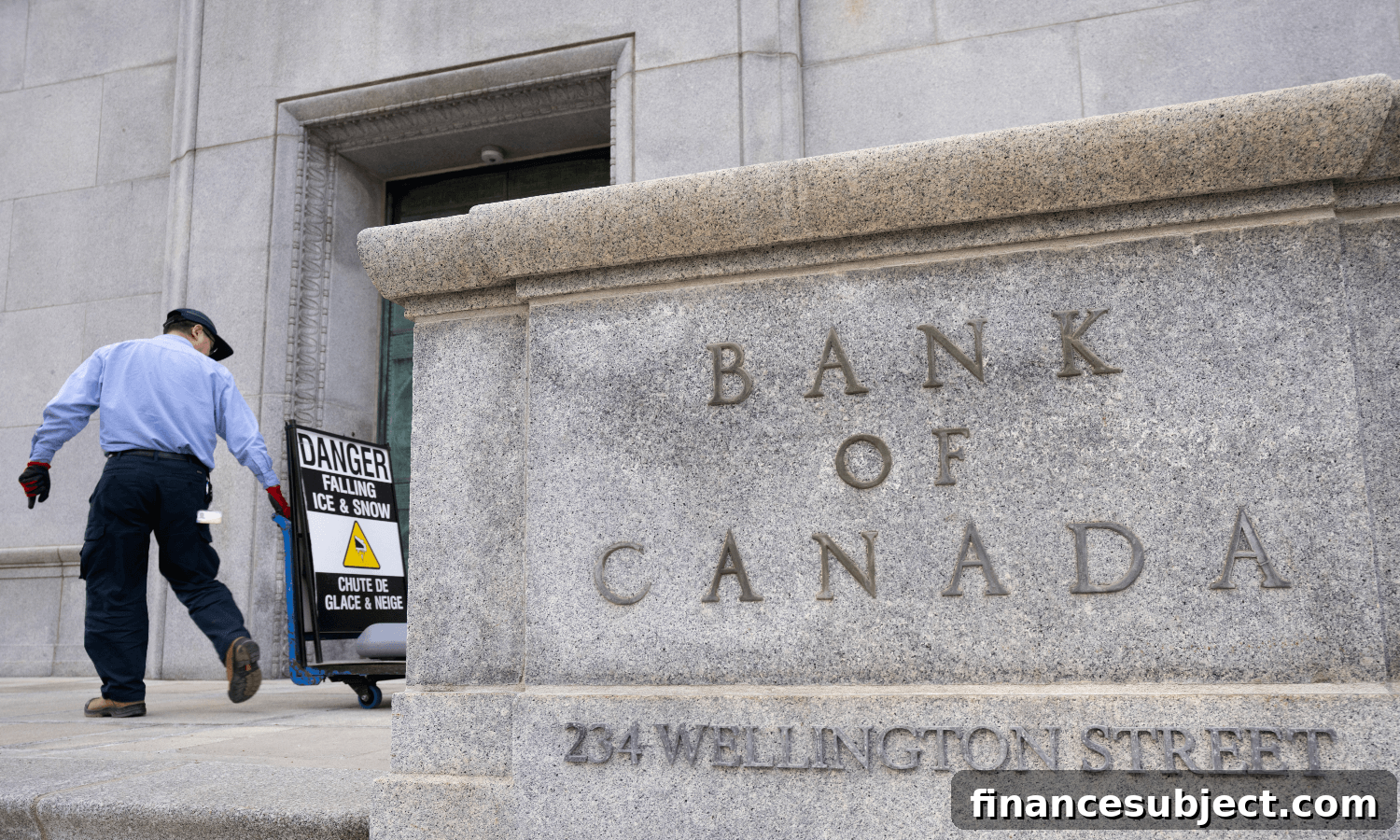
The Bank of Canada announced another substantial interest rate cut, but governor Tiff Macklem warned that future reductions are likely to come more slowly.
On Wednesday the central bank lowered its policy rate by a half percentage point, the fifth consecutive cut, taking the benchmark interest rate to 3.25%.
Economists had largely expected a large move after November’s labour force report showed the unemployment rate rising to 6.8%, signaling softer conditions in the job market.
Macklem signals a “more gradual approach” for future cuts
In prepared remarks, Governor Tiff Macklem explained that the Bank moved quickly with two large reductions in succession because inflation has returned to the Bank’s target and economic activity no longer needed to be slowed so sharply.
At the same time, Macklem said the Bank will likely adopt a slower, more measured pace for any further easing.
“The governing council has reduced the policy rate substantially since June, and those cuts will work their way through the economy,” Macklem said, adding that with the policy rate now much lower than earlier in the year, the Bank expects to proceed more gradually if the economy evolves broadly as expected.
The policy rate now sits at the upper bound of the Bank’s estimated neutral range. The neutral rate—where monetary policy neither stimulates nor restrains growth—is estimated by the Bank to lie between 2.25% and 3.25%.
Macklem noted that third-quarter economic growth in Canada was weaker than the Bank had projected. Looking ahead, the Bank expects growth next year to be weaker than previously forecast, in part because the federal government has reduced immigration targets.
Potential U.S. tariffs pose an economic risk
The governor also pointed to elevated uncertainty from the possibility that a new U.S. administration could impose tariffs on Canadian exports. Macklem said such measures, if implemented at the suggested scale, would be highly disruptive to both the Canadian and U.S. economies, and the Bank is monitoring that risk closely.
The Bank of Canada will release updated economic projections on Jan. 29, after the U.S. presidential inauguration.
CIBC, RBC economists predict ongoing quarter-point cuts
Market economists now generally expect the Bank to move to smaller, quarter-point rate cuts through 2025.
Avery Shenfeld, chief economist at CIBC, wrote that the Bank signalled it was done using “the big guns” but likely retains scope to ease policy further in smaller steps to support growth. CIBC’s forecast calls for four consecutive quarter-point cuts at the Bank’s next meetings, which would take the policy rate to 2.25%.
RBC economists expect the benchmark rate to fall to 2% by mid-2025. RBC’s Claire Fan said policy will likely need to move into more stimulative territory next year to revive faster, healthier growth.
Federal Liberals welcomed the decision. Prime Minister Justin Trudeau described the rate cut as “a step in the right direction to bring down costs for Canadians” in a social media post.
The Bank of Canada just cut interest rates again — down to 3.25%.
A step in the right direction to bring down costs for Canadians.
— Justin Trudeau, December 11, 2024
Finance Minister Chrystia Freeland said on Parliament Hill that the cut is “good news” and signals that the government’s economic approach is having a positive effect.
Resource highlight
You’re 2 minutes away from getting the best mortgage rates.
Answer a few quick questions to get a personalized quote, whether you’re buying, renewing or refinancing.
Powered by ratehub.ca
Text of the Bank of Canada’s latest interest rate decision
The Bank of Canada cut its key policy rate by 50 basis points on Wednesday to take it to 3.25%. Here is the text of the central bank’s decision:
The Bank of Canada today reduced its target for the overnight rate to 3.25 per cent, with the Bank Rate at 3.75 per cent and the deposit rate at 3.25 per cent. The Bank is continuing its policy of balance sheet normalization.
The global economy is evolving largely as expected in the Bank’s October Monetary Policy Report (MPR). In the United States, the economy continues to show broad-based strength, with robust consumption and a solid labour market. U.S. inflation has been holding steady, with some price pressures persisting. In the euro area, recent indicators point to weaker growth. In China, recent policy actions combined with strong exports are supporting growth, but household spending remains subdued. Global financial conditions have eased and the Canadian dollar has depreciated in the face of broad-based strength in the U.S. dollar.
In Canada, the economy grew by one per cent in the third quarter, somewhat below the Bank’s October projection, and the fourth quarter also looks weaker than projected. Third-quarter GDP growth was pulled down by business investment, inventories and exports. In contrast, consumer spending and housing activity both picked up, suggesting lower interest rates are beginning to boost household spending. Historical revisions to the National Accounts have increased the level of GDP over the past three years, largely reflecting higher investment and consumption. The unemployment rate rose to 6.8 per cent in November as employment continued to grow more slowly than the labour force. Wage growth showed some signs of easing, but remains elevated relative to productivity.
A number of policy measures have been announced that will affect the outlook for near-term growth and inflation in Canada. Reductions in targeted immigration levels suggest GDP growth next year will be below the Bank’s October forecast. The effects on inflation will likely be more muted, given that lower immigration dampens both demand and supply. Other federal and provincial policies—including a temporary suspension of the GST on some consumer products, one-time payments to individuals, and changes to mortgage rules—will affect the dynamics of demand and inflation. The Bank will look through effects that are temporary and focus on underlying trends to guide its policy decisions.
In addition, the possibility the incoming U.S. administration will impose new tariffs on Canadian exports to the United States has increased uncertainty and clouded the economic outlook.
CPI inflation has been about two per cent since the summer, and is expected to average close to the two per cent target over the next couple of years. Since October, the upward pressure on inflation from shelter and the downward pressure from goods prices have both moderated as expected. Looking ahead, the GST holiday will temporarily lower inflation but that will be unwound once the GST break ends. Measures of core inflation will help us assess the trend in CPI inflation.
With inflation around two per cent, the economy in excess supply, and recent indicators tilted towards softer growth than projected, Governing Council decided to reduce the policy rate by a further 50 basis points to support growth and keep inflation close to the middle of the one-to-three per cent target range. Governing Council has reduced the policy rate substantially since June. Going forward, we will be evaluating the need for further reductions in the policy rate one decision at a time. Our decisions will be guided by incoming information and our assessment of the implications for the inflation outlook. The Bank is committed to maintaining price stability for Canadians by keeping inflation close to the two per cent target.
Newsletter
Get free MoneySense financial tips, news & advice in your inbox.
More about the Canadian economy:
- GST holiday break: Is it good for Canada’s economy?
- Canada’s inflation rate increased to 2% in October 2024
- How Trump’s election win could affect interest rates in Canada
- Inflation is on target in Canada, so why is food (and other stuff) still so expensive?