

Kyle Prevost, creator of 4 Steps to a Worry-Free Retirement, Canada’s DIY retirement planning course, summarizes recent financial headlines and provides context for Canadian investors.
The Trump effect
Markets have shifted noticeably since my last Making Sense of the Markets column a few weeks ago. With Republicans expected to control all three branches of the U.S. federal government, major indexes rallied: the S&P 500 passed 6,000, the Dow Jones Industrial Average reached 44,000, and the TSX hit an all-time high of 25,000. Investors appear to be rewarding the prospect of a decisive election outcome, a calmer transition at the White House, and the potential for large tax cuts.
There are many theories about how president-elect Donald J. Trump’s policy proposals could influence global markets. Many campaign pledges are unlikely to be implemented in full, so these observations come with that important caveat. Here are some of the themes that investors are discussing after the election:
- Cryptocurrencies have continued to attract speculative flows. Crypto lobbying and political attention have helped drive price momentum in bitcoin and other tokens.
- Tesla (TLSA/NASDAQ) has seen its share price rally since election day. Part of that move reflects market enthusiasm about management access and regulatory outcomes.
- Trump Media & Technology Group Corp. (DJT/NASDAQ) has been prominent among the year’s meme stocks, with market value expanding despite a lack of meaningful profits to date.
Some Canadian small and medium-sized exporters have raised concerns about proposed tariffs of 10% to 20% on goods produced outside the United States. At the same time, certain sectors—like Canadian oil and gas—may be less vulnerable to aggressive tariffs given political and commercial ties. A surge in U.S. domestic demand fueled by fiscal stimulus could also offset tariff pressures for Canada overall, but the impact will vary by trading partner and industry.
Goldman Sachs’ chief Asia-Pacific economist recently highlighted Korea, Taiwan and Vietnam as particularly exposed to tariff risk, in addition to China. Voter frustration over rising prices also constrains how far tariff-driven protectionism can be pushed, since higher import taxes tend to increase consumer costs and worsen inflation—an issue voters already feel acutely.
Analysts at the Tax Policy Center and the Peterson Institute for International Economics estimate that a 20% global tariff combined with a 60% tariff on Chinese goods could raise typical U.S. household costs by roughly $3,000 per year. That illustrates why tariffs can be politically attractive but economically painful.
It’s also worth noting that much of this information was quickly priced into markets in the days following the election. If you’re looking to trade based on these developments, remember that the initial market moves often happen fast, and getting in after the headline may mean you’re late to the party.
Read more:
- What does Trump’s election mean for the Canadian economy?
- How Trump’s election win could affect interest rates in Canada
- Price of bitcoin hits new high after Trump victory, and more crypto news
Also read
The best online brokers, ranked and compared
Big earnings day for Shopify
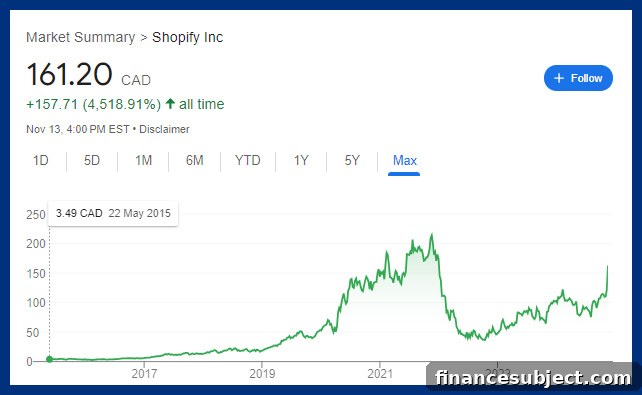
Ottawa-based Shopify Inc. reported stronger-than-expected results, and its stock surged: shares were up 21.5% on Tuesday and roughly 30% over the five trading days through Thursday, finishing at $153.43. The company beat earnings estimates and raised forward guidance, a key reason for the rally.
Shopify’s earnings highlights
Shopify reports in U.S. dollars because of its dual listing on the Toronto and New York exchanges.
• Shopify (SHOP/TSX): Earnings per share of USD $0.26 versus $0.20 expected, and revenues of USD $2.04 billion versus $2.01 billion predicted.
The market capitalization surge put Shopify back near the top of Canadian public companies, with an approximate market cap of $148 billion—behind RBC but ahead of several large financials. Shopify’s revenue growth and improved margins were driven by international expansion and growing adoption of its AI-enabled tools and commerce features.
Shopify outlined how features like Shopify Flow, Shopify Magic and Commerce Components are helping merchants automate inventory and improve operations, which in turn supports higher transaction volumes and revenue. Quarterly revenue rose 26% year over year. Morningstar noted that gross merchandise value accelerated and Shopify Payments processed a growing share of transactions.
That said, Shopify’s valuation remains rich; its price-to-earnings ratio is currently around 120x. Continued strong revenue growth will be necessary for the company to justify that valuation, and investors should expect volatility.
Read: Shopify share price soars after Q3 earnings beat
Also read
Canada’s best dividend stocks
Canadian fossil fuel majors improve earnings
In Canada, several energy companies reported solid quarters. Upgrades in operational efficiency and favorable commodity prices supported better-than-expected results for major producers and midstream firms.
Canadian energy earnings highlights
Suncor and Keyera announced their quarterly results.
- Suncor Energy Inc. (SU/TSX): Earnings per share of $1.48 versus $1.12 expected, and revenue of $13.06 billion versus $13.00 billion estimated.
- Keyera (KEY/TSX): Earnings per share of $0.81 versus $0.58 expected, and revenues of $1.73 billion versus $1.76 billion forecast.
Suncor’s improved performance reflects management’s emphasis on cost control and capital allocation. Quarterly earnings rose to $2.02 billion from $1.54 billion year over year, and the stock reacted positively. Management used a portion of free cash flow to pay down $1.4 billion of debt and return $1.5 billion to shareholders through buybacks and dividends. Suncor also indicated it will return 100% of excess cash to shareholders once its debt target is met, which could mean larger buybacks and dividend increases if oil prices remain supportive.
Suncor’s break-even for West Texas Intermediate crude sits near $45 per barrel, and oil has traded broadly above that level since the pandemic lows. However, analysts warn that higher production from OPEC and potential policy shifts elsewhere could put downward pressure on prices in the coming year.
Keyera’s results showed strong cash generation and reduced leverage, with debt-to-EBITDA declining to about 1.9 times—below the company’s historical target range. That balance-sheet strength supported a 4% dividend increase, although the stock was modestly weak on the day of the report as investors focused on cashflow metrics and future growth prospects.
Read more about Suncor’s dividend boost and how Keyera compares with peers in the pipeline sector.
Also read
The best online brokers, ranked and compared
Canadians are looking for cheaper groceries
This week three Canadian blue-chip companies posted largely in-line results with few surprises. The retail and utilities sectors showed mixed outcomes as consumer preferences and cost pressures influenced performance.
Canadian earnings highlights
Additional quarterly results included:
- Loblaw Companies Ltd. (L/TSX): Adjusted earnings per share of $2.50 versus $2.46 expected, and revenue of $18.54 billion versus $18.64 billion estimated.
- Canadian Utilities (CU/TSX): Earnings per share of $0.43 versus $0.41 predicted, and revenues of $860 million versus $935 million forecast.
- Power Corporation of Canada (POW/TSX): Earnings per share of $0.84 versus $1.09 expected; revenue details were not provided.
Loblaw shares dipped after the company signaled an increased focus on discount formats such as No Frills and Maxi, a strategy that can pressure margins even as it drives volume. Power Corporation’s earnings miss weighed on its stock, with operating earnings down year over year. Canadian Utilities posted mixed results and saw a modest share-price uptick after the report.
The market also saw a notable IPO this week: Groupe Dynamite Inc., the retailer behind Garage and Dynamite, launched a $2.3 billion IPO on the Toronto Stock Exchange under the symbol GRGD, with the CEO retaining a significant ownership stake.
Rankings
The best ETFs in Canada
More about investing:
- Boost your portfolio: Why and how to increase small-cap exposure with ETFs
- WeBull Canada review
- Best robo-advisors in Canada
- Scared of selling? When holding on to stocks can hurt you financially
- Gemini is exiting the Canadian market, plus more crypto news