

With U.S. equity indexes such as the S&P 500 repeatedly reaching record highs this year, the investing environment feels charged and uncertain—especially after the recent U.S. presidential election. The victory by Donald Trump has increased market volatility as investors assess policy risks and potential economic change. In this climate, many investors are turning to exchange-traded funds (ETFs) to manage uncertainty and reduce portfolio risk.
Reducing risk with ETFs
Despite the recent market rally sometimes dubbed a “Trump pump,” several analysts, including those at Goldman Sachs, expect only modest U.S. equity returns over the coming decade—roughly 3% annually after adjusting for inflation and dividends. The main reason: elevated valuations across major equity indexes.
What is the P/E ratio?
The price-to-earnings (P/E) ratio is a common valuation metric that compares a company’s current share price to its earnings per share (EPS). It helps investors assess whether a stock is expensive relative to its profits. The basic idea: price per share divided by earnings per share.
Read the full definition in the MoneySense Glossary: What is price-to-earnings ratio?
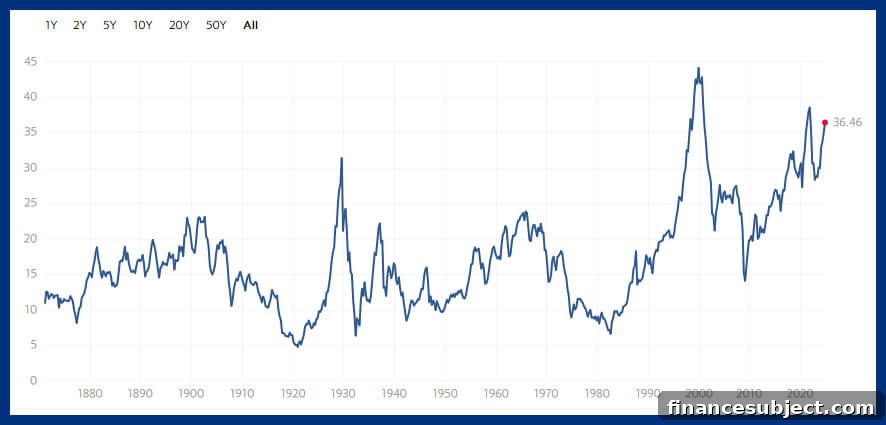
One popular valuation gauge is the Shiller P/E ratio, also known as the CAPE (Cyclically Adjusted Price Earnings) ratio. CAPE smooths earnings by averaging inflation-adjusted profits over the previous ten years, which reduces the impact of one-off booms or busts and offers a longer-term perspective on expected returns.
At the time of writing, the Shiller P/E for the S&P 500 sits at 36.46—well above its historical mean of 17.17 and median of 16.00. Such an elevated reading typically signals that future equity returns may be lower than long-term averages, and it reinforces why some investors are looking for ways to reduce exposure to market swings through ETFs.
Shiller P/E ratio
As a retail investor, my core approach remains simple: own low-cost index funds and stay the course. But for investors who are uneasy about current valuations or recent market volatility, there are practical ETF-based strategies to reduce portfolio risk—what I mean by “de-risk” is lowering volatility and limiting the depth of drawdowns (the drop from peak to trough during a market downturn).
De-risking with cash ETFs
One straightforward method to lower portfolio risk is to allocate a portion of assets to cash equivalents rather than keeping a fully invested equity position. This is a form of diversification. Cash-like ETFs—such as Treasury bill ETFs, high-interest savings account (HISA) ETFs, and money market ETFs—can provide stability and liquidity while reducing overall volatility.
Consider a simple backtest using Portfolio Visualizer: portfolio one is 100% iShares MSCI World Index ETF (XWD); portfolio two adds 10% iShares Premium Money Market ETF (CMR); portfolio three increases CMR to 20%. The results show that adding cash equivalents lowers both standard deviation and maximum drawdown, though it also reduces terminal wealth and annualized returns.
| Metric | Portfolio one (100% XWD) |
Portfolio two (90% XWD 10% CMR) |
Portfolio three (80% XWD 20% CMR) |
|---|---|---|---|
| Start balance | $10,000 | $10,000 | $10,000 |
| End balance | $29,581 | $27,127 | $24,840 |
| Annualized return (CAGR) | 11.66% | 10.68% | 9.69% |
| Standard deviation | 12.13% | 10.92% | 9.71% |
| Best year | 22.38% | 20.44% | 18.53% |
| Worst year | -11.59% | -10.22% | -8.87% |
| Maximum drawdown | -18.18% | -16.46% | -14.71% |
| Sharpe ratio | 0.82 | 0.81 | 0.81 |
| Sortino ratio | 1.30 | 1.29 | 1.29 |
Adding cash equivalents can make the ride smoother and reduce the severity of losses, which helps investors who prefer steadier returns and lower stress during downturns. The trade-off is lower long-term returns: reducing volatility with cash typically reduces the Sharpe ratio little or not at all, meaning you generally give up return in proportion to the risk you remove.
De-risking with low-volatility ETFs
Another way to lower portfolio volatility is to target securities with historically lower price swings. Low-volatility ETFs focus on stocks with lower beta values—stocks that tend to move less than the overall market. Beta measures a security’s sensitivity to market movements: a beta above 1 amplifies market moves, while a beta below 1 mutes them.
Low-volatility strategies can improve consistency because they reduce downside exposure: losses require disproportionately larger gains to recover (e.g., a 25% drop requires a 33% gain to break even). That asymmetry makes minimizing drawdowns particularly valuable over the long term.
Historical backtests illustrate this effect. For example, the BMO Low Volatility Canadian Equity ETF (ZLB) has shown a lower standard deviation and a higher compound annual growth rate (CAGR) than the iShares S&P/TSX 60 ETF (XIU) in past periods.
| Metric | XIU | ZLB |
|---|---|---|
| Start balance | $10,000 | $10,000 |
| End balance | $22,749 | $24,276 |
| Annualized return (CAGR) | 8.72% | 9.44% |
| Standard deviation | 12.47% | 10.47% |
| Best year | 28.05% | 22.93% |
| Worst year | -7.82% | -2.77% |
| Maximum drawdown | -20.23% | -19.08% |
| Sharpe ratio | 0.58 | 0.73 |
| Sortino ratio | 0.86 | 1.15 |
Still, low-volatility ETFs are not immune to market-wide crashes. In severe sell-offs, correlations across asset classes tend to rise and many investments move down together. The COVID-19 crash of early 2020 is a reminder: funds that usually hold up better can still suffer large drawdowns when the market falls sharply.
Newsletter
Get practical MoneySense financial tips, news & advice in your inbox.
There’s no “free lunch”
The idea of a “free lunch” in investing is the hope that you can lower risk without sacrificing returns. Harry Markowitz famously called diversification the only free lunch in finance. In practice, though, avoiding trade-offs requires assets that have low or negative correlations—so when one asset falls, another rises.
That ideal relationship is fragile. During severe market stress, correlations typically rise toward 1.0 and many assets fall together. Some instruments—like put options or long volatility derivatives—reliably profit during crashes, but their ongoing costs make them unsuitable for most long-term investors.
Many alternative or hedge-fund-style ETFs promise downside protection but charge high fees and suffer from survivorship bias, meaning users see only past winners while failed strategies disappear from the record. For most Canadian ETF investors, a more pragmatic approach is to “diversify your diversifiers”: combine multiple asset classes that behave differently across economic conditions.
For example, global equities provide long-term growth potential, high-quality bonds can cushion portfolios in recessions, commodities can hedge inflation and rising rates, and cash equivalents add liquidity and stability. Layering these components—each with its own role—creates a resilient, defence-in-depth portfolio that smooths returns and mitigates various risks.
Tools
MoneySense’s ETF Screener Tool
Read more on investing:
- The best ETFs for Canadian investors
- The best online brokers in Canada
- A guide to the best robo-advisors in Canada
- The best TFSAs in Canada
- The best RRSP investments