

Market-cap-weighted indices, such as the CRSP US Total Market Index tracked by the Vanguard U.S. Total Market Index ETF (VUN), naturally allocate less to small-cap stocks. By design, these indices give larger weights to companies with bigger market capitalizations (share price times shares outstanding), so large-cap firms dominate the index. That said, small-cap stocks remain an important part of a diversified portfolio and deserve attention.
Historically, small-cap stocks have often outperformed larger-cap stocks over long periods, a result documented by academic research and long-term market data. While mega-cap dominance has been a notable feature of the past decade, investors should avoid allowing recent performance to erase the broader historical perspective.
Further reading
Top online brokers, compared
What is market cap?
Market capitalization, or market cap, measures a company’s total market value by multiplying its outstanding shares by the current share price. Investors use market cap to compare company size within an industry or sector and to categorize stocks as large-cap, mid-cap, or small-cap. Exchanges and even cryptocurrencies are often described in terms of market cap to indicate scale and relative importance.
See the MoneySense investing glossary for more definitions.
Why invest in small-cap stocks
Asset pricing models help explain stock returns relative to risk. The Capital Asset Pricing Model (CAPM) links expected return to market risk, implying higher expected returns for riskier investments. But CAPM does not capture every source of return.
In the 1990s, Eugene Fama and Kenneth French expanded CAPM into a multi-factor framework to better explain historical return patterns. Their original three-factor model includes:
- Market factor (Rm–Rf): the extra return from holding stocks versus a risk-free asset like government bonds.
- Size factor (SMB: Small Minus Big): historically, smaller companies have tended to generate higher returns than larger firms, contributing a size premium.
- Value factor (HML: High Minus Low): companies with lower prices relative to fundamentals often outperform pricier counterparts over time.
The size factor explains why small-cap stocks can outperform over the long run: they carry greater risk and return potential, which can reward patient investors willing to tolerate volatility.
How have small-cap stocks performed?
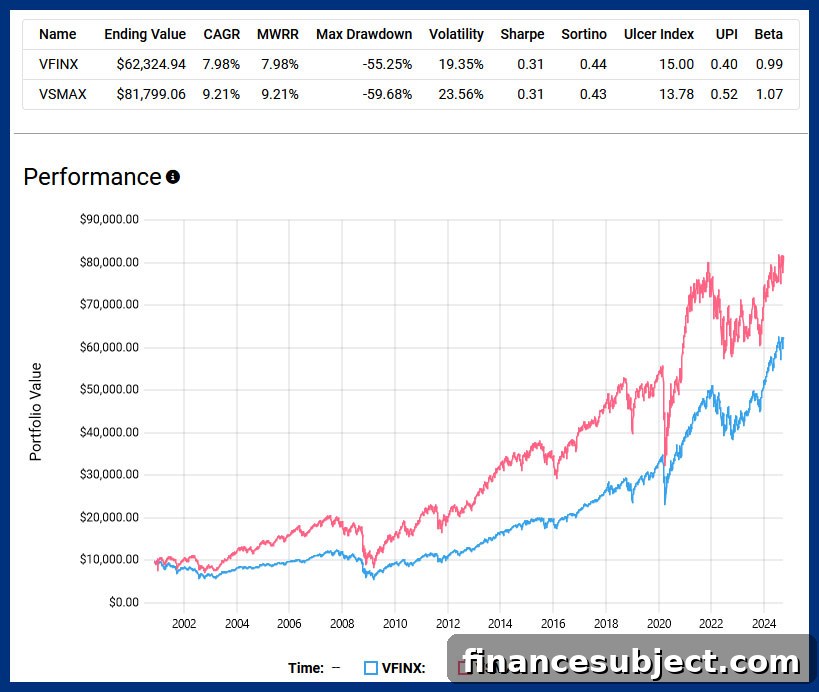
One way to compare performance is to look at representative index funds. For U.S. markets, the Vanguard 500 Index Fund (VFIAX), which follows the S&P 500, can be compared with the Vanguard Small-Cap Index Fund (VSMAX). Examining a long back-test period that spans major market cycles—dot-com bust, the 2008 financial crisis, the COVID-19 crash and subsequent recovery—helps reveal longer-term patterns.
Across the period from November 2000 to September 2024, the small-cap fund (VSMAX) recorded a higher compound annual growth rate than the S&P 500 fund (VFIAX). However, this higher return was accompanied by greater volatility and deeper drawdowns. On a risk-adjusted basis, measured by the Sharpe ratio, both funds delivered similar results, indicating that small-cap outperformance came with proportionally higher risk.
How much should you allocate to small cap?
Allocating to small caps is not a one-size-fits-all decision. Small-cap exposure increases portfolio volatility, and their periods of underperformance can be long and psychologically challenging for investors. For many, a modest allocation or none at all may be appropriate depending on risk tolerance, time horizon and overall strategy.
If you want small-cap exposure without overcommitting, consider a core-satellite approach: keep the core of the portfolio in broad, low-cost market exposures—such as large-cap index funds—and allocate a smaller satellite portion to small caps for diversification and potential long-term outperformance. A common guideline is to limit small-cap exposure to roughly 10%–20% of the total portfolio, tailored to personal risk tolerance and financial goals.
Tools
MoneySense ETF screener
The best small-cap ETFs to consider
For Canadian investors, domestic small-cap ETF options are limited and often carry higher fees relative to larger foreign-listed funds. That can make U.S.-listed ETFs an attractive alternative for cost-conscious investors seeking broad small-cap exposure.
Vanguard’s U.S. small-cap offerings are notable for low costs—for example, the Vanguard Small-Cap ETF (VB) is known for a very low expense ratio and tracks a broad U.S. small-cap index. Other widely used options include the iShares Russell 2000 ETF (IWM) and the iShares Core S&P Small-Cap ETF (IJR). IJR tracks the S&P 600, which applies additional quality screens that can influence its long-term performance relative to other small-cap indexes.
For investors who prefer active or factor-based approaches, some managers combine small-cap exposure with value or quality tilts. Firms such as Avantis Investors and Dimensional Fund Advisors offer small-cap products that emphasize factor-driven strategies at competitive fees. Examples include the Avantis U.S. Small Cap Equity ETF (AVSC) and Dimensional US Small Cap ETF (DFAS), which aim to deliver diversified small-cap exposure while applying disciplined investment frameworks.
More on ETFs in Canada
- Webull Canada review
- Private investments and alternatives: considerations
- Comparing U.S. ETFs with lower fees
- Bonds vs. GICs: fixed-income choices