

Kyle Prevost, creator of 4 Steps to a Worry-Free Retirement, Canada’s DIY retirement planning course, shares financial headlines and context for Canadian investors.
The Chinese government commands the economy to grow
Classifying national economies as purely communist, socialist or capitalist no longer reflects reality. Most countries now operate mixed economies, and the practical use of fiscal and monetary policy is increasingly nuanced. Even so, China’s economic model stands out for its unique blend of market mechanisms and heavy state direction—so much so that “commanding” economic growth is a useful way to understand recent policy moves.
China has been wrestling with a prolonged weakness in its property sector and growing deflation risks. In response, authorities recently announced a broad package of fiscal and monetary stimulus designed to jump-start lending, support the stock market and revive consumer confidence. Markets reacted quickly and positively to the move, reflecting how much influence Beijing still holds over economic outcomes.
Key elements of the package include:
- A reduction in the reserve requirement ratio for banks by 0.50%, freeing up liquidity and effectively encouraging roughly 1 trillion yuan (about USD$142 billion) in additional lending capacity.
- Signals from the People’s Bank of China that further reserve cuts are possible in 2024.
- Lower mortgage rates and reduced minimum down-payment requirements to make housing more affordable.
- A government-backed equity fund worth about USD$71 billion aimed at buying Chinese stocks and enabling corporate buybacks.
The equity-fund measure is notable: a state-directed pool of capital being deployed directly into the public stock market or used to finance buybacks blurs conventional economic labels. The policy is intended to restore confidence among consumers and investors and to spur spending and investment. With housing accounting for a very large share of China’s GDP and household wealth, and with demographic pressures showing up in shrinking population figures, Beijing likely felt decisive action was necessary.
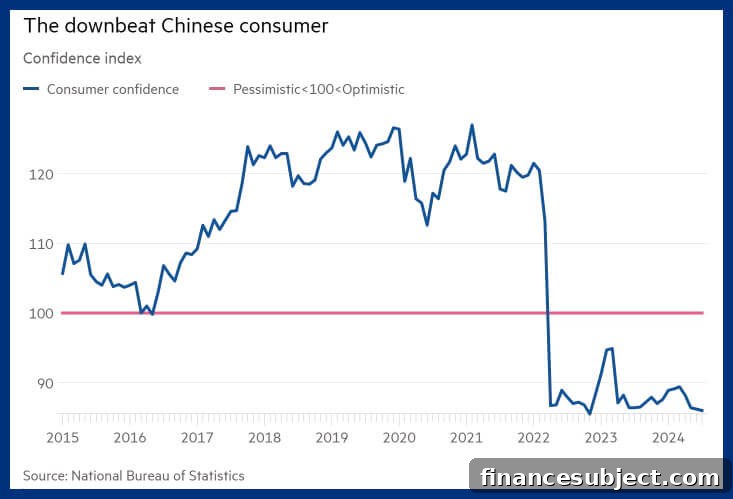
Analysts are divided on whether the package is large enough to restore sustained growth. Some noted that the scale of support is small compared with past episodes—for example, the U.S. injected roughly USD$5 trillion during the COVID-19 emergency—so China may need further measures if the initial boost proves insufficient. Early market response was enthusiastic: the CSI 300 jumped 4.3% following the announcements, reflecting investor hope that Beijing’s intervention will lift near-term activity.
The central challenge remains structural: when housing contributes nearly a third of GDP and 70% of household wealth, a long-term demographic slowdown makes rebalancing especially difficult. Policymakers are betting that directed fiscal and monetary action can reshape incentives and quicken a recovery; whether those “commanded” policies can adapt fast enough is the question investors will be watching.
Micron and Costco shine
In a relatively quiet U.S. earnings week, Micron Technology stole headlines and sparked a rally in semiconductor stocks, while Costco delivered steady results.
U.S. earnings highlights
Figures are in U.S. dollars.
- Costco (NASDAQ: COST): Earnings per share of $5.15 (consensus $5.08) and revenues of $79.70 billion (consensus $80.03 billion).
- Micron (NASDAQ: MU): Earnings per share of $1.18 (consensus $1.11) and revenues of $7.75 billion (consensus $7.65 billion).
Micron’s modest earnings beat and optimistic commentary about AI-driven demand sent its shares up sharply—about 15%—and lifted other memory- and data-center chip stocks. Demand for memory and storage tied to data centers and artificial intelligence remains robust, and Micron’s partnership with high-profile chip customers contributes a sizable portion of its sales. CEO Sanjay Mehrotra described the current period as an exceptionally exciting time for memory and storage technology.
Costco reported healthy same-store sales growth and rising net sales, with its private-label Kirkland brand performing well. Younger shoppers increasingly account for new memberships, suggesting a durable pipeline of customers. Despite solid operating results, Costco shares were relatively unchanged in after-hours trading; the company’s stock has nonetheless been a strong performer over the past year.
Separately, M&A rumors surfaced when Qualcomm reportedly approached Intel about a potential takeover. Many analysts warned that any deal would face significant regulatory hurdles in multiple jurisdictions, making completion uncertain.
What’s going on with Canadian telco stocks?
Canada’s large telecommunications companies—Bell, Rogers and Telus—have historically been steady dividend payers and cash generators. That steady performance has eroded recently: Bell and Rogers are down more than 12% year-to-date and Telus roughly 6%, pushing yields into the 7%–9% range and sparking debate about sustainability.
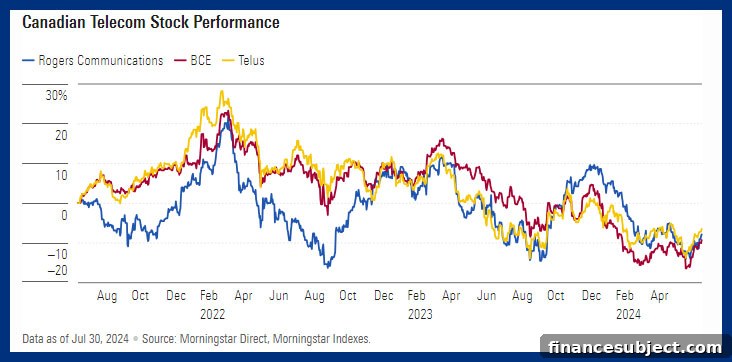
The main reasons for the recent weakness include:
- Higher interest rates have increased financing costs for these capital-intensive businesses, which carry large debt loads.
- Heavy spending on 5G infrastructure has not yet translated into meaningful increases in revenue from phone plans, pressuring returns on capital.
- Intensified competition among the three major carriers has led to promotional pricing and lower plan margins; telecom plan prices have fallen significantly over the past several years.
- Cable-TV divisions face secular decline from cord-cutting and the rise of streaming, trimming a once-stable revenue stream.
Lower interest rates and the winding down of major capital spending could improve profitability over time. However, current payout ratios for these carriers exceed 100% in many cases, indicating dividends may be unsustainable without cuts to expenses or stronger free cash flow. Still, these companies’ dominant positions in the Canadian market suggest a potential recovery if conditions normalize.
Let the good times roll
Across many asset classes, markets have enjoyed a very strong stretch. A quick recap of year-to-date performance:
- The TSX Composite is up roughly 14% and continues to gather momentum.
- The S&P 500 has gained about 20%.
- The MSCI EAFE index—representing developed markets outside North America—is up over 8%.
- Canadian bond ETFs are up in the 2%–3% range.
- Bitcoin has rallied significantly year-to-date.
- Gold is up nearly 30%.
- Canadian REITs, as measured by common benchmarks, have posted solid gains.
- Central banks around the world are moving toward rate cuts as inflation eases, creating broader market tailwinds.
- China’s recent fiscal and monetary easing adds another supportive element for global markets.
When the worst market concern is that national housing prices are broadly flat year-over-year, it’s a sign markets are generally healthy. Still, investors should remember that markets go through cycles: extended good stretches are often followed by corrections. Tools such as the VIX volatility index can provide a sense of investor nervousness; current readings suggest a relatively calm environment compared with past spikes.
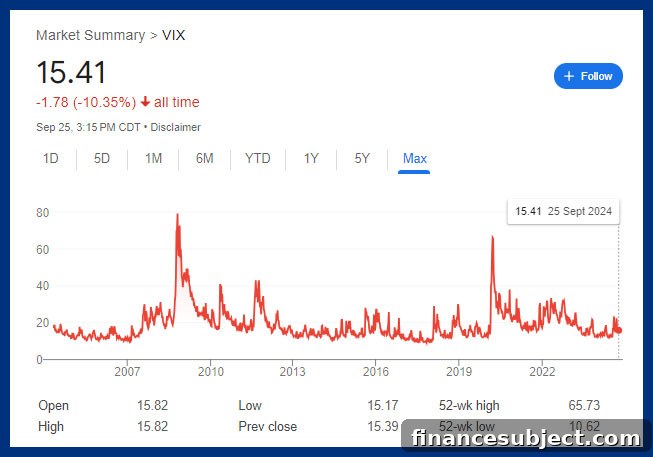
Enjoy the positive market backdrop, but maintain a long-term plan and diversified portfolio to weather inevitable downturns. Markets usually reward patience and discipline over the long run.
Read more about investing:
- Best ETFs in Canada
- Is VFV a good buy? Lower-fee U.S. ETF alternatives
- How to buy your first stocks in Canada
- Capital gains tax in Canada and other common questions