

Kyle Prevost, creator of 4 Steps to a Worry-Free Retirement, Canada’s DIY retirement planning course, summarizes financial headlines and provides context for Canadian investors.
Nvidia earnings land on the moon—shareholders were aiming for the stars
Almost any company would celebrate the quarterly results Nvidia reported, but Nvidia today is not a typical company. Its scale, growth and investor expectations have set an unusually high bar.
Nvidia earnings highlights
All numbers below are in USD.
- Nvidia (NVDA/NASDAQ): Earnings per share: $0.68 (consensus roughly $0.64). Revenues: $30.04 billion (consensus roughly $28.70 billion).
Revenues rose roughly 80% year-over-year and net income jumped about 268%. With such a flood of earnings, the company used $50 billion to repurchase shares. Even so, Nvidia stock slipped in after-hours trading—down about 7% immediately after the close, with further movement over the next sessions. Other AI-linked chipmakers moved lower in sympathy.
Despite the recent pullback, Nvidia is still up dramatically: roughly 150% year-to-date and more than 900% since the end of 2022. That surge has created extraordinary expectations. When a company grows this fast, analysts must continually reset forecasts; this quarter looks like a moment when forecasts finally caught up and dampened the immediate celebratory response.
CEO Jensen Huang said the company remains on track to meet production targets for its new Blackwell chip architecture, calling demand and anticipation for the technology “incredible.” Gross margins softened to about 75.1% from 78.4% the previous quarter but remain far above most large-cap companies and up from 70.1% a year earlier. To put it in perspective, many established businesses operate with gross margins well below this level.
Overall, Nvidia’s results reflect both staggering profitability and the difficulty of matching sky-high investor expectations quarter after quarter. Analysts and investors will likely adjust near-term estimates to reflect a more normalized cadence for such rapid growth.
Read more: “High expectations: Nvidia shares are down despite Q2 earnings beat”
Banks are less scared of Canadian defaults
Last week TD reported earnings dominated by strong Canadian fundamentals but impacted by U.S. penalties. This week, Canada’s five other major banks released quarterly results that highlighted resilient operations and, in many cases, lighter-than-expected provisions for credit losses.
Canadian banking highlights
Here’s how Canadian banks performed in the three months ending July 30, 2024:
- Bank of Montreal Financial Group (BMO/TSX): Adjusted EPS about $2.64 (analysts ~ $2.76); revenues roughly $8.19 billion.
- The Bank of Nova Scotia (Scotiabank, BNS/TSX): Adjusted EPS about $1.63 (analysts ~ $1.62); revenues roughly $8.36 billion.
- Royal Bank of Canada (RBC/TSX): Adjusted EPS about $3.26 (analysts ~ $2.95); revenues roughly $14.63 billion.
- Canadian Imperial Bank of Commerce (CIBC/TSX): EPS about $1.93 (analysts ~ $1.74); revenues roughly $6.60 billion.
- National Bank of Canada (NA/TSX): Adjusted EPS about $2.68 (analysts ~ $1.80); revenues roughly $2.98 billion.
Two banks—National Bank and RBC—again stood out for execution and results. The key theme across the quarter was lower-than-feared provisions for credit losses (PCLs) at several institutions. For instance, CIBC’s PCLs were down significantly from last year, delivering an immediate boost to reported earnings. RBC’s provisions were lower than the previous quarter and below some analysts’ expectations.
Not every bank saw PCLs fall: BMO and Scotiabank reported higher provisions year-over-year; for Scotiabank, foreign operations in Latin America were a primary drag. Market reactions followed the earnings: CIBC and National Bank saw notable share gains after their reports, while BMO’s stock lagged, falling after its release.
RBC’s integration of HSBC Canada assets continues to progress, and attention now moves to shareholder votes on National Bank’s proposed acquisition of Canadian Western Bank. National Bank’s shares have rallied strongly this year as investors anticipate value creation from that expansion into western Canada. All of the major banks maintained their dividends this quarter.
Read more: “Canadian banks earnings reports”
Couche-Tard takes aim at Slurpee King
Growing up near Winnipeg—the self-styled Slurpee Capital of the World—gave me a sense of 7-Eleven’s place in North American life. Visiting Japan and Thailand last year revealed just how central convenience stores like 7-Eleven are to daily life across Asia. That context makes the news that Alimentation Couche-Tard (ATD/TSX) submitted a friendly proposal to acquire Tokyo-based Seven & I Holdings particularly notable.
The potential deal is historic for several reasons:
- It would be the largest-ever Japanese target acquired by a foreign buyer.
- It tests Japan’s 2023 takeover rules aimed at balancing openness to foreign capital with protections for strategic assets.
- If approved, it could surpass previous large Canadian deals to become one of Canada’s largest-ever corporate takeovers.
- The combination would merge Couche-Tard’s roughly 16,700 stores across 31 countries with Seven & I’s roughly 85,800 locations in 19 countries.
- Together, the combined entity would control a significant U.S. convenience store market share—well ahead of the next competitor.
- It’s a bold move for Couche-Tard, valued at about $56 billion today, given Seven & I’s estimated value near $38 billion.
- To complete such a transaction, analysts expect Couche-Tard would need to raise a substantial amount of new equity—potentially approaching $18 billion—alongside cash and financing, which has led to speculation that large Canadian institutional investors could participate.
Couche-Tard described the proposal as friendly and non-binding. The company has a track record of large acquisitions and integrations, though regulatory or political objections—similar to what blocked its previous bid for a major European retailer—could still derail a transaction of this scale. For now, Seven & I shareholders reacted positively, with shares jumping on the announcement.
1900 vs. 2023 stock markets
Looking beyond quarterly noise is essential: market leadership shifts across decades and centuries. The global stock market landscape in 1900 was dominated by European powers and by industries such as railways. Today, technology giants—Nvidia, Apple, Microsoft and Google among them—command outsized influence.
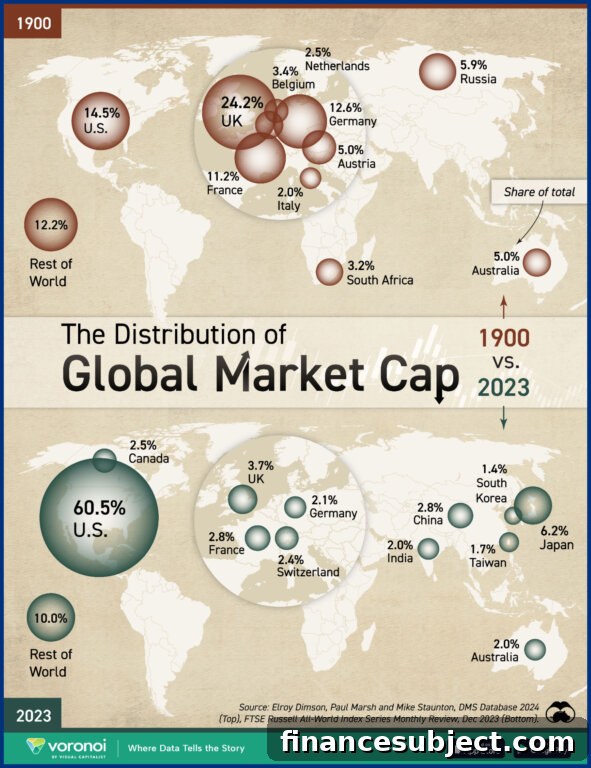
At the start of the 20th century, Britain’s global financial dominance looked very different than today’s U.S.-led markets. The market capitalizations and industry leaders have shifted dramatically: where the biggest names in 1900 were railways and resource firms, today’s leaders are technology and platform businesses.
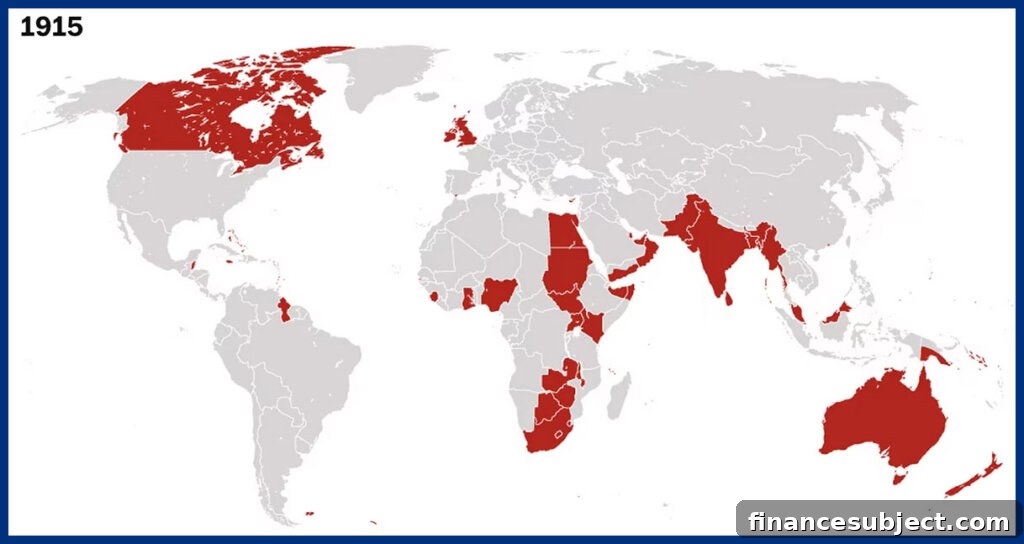
Europe’s share of global stock market capitalization has dropped from around two-thirds in 1900 to roughly one-tenth today, and Asia—especially China and India—has grown steadily. These long-term shifts matter for investors who think in decades rather than quarters.
Read more about investing:
- Best ETFs in Canada
- Buying your first stocks in Canada
- How capital gains tax works and other common questions answered