
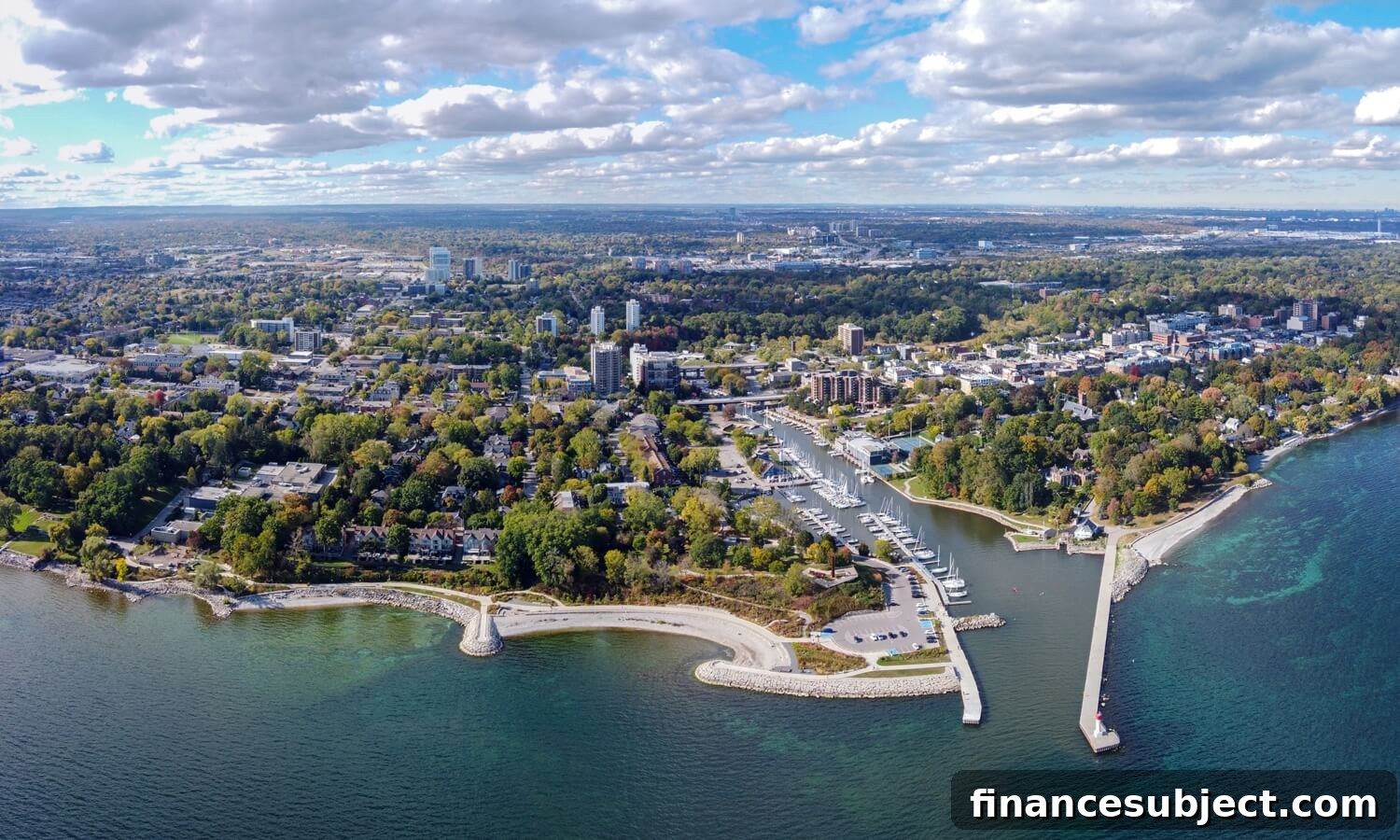
Halton Region, located between Toronto to the east and Hamilton to the west, comprises four municipalities: Burlington, Oakville, Milton and Halton Hills. The region combines suburban calm with urban conveniences and is frequently ranked among Canada’s safest communities. Halton is also one of Ontario’s fastest-growing areas, with strong population growth between 2018 and 2021.
Table of contents: Best places to buy in Halton
- The best neighbourhoods in Halton
- Closer look at the top three neighbourhoods
- Real estate trends in Halton
- Methodology (data sources and methods)
Best places to buy real estate in Burlington, Oakville, Milton and Halton Hills
Below is a clean, easy-to-scan table of top neighbourhoods across Halton Region for buyers and investors. It includes 2023 benchmark prices, short- and medium-term growth, value and economics scores, accessibility ratings and the share of households with children. Use the table to compare neighbourhoods at a glance and identify areas that match your priorities—value, income and education levels, or walkability and transit access.
| Rank | Neighbourhood | City | Benchmark price 2023 | 1-year growth | 3-year growth | 5-year growth | Value (0–5) | Economics (0–5) | Accessibility (0–5) | Children (%) |
|---|---|---|---|---|---|---|---|---|---|---|
| 1 | Palmer | Burlington | $965,171 | 1% | 41% | 91% | 4.7 | 4.1 | 1.2 | 53% |
| 2 | Clearview | Oakville | $1,599,707 | 4% | 38% | 92% | 3.7 | 5.0 | 3.1 | 54% |
| 3 | Uptown Core | Oakville | $875,271 | 6% | 39% | 65% | 5.0 | 3.7 | 4.0 | 56% |
| 4 | Glen Abbey | Oakville | $1,529,489 | 5% | 48% | 70% | 4.0 | 4.4 | 3.5 | 66% |
| 5 | Uptown | Burlington | $774,233 | -15% | 68% | 120% | 4.7 | 3.5 | 3.7 | 49% |
| 6 | West Oak Trails | Oakville | $1,361,186 | 3% | 35% | 60% | 3.8 | 4.4 | 2.5 | 66% |
| 7 | Iroquois Ridge South | Oakville | $1,167,142 | -2% | 34% | 82% | 3.9 | 3.7 | 2.3 | 56% |
| 8 | Appleby | Burlington | $1,044,117 | 2% | 25% | 59% | 4.0 | 3.5 | 4.2 | 49% |
| 9 | Orchard | Burlington | $1,067,085 | -3% | 39% | 58% | 3.9 | 3.5 | 3.7 | 49% |
| 10 | Headon Forest | Burlington | $981,288 | -12% | 34% | 65% | 3.3 | 4.1 | 3.2 | 53% |
Source: Toronto Regional Real Estate Board
Return to menu.
Top three neighbourhoods in Halton
1. Palmer, Burlington
Palmer sits in northern Burlington and is known for mature trees, larger lots and housing stock that includes split-levels, raised bungalows, Tudor and Colonial Revival styles, and townhomes. Its 2023 benchmark price was $965,171—up 1% from 2022, up 41% from 2020 and up 91% from 2018. That performance contributes to a high value score (4.7) and a strong economics score (4.1), reflecting solid household incomes and education levels. Palmer delivers community amenities such as Lansdown and Palmer parks with playgrounds, tennis courts and baseball diamonds. Walkability and transit access are limited relative to other Halton neighbourhoods, which is reflected in a lower accessibility score.
2. Clearview, Oakville
Clearview is an established, family-focused neighbourhood near Oakville’s eastern edge. It features generous green spaces, parks and wooded areas connected by trails, making outdoor recreation a key draw. The 2023 benchmark price was $1,599,707, driven by steady growth in recent years: +4% year-over-year, +38% over three years and +92% over five years. Clearview also scores highly on local economics, indicating strong household incomes and education. The neighbourhood offers many schooling options and easy commuting access to Mississauga and Toronto, while maintaining a suburban, park-rich character.
3. Uptown Core, Oakville
Uptown Core lies at the intersection of Trafalgar Road and Dundas Street in Oakville and represents a more urban, higher-density option within Halton. Housing mixes modern townhomes and low- to mid-rise condos, supporting a walkable, transit-friendly environment. The 2023 benchmark price was $875,271—up 6% from 2022, +39% over three years and +65% over five years. Uptown Core earned the top value score among the region’s best neighbourhoods (5.0) and performs well on accessibility (4.0), thanks to connected trails, parks and a concentration of shops and services suitable for first-time buyers and young families.
What’s happened in the Halton Region real estate market?
Halton’s price pattern in 2023 differed from many Canadian markets. Rather than peaking mid-summer, the region’s composite benchmark home price reached its high in December, hitting about $1.3 million. Prices rose steadily through the first half of the year—from roughly $1.12 million in January to about $1.29 million in June—before cooling through the fall. That steady trajectory reflects local demand resilience even as interest rate shifts influenced buyer and seller behaviour.
A local real estate agent observed that the Bank of Canada’s July 2023 rate increase cooled buyer activity and reinforced a seller mindset that prices would continue upward, which limited listing supply. Higher mortgage rates and elevated prices pushed many buyers away from large detached homes and toward more affordable alternatives such as townhomes and properties on the fringes of core neighbourhoods.
What’s next for real estate in Halton Region?
Future price movement in Halton will largely track changes in interest rates and broader economic conditions. Early-year data show modest year-over-year gains but month-to-month fluctuations, leaving buyers cautiously optimistic that rate cuts could improve affordability. If rates remain higher for longer, however, demand could stay muted.
Local market participants expect continued interest in townhomes and compact housing formats as affordability remains a central concern. While pent-up demand may re-emerge if rates fall, sellers’ expectations and limited new supply could moderate the impact of any rate easing. In short, the market outlook depends on how quickly borrowing costs move and how strongly buyers respond to improved financing conditions.
Return to menu.
Further reading
- Buying a second home: how it works in Canada
- Mortgage down payment calculator and affordability planning
- First Home Savings Account (FHSA) options and guidance
- Choosing between fixed and variable mortgage rates
About this article
This article reflects regional market data and commentary to help home buyers and investors evaluate neighbourhoods in Halton Region. Data sources include regional real estate board statistics and local market insight.