

Kyle Prevost, creator of 4 Steps to a Worry-Free Retirement, Canada’s DIY retirement planning course, summarizes recent financial headlines and explains what they mean for Canadian investors.
If the summer heat doesn’t get you, inflation will
Canadians hoping for an early cut to interest rates will likely have to wait. Statistics Canada reported a May Consumer Price Index (CPI) reading of 2.9%, up from April’s 2.7%.
The money markets currently assign about a 45% probability that the Bank of Canada (BoC) will cut rates at its July 24 meeting. Given the recent rebound in inflation, cutting rates too soon would risk undermining the BoC’s credibility after its aggressive hikes designed to bring inflation under control.
CPI May 2024 highlights
Key takeaways from the May CPI report:
- Overall CPI rose 2.9% year-over-year in May, 0.2 percentage points higher than April.
- Renters are facing rising costs: year-over-year rent increased 8.9%.
- Mortgage interest costs surged 23.3% year-over-year.
- Core CPI, which excludes volatile items such as gas and groceries, was about 2.85%.
- Travel-related costs climbed, with airfare up 4.5% and tours up 6.9%.
- Gasoline prices rose 5.6% year-over-year.
- Grocery prices increased 1.5% year-over-year, though they are 22.5% higher than in May 2020.
- Cell phone service prices continue to fall, down 19.4% since May 2023.
The BoC would likely have preferred inflation closer to 2.5% to justify easing policy and demonstrate a clearer downward trend. Balancing the goals of stable inflation, full employment, and long-term growth will remain a difficult task for Governor Tiff Macklem and his colleagues.
In the current environment, savers continue to benefit from higher interest rates on products such as guaranteed investment certificates (GICs) and high-interest savings accounts (HISAs), while borrowers are still waiting for relief. For investors, strategies that protect purchasing power during higher inflation are worth considering.
FedEx delivers, Nike falls short
This week’s U.S. earnings results showed a sharp contrast: FedEx pleased shareholders while Nike disappointed the market.
U.S. earnings highlights
Selected figures from the latest reports (U.S. dollars):
- Nike (NKE/NYSE): Reported earnings per share of $1.01 versus $0.83 expected, but revenue of $12.61 billion fell short of the $12.84 billion forecast.
- FedEx (FDX/NYSE): Reported earnings per share of $5.41 versus $5.35 expected, and revenue of $22.11 billion slightly exceeded the $22.08 billion forecast.
Nike’s quarter was mixed: cost reductions, including 1,500 job cuts, lifted profit per share above estimates, yet sales weakness in China and broader macroeconomic uncertainty led management to forecast a roughly 10% sales decline next quarter. Investors focused on the weaker outlook, and Nike shares fell more than 12% in after-hours trading.
Nike’s CFO sought to reassure investors about the company’s long-term prospects in China and highlighted growth opportunities in running, women’s apparel, and the Jordan brand.
FedEx reported a stronger reaction. Shares rose more than 15% after the company outlined cost-saving measures expected to deliver about $4 billion in savings over two years and discussed consolidating air and ground operations to potentially boost margins.
Cash-strapped consumers pinch Couche-Tard
Alimentation Couche-Tard, Canada’s gas and convenience-store giant and the country’s 13th-largest company, reported quarterly results this week.
Alimentation Couche-Tard earnings highlights
Figures reported in U.S. dollars:
- Alimentation Couche-Tard (ATD/TSX): Earnings per share: $0.48 (vs. $0.50 expected). Revenue: $17.59 billion (vs. $16.98 billion expected).
The results were mixed: revenue remained solid, but earnings missed expectations for the second consecutive quarter. Management attributed the earnings shortfall to a reporting period that was one week shorter than the prior year, higher depreciation from investments and acquisitions, lower profit margins, and weaker consumer demand.
Couche-Tard’s declining sales
| Canada (YOY) | U.S. (YOY) | Europe (YOY) | |
| Fuel (volume) | -3.5% | -1.6% | -1.7% |
| Same-store merchandise (sales) | -3.4% | -0.5% | -2% |
Those figures suggest Canadian consumers are cutting back on discretionary travel and convenience-store purchases. Couche-Tard’s share price has been volatile in 2024, reflecting investor uncertainty about near-term demand and margin pressures.
Also read
Canada’s best dividend stocks
Canadian GDP-per-capita is lagging
GDP per capita is often an abstract metric, but it matters: it captures how much value each worker produces and underpins improvements in living standards over time. Canada used to outpace or match the United States in GDP per capita; that is no longer the case.
What is GDP?
Gross domestic product (GDP) measures the total value of goods and services produced in a country over a given period, typically a quarter or a year. Economists calculate GDP through output, income, or expenditure approaches.
Read the full definition in the MoneySense Glossary: What is GDP?
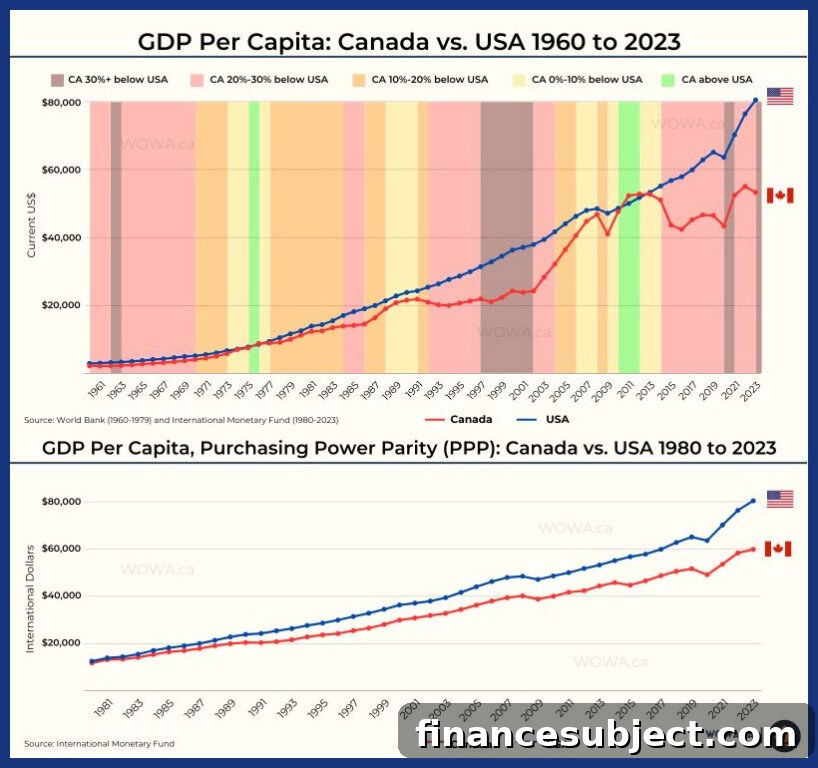
Canada’s relative decline in GDP per capita is linked to global shifts away from fossil fuels and toward large technology-driven industries, sectors where the U.S. has attracted disproportionate investment. IMF-based projections show the U.S. continuing to outpace Canada, driven in part by policies that encourage capital investment and higher returns.
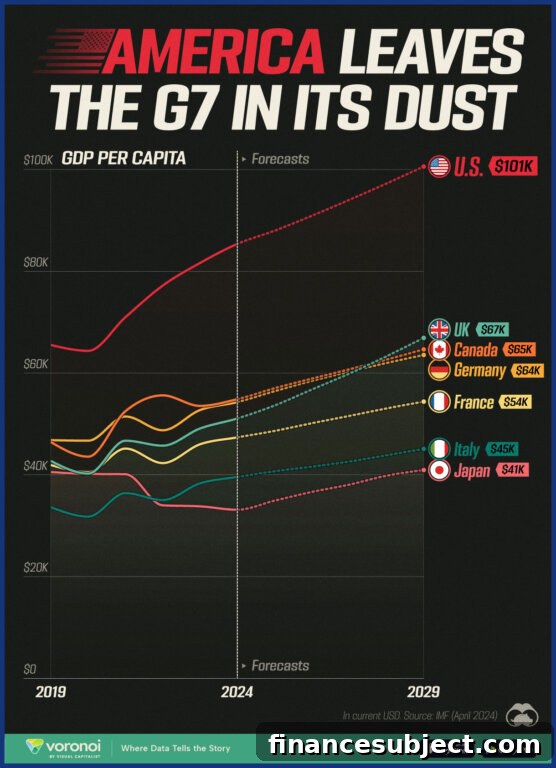
Canada has many structural advantages—natural resources, proximity to the world’s largest economy, and a stable parliamentary democracy—but policy choices matter. Higher capital gains taxes, internal trade barriers between provinces, and heavy regulation in some industries can discourage investment. If Canada does not attract or generate more productive investment, its workers may struggle to produce goods and services that compete internationally. Over time, that could lead to a smaller economic pie and tougher conditions for Canadian households and businesses.
Tools
MoneySense’s ETF Screener Tool
Read more about investing:
- Best ETFs in Canada
- National Bank to buy Canadian Western Bank at $5 billion valuation
- Buying your first stocks in Canada
- How much is capital gains tax and other questions answered
- Will the AI “gold rush” last?