

Does your child have a registered education savings plan (RESP)? It’s one of the most effective ways for families to save for post-secondary education. Contributions grow tax-free inside the plan, and the government adds grants that can total up to $7,200 over the life of the plan, rewarding regular saving.
Most parents want their children to be happy, healthy and successful, and a strong education helps open doors. But post-secondary study is expensive. In 2022–23 the average undergraduate tuition in Canada was $6,834 for one year; over four years that’s more than $27,000, not including living costs, residence, textbooks and other expenses.
An RESP lets parents, grandparents and other family members save specifically for a child’s college or university costs. Below we explain how RESPs work, outline key rules, and compare three practical funding strategies so families can make the most of these accounts.
How do RESPs work?
RESPs are tax-sheltered accounts similar to RRSPs and TFSAs, but their purpose is to pay for post-secondary education. Here are the core features and rules families should know:
- Contributions are made with after-tax dollars. You don’t get a tax deduction for contributions, but earnings grow tax-free inside the plan.
- The federal government provides the Canada Education Savings Grant (CESG), which adds 20% on contributions up to $2,500 per year—meaning up to $500 in CESG annually per child.
- The lifetime CESG limit per child is $7,200. If you contribute less than $2,500 in a year, unused CESG room can be carried forward until the end of the year the beneficiary turns 17; the maximum CESG payable by carry-forward is $500 per year, and in any year the CESG paid cannot exceed $1,000 per beneficiary.
- There is no annual contribution cap for RESPs, but the lifetime contribution limit per beneficiary is $50,000.
- RESPs can be set up as individual plans (for one beneficiary) or family plans (one plan for multiple children). Funds in a family plan can be allocated among beneficiaries in any proportion, provided no child receives more than $7,200 in CESG funds.
- Funds can be used at qualifying post-secondary institutions, including colleges, universities, trade schools, registered apprenticeship programs and eligible schools outside Canada.
- Permitted investments mirror many RRSP options: cash, guaranteed investment certificates (GICs), bonds, stocks, mutual funds, and other registered-eligible investments.
- When withdrawn, original contributions come out tax-free. Investment earnings and government grants are taxable when paid out as educational assistance payments, but these amounts are typically taxed in the student’s hands—often at little or no tax because students tend to have low incomes and can use tuition and other tax credits.
- Low-income families may qualify for the Canada Learning Bond (CLB), which can add up to $2,000 to an RESP for eligible children without requiring personal contributions.
- If the beneficiary chooses not to pursue post-secondary education, contributions can usually be withdrawn tax-free by the subscriber, but CESG funds must be returned to the government and investment earnings will be taxable.
What is the best way to fund RESPs?
Should you aim to deposit $2,500 every year to capture the full annual CESG? Would it be better to front-load the RESP with the full $50,000 life-limit? Or is a hybrid plan the smarter route? To explore these choices, financial planners and investment advisors recommend considering your overall savings, available non-registered assets and other registered accounts like TFSAs and RRSPs.
Below are three common approaches, with simplified illustrations used for comparison. These examples assume an RESP opened in a child’s first year and contributions continuing through the child’s 18th year, and they use a 6% annualized return purely for illustration.
Option 1: Regular contributions to maximize grants
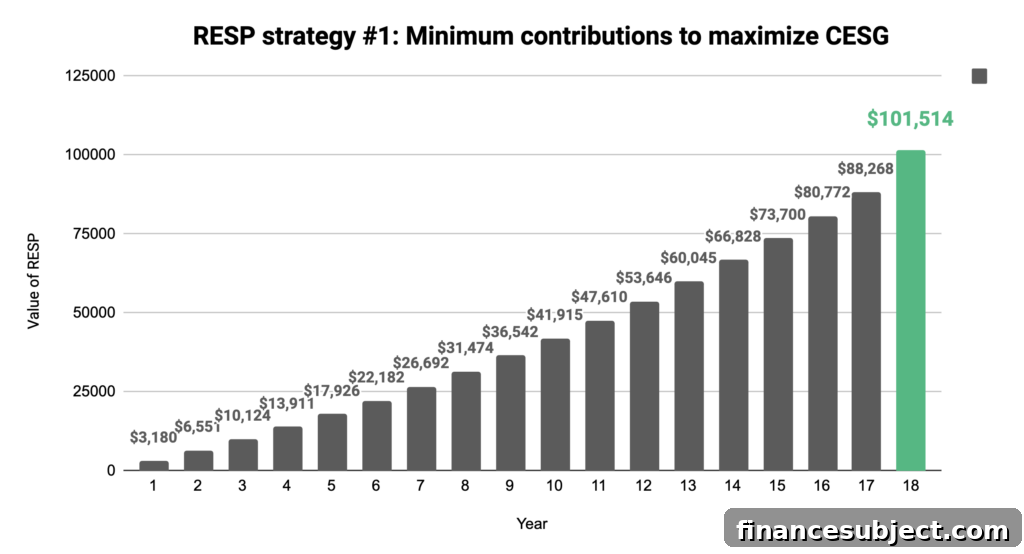
The simplest strategy is to contribute $2,500 each year to secure the full annual CESG of $500. This approach benefits from a guaranteed 20% government top-up and also takes advantage of dollar-cost averaging—contributing steadily over time to smooth market volatility.
In a basic example, contributing $2,500 per year would reach the $7,200 CESG cap by year 15. If the plan also reaches the $50,000 lifetime contribution limit with a larger contribution in year 18, and assuming a 6% return, the final balance could be roughly $101,514: $50,000 from contributions, $7,200 from CESG and about $44,314 from investment growth.
This option is a great fit for families with steady cash flow who want to consistently capture government grants and avoid timing the market.
Option 2: Front-load the RESP with a lump sum
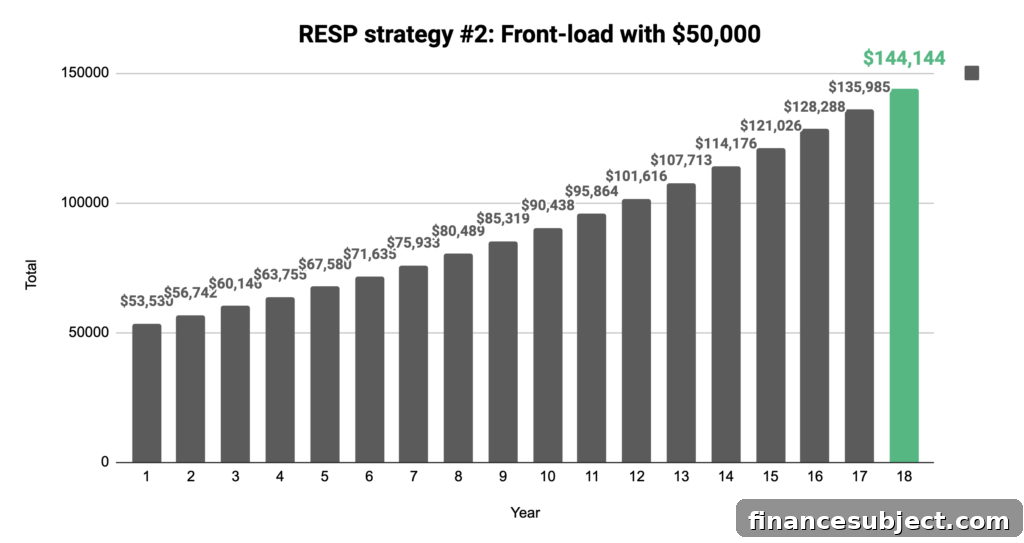
Some families may consider placing a large lump sum—up to $50,000—into an RESP early on. That locks in tax-sheltered growth for the full saving horizon. However, only $500 of CESG would be paid in that first year on a $50,000 contribution, and there’s market-timing risk if the lump sum is invested right before a downturn.
Using the same 6% return assumption, a $50,000 front-loaded contribution could grow to approximately $144,144: $50,000 contributions, $500 CESG and $93,644 investment income. The higher result comes from longer tax-sheltered compounding, but it only makes sense if that lump sum doesn’t displace higher-priority registered savings like RRSPs or TFSAs where tax advantages could be greater.
Drawbacks of front-loading
Front-loading ignores the opportunity cost: if the $50,000 would otherwise have been invested in a TFSA or RRSP, you may lose more valuable tax sheltering elsewhere. A lump sum makes sense only after other registered accounts are appropriately funded or if the funds are spare non-registered savings.
Option 3: Hybrid approach — lump sum plus regular contributions
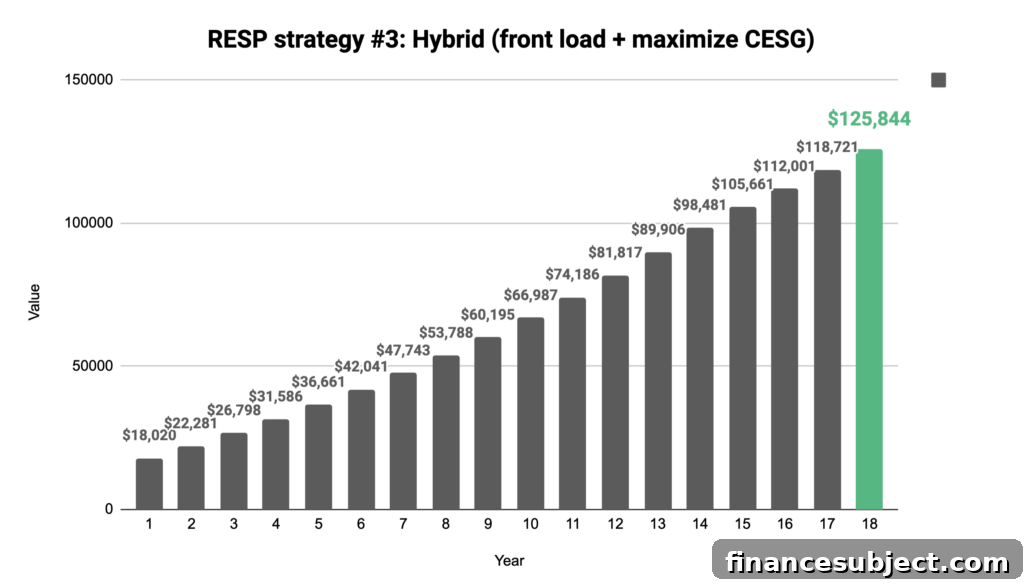
A middle ground can capture both early compounding and the CESG. For example, a planner might recommend an initial lump sum of $16,500 in year one, followed by $2,500 a year for 13 years and a $1,000 contribution in year 15, totaling $50,000 in contributions. Using the same 6% assumption, this hybrid could produce a balance around $125,844: $50,000 contributions, $7,200 CESG and about $68,644 in investment earnings.
The hybrid approach reduces timing risk compared with full front-loading while still benefiting from significant early tax-sheltered growth and maximizing government grants.
Should you borrow to contribute to an RESP?
Borrowing to invest—using leverage—is usually not recommended for RESP contributions. Interest on personal loans used to invest in RESPs is not tax-deductible, and borrowing adds financial risk. That said, if you have low existing debt, a predictable plan to repay, and access to credit at a low rate, short-term borrowing to capture CESG in a particular year might be considered, but only after careful planning.
The RESP bottom line: contribute what you can, when you can
For many families, a hybrid approach is optimal: contribute a modest lump sum early to benefit from long-term tax-sheltered compounding, then make regular $2,500 annual contributions to consistently secure the CESG. But flexibility matters—if you can’t contribute a large lump sum or never reach the $50,000 limit, contributing any amount still yields tax-sheltered growth and access to government grants. Unused CESG room can be carried forward until the end of the year the beneficiary turns 17.
As a protective measure, the Canada Deposit Insurance Corporation (CDIC) extended coverage in 2022 to insure up to $100,000 per RESP beneficiary for eligible deposits such as term deposits and GICs. CDIC coverage does not apply to stocks, bonds, ETFs or mutual funds.
Read more about RESPs:
- RESP guide: making the transition from saving to funding post‑secondary education
- Unconventional ways of investing in a family RESP
- Student Money Guide: how to pay for school and still have a life
- RESP investing strategies for busy parents
- Will a teen have to pay tax on withdrawals from a family RESP?