

Retired Money highlights
- Many Canadians say they expect to need about $1.7 million to retire, according to a BMO poll
- How someone could save $1.7 million inside RRSPs over a working lifetime
- Other factors that affect how much retirement savings you actually need
If you’re beginning the long process of saving for retirement, you may have seen BMO’s recent study reporting that Canadians believe they need about $1.7 million to retire. Adjusted for inflation, that figure is roughly 20% higher than the $1.4 million reported in 2020.
My initial back-of-the-envelope calculation showed that reaching $1.7 million in a registered retirement savings plan (RRSP) over 40 years would require very large annual contributions if you assume only modest investment returns. However, starting early and relying on compounded, tax-deferred returns inside an RRSP substantially lowers the annual amount you must save.
How to save $1.7 million for retirement
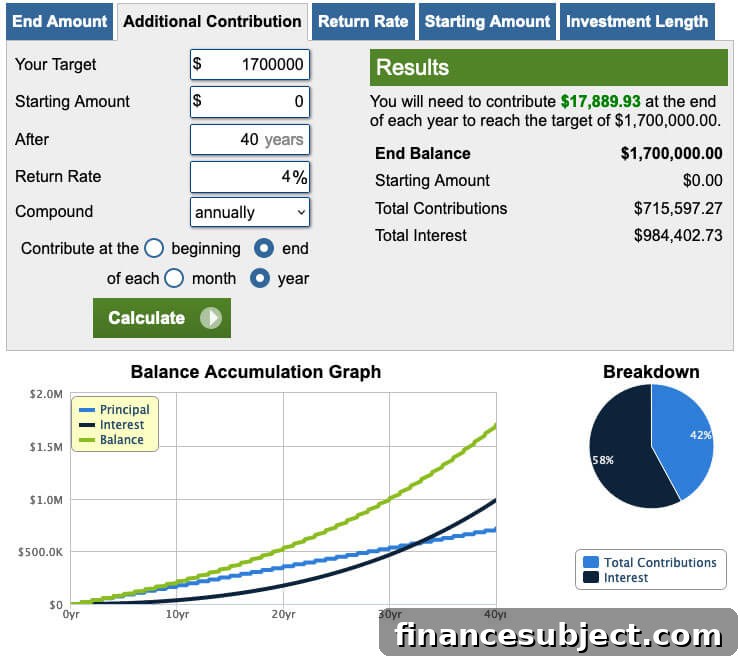
For many younger savers the $1.7 million number feels intimidating. Using a conservative assumed annual return of 4%, an investor would need to contribute roughly $17,000 a year into an RRSP for 40 years to reach $1.7 million. That example assumes modest returns — for some, this may feel achievable; for others, unrealistic — but it demonstrates the power of compounding and time.
Experts consulted for follow-up analysis agreed that a conservative 4% rate of return is a reasonable baseline. At 4% growth compounded annually, an annual contribution of about $17,900 (rounded) made at the end of each year would reach $1.7 million after 40 years. Over that period, total contributions would be about $716,000, with roughly $984,400 coming from investment growth.
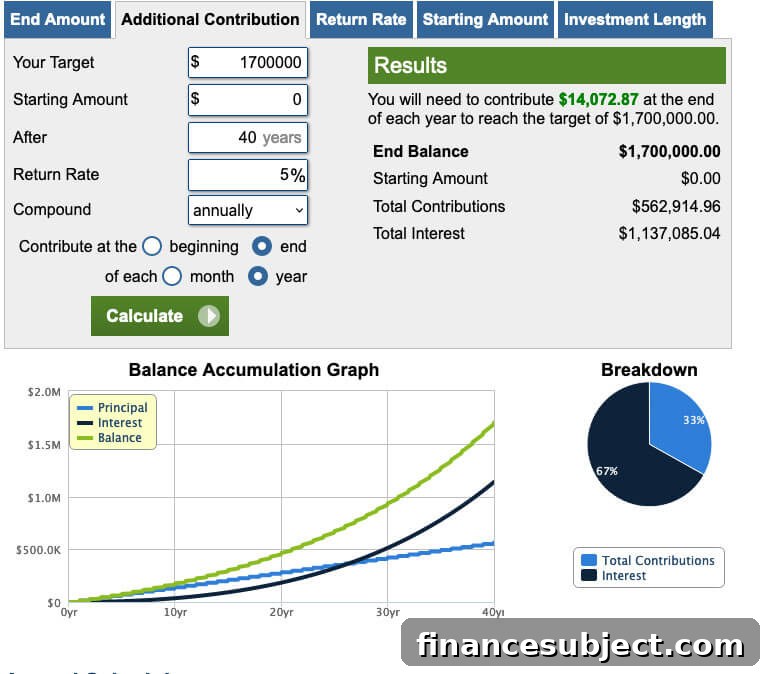
If you can earn a slightly higher long-term return, your required annual contribution falls. For example, at a 5% annual return, contributing about $14,073 each year for 40 years would reach the $1.7‑million target. That path involves about $562,915 in total contributions and roughly $1,137,085 in investment growth.
Advisors typically use a mix of stocks, bonds and alternative investments to aim for a reasonable long-term return after fees. For example, some planners assume about a 5% net return with 3% inflation baked into their forecasts. They also build stress testing into their projections so clients understand the range of possible outcomes.
One common stress test is a Monte Carlo simulation, which models many scenarios — including less favorable market returns — to estimate the likelihood that a portfolio will meet spending goals. Using that approach, a couple with $1.7 million and a paid-off home who receives full Canada Pension Plan (CPP) and Old Age Security (OAS) benefits might afford about $8,500 per month at a 4% portfolio return under ideal conditions. But the simulation might show only about a 57% chance of that outcome. Lowering monthly spending to $7,000 increases the probability of success to about 97%.
With a 5% portfolio return after fees, ideal conditions might support around $9,250 per month of spending. To make success more likely, reducing monthly withdrawals to about $8,000 can yield a higher probability in stress tests.
Do all Canadians need to save the same amount?
No — the $1.7 million figure is a broad survey result and individual needs vary widely. Key factors include household type, existing pensions, expected lifestyle in retirement, and how long you will be retired.
Couples can pool resources and expenses, so a shared target translates to about $850,000 per person if both partners plan to rely equally on savings. But many retirees have defined benefit (DB) pensions or other predictable income that substantially reduces how much they must save personally. Long-tenured public-sector workers with inflation-indexed DB plans may accumulate pension values that rival or exceed $1 million, making large additional savings less necessary.
Certified Financial Planner Steve Bridge observed that a couple with two DB pensions might not need extra savings at all. Conversely, someone with no pension who wants an expensive retirement and retires early could require many millions, especially if they stop working well before typical retirement ages.
Besides RRSPs, retirees can draw on tax-free savings accounts (TFSAs), non-registered investments, employer-sponsored defined contribution plans or group RRSPs. CPP and OAS are also important pillars: Canadians can start CPP as early as 60 and OAS as early as 65, and delaying both benefits can increase lifetime income from these programs and reduce reliance on personal savings.
For example, replacing one spouse’s RRSP with an employer pension that pays $40,000 annually indexed to inflation improves overall retirement security. In scenarios like this, probability-of-success measures in stress tests typically improve by 10–15 percentage points, though rarely to a guaranteed 100%.
Views from retirement experts
Retired actuary Malcolm Hamilton notes that many couples who buy and pay for a home and raise children often find they can live comfortably on about half their employment income once debts are settled and children have left home. He argues CPP and OAS provide meaningful inflation‑linked income for typical couples, and while saving extra is beneficial, not everyone needs to match the high targets suggested by some planners or institutions.
Financial planner Aaron Hector cautions against treating a single number like $1.7 million as a universal target. That survey figure reflected responses from 1,500 online participants, but individual circumstances — account types, tax consequences and the balance between registered and non‑registered savings — can make identical nominal amounts worth very different things after tax and withdrawal strategies are considered.
Hector emphasizes that financial planning is personal: the only way to know if you are on track is to model your unique circumstances and retirement goals.
Location matters: living costs across Canada
Where you live strongly influences how much you need to retire. In lower-cost regions, $1.7 million likely places you among the wealthiest retirees and is probably more than enough for a comfortable lifestyle, especially for homeowners whose mortgages are paid off. In higher-cost cities such as Toronto or Vancouver, particularly for renters or those without significant home equity, more savings may be necessary to maintain the same standard of living.
Ultimately, whether you need $1.7 million to retire depends on your personal goals, housing situation, expected public pensions, health, and how long you expect to be in retirement. A financial planner can help translate these variables into a realistic, personalized savings plan.
Further reading on retirement planning:
- Understanding your company pension plan
- TFSA contribution room calculator
- Determining your RRSP contribution limit
- Planning for retirement with little or no savings