

How do you make decisions you won’t regret when everything around you feels unstable? Use a clear, repeatable approach I call the Decision Crisis Playbook.
The Decision Crisis Playbook
A decision crisis happens when you must make major choices during a difficult period, but your basic needs—food, shelter and personal safety—are still met. The pressure comes from uncertainty about outcomes combined with high emotional or financial stakes.
- Avoid deciding from panic. Pause and look for a small hopeful perspective to steady you.
- Choose long-term, values-aligned options instead of short-term relief that may create future regret.
- Focus your energy on what you can control and act where you can make a difference.
- Set practical boundaries or guardrails to prevent running out of time, money, or emotional capacity.
- Accept and prepare for a new normal rather than clinging to the past.
The Decision Crisis Playbook helps you make no-regret decisions that protect your future wellbeing. It’s designed to be practical and repeatable: a survival guide that reduces immediate stress and increases confidence in the months and years that follow.
Subscribe
What is a decision crisis?
In short, a decision crisis is a moment when life changes or pressures force you to make consequential choices amid great uncertainty. These are not everyday decisions like what to eat tonight. They are life-altering questions with complex constraints, many possible outcomes, and no guarantee any choice will turn out exactly as hoped.
Examples include losing a job and deciding whether to accept lower pay quickly or hold out for a better opportunity; separating from a partner and debating whether to buy out their share of the home or sell and divide proceeds; or confronting a midlife reassessment that reveals you’re living against your core values. In every case, the formula is the same:
Uncertain outcome + high stakes (emotional or financial) + difficult decisions
The most stressful element of a decision crisis is making critical choices while already emotionally taxed. The pressure feels enormous because each choice can affect your financial stability, relationships, and long-term wellbeing.

These decisions are rarely straightforward. Do you move overseas to pursue a dream at the cost of family proximity? Do you end a relationship out of a lack of love despite respect and shared history? Do you invest in fertility treatments to preserve future options? Each “mega” decision contains dozens of micro-decisions and tangled emotions, so it’s natural to fear making the wrong choice. Regret can erode confidence and peace of mind—two things the Decision Crisis Playbook aims to restore.
There are generally two types of decision crises I encounter with clients:
External decision crises are thrust upon you: a sudden job loss, a serious illness in the family, an accident, or an unexpected breakup. These events require immediate and consequential choices.
Crossroads decision crises develop gradually when your behavior or choices drift away from your core values. Think of a career that once fit but no longer does, or a life trajectory that slowly becomes unbearable. Nothing dramatic sparks the crisis, but over time a sense of “This can’t be my life anymore” forces you to act.
Both types share the same core features: future outcomes are unclear, stakes are high, and decisive action is needed to move forward.
The Playbook is not a promise that every decision will yield perfect results. Instead, it is a disciplined process that limits impulsive choices and centers decisions on your long-term values and priorities. Over years of advising clients, I’ve watched who thrives after a crisis: people who make thoughtful, no-regret decisions, guided by a process rather than by panic or short-term comfort.
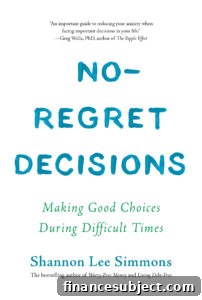
Shannon Lee Simmons is a Certified Financial Planner and founder of the New School of Finance, an advice-only planning firm. She speaks and teaches about personal finance and appears regularly as a financial expert in broadcast and print media.
This article is adapted from the book No-Regret Decisions (HarperCollins, January 2023).
Read more about financial planning:
- What is financial psychology?
- How financial advisors can help at different life stages
- Married with money: How to combine finances with your partner
- Taking stock of pandemic-era financial decisions