
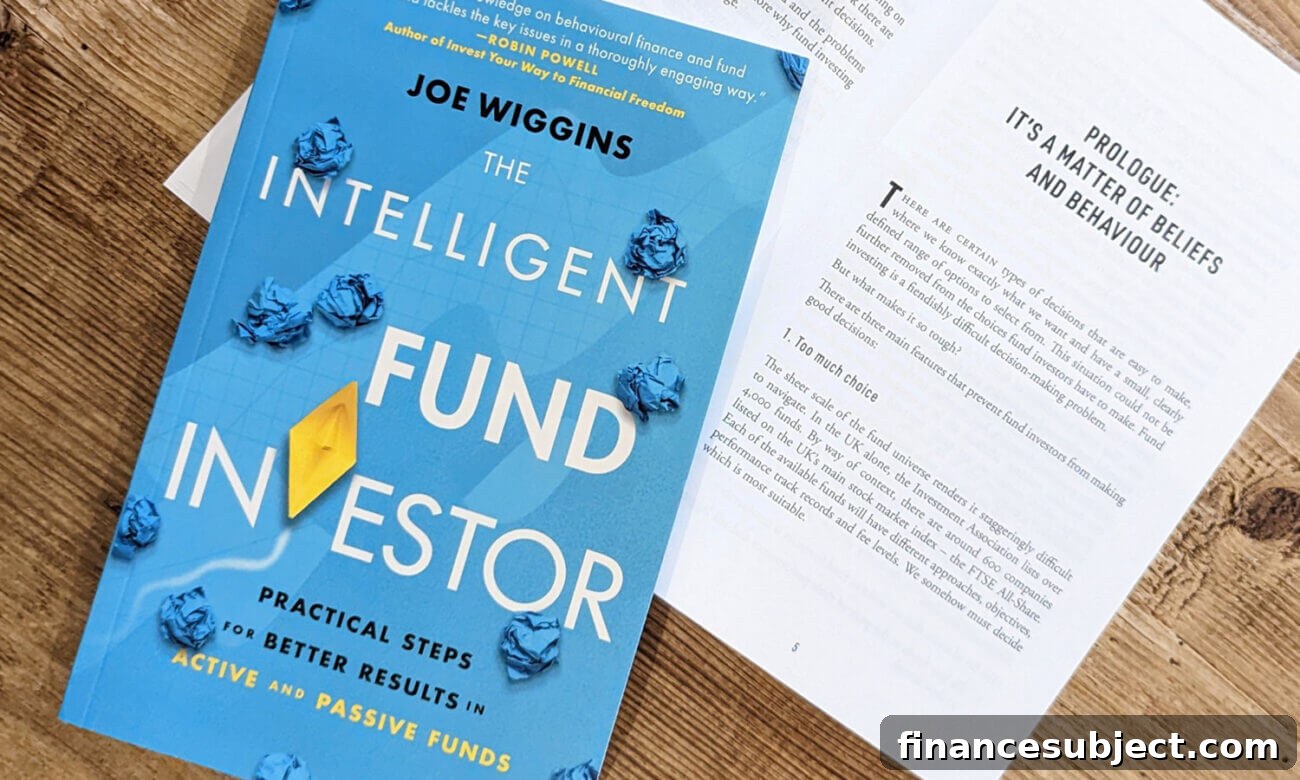
Wow — I just finished Joe Wiggins’ book, The Intelligent Fund Investor (Harriman House, November 2022). It’s a clear, evidence-based guide to fund investing that I’d recommend to both DIY and professional investors. The writing is concise, the arguments are practical, and I read every chapter straight through—something I don’t always do with investment books.
What makes a fund investor intelligent?

Wiggins focuses squarely on fund investing, including exchange-traded funds (ETFs) and mutual funds, and asks a straightforward question: what does it take to be an intelligent fund investor? His answer is elegant: hold a coherent set of beliefs grounded in evidence, and manage your own behaviour. Those two elements, he argues, are the foundation of successful long-term investing.
The book uses research findings, real-world examples and memorable anecdotes to support this thesis across ten chapters. Each chapter tackles a common misconception or pitfall investors face and offers practical guidance. Below are the chapter themes to give you a sense of the book’s scope:
- Don’t invest in star fund managers
- The death of active funds has been (somewhat) exaggerated
- Smooth fund performance conceals risk
- Choose simple over complex
- Great stories make for awful investments
- Investment risk is not volatility: it is disaster and disappointment
- Past performance is a terrible way to select a fund
- The incentives of asset managers are not aligned with their investors
- A long time horizon is a fund investor’s greatest advantage
- Seeing beyond the myths and marketing of ESG investing
What stands out in The Intelligent Fund Investor
One of the most valuable features of Wiggins’ book is its breadth. Rather than focusing narrowly on a single theme—such as indexing—he examines the wider ecosystem of funds, fees, incentives and investor behaviour. That broader viewpoint helps readers understand when different approaches make sense and when they do not.
For example, Wiggins challenges the simple conclusion that indexing always beats active management. He explains that index performance depends on the composition and weighting method used. When a capitalization-weighted index is dominated by a handful of large winners, active managers find it especially hard to outperform. Conversely, when an equally weighted index outperforms a cap-weighted index, active managers may have a better opportunity.
He illustrates this idea with an anecdote about two fishermen: a skilled angler in a pond with few fish versus a beginner fishing in a pond teeming with fish. The beginner appears more successful only because the environment is richer, not because of superior skill. That story helps explain why funds that shone during specific market conditions—such as the tech-heavy rally during the COVID years—weren’t necessarily the result of superior management, and why investors who chased those returns often faced disappointment later.
Why chasing past returns usually fails
Wiggins summarizes why chasing recent winners is a poor strategy with three economic and behavioral forces:
- Mean reversion: Exceptional short-term performance often gives way to returns closer to long-term averages.
- Investor sentiment: Popular funds attract flows that push valuations higher, and when sentiment reverses, outflows can be rapid and painful.
- Valuations: As securities in a fund rise in price, their future expected returns decline.
Watch out for complexity and marketing
Wiggins also calls attention to the sales pitches behind complex funds. He lays out a familiar pattern: a fund promises returns that are different and better, claims exclusivity, admits the strategy is hard to understand (implying that’s why it works), and invites you to trust the clever managers. Wiggins warns that if you can’t understand a fund, you can’t make an informed decision—investors end up watching a magic trick and hoping the rabbit appears.
Complexity often comes with opaque fee structures too. Incentive fees may be described as performance-linked, but base fees typically remain unchanged when performance slips, resulting in higher long-term cost to investors. Wiggins encourages readers to scrutinize both the mechanics and the economics of any fund they consider.
Practical takeaways for smarter investing
The core lessons are practical and actionable: prefer simplicity, understand the incentives and fee arrangements, be skeptical of stories that justify past performance, and build a plan that accounts for your behaviour over time. Importantly, Wiggins doesn’t insist on dogmatic indexing; he suggests a sensible mix of low-cost index funds and carefully chosen low-cost active funds, where evidence supports their use.
If you want to refine your fund selection process and improve your investment outcomes, The Intelligent Fund Investor is a thoughtful, well-researched guide. It offers a balanced perspective that helps investors separate marketing from merit and develop the habits that lead to long-term success.
Allan Norman provides certified financial planning services through Atlantis Financial Inc. Allan conducts securities-related business through Aligned Capital Partners Inc. (ACPI). ACPI is regulated by the Investment Industry Regulatory Organization of Canada (IIROC.ca). Allan can be reached at atlantisfinancial.ca or [email protected].