

5 ways to build a portfolio
Core portfolios
Advanced portfolios
The classic Couch Potato portfolio — a straightforward mix of global equities and Canadian bonds — has delivered solid long-term returns and remains a simple, effective approach for many investors. However, its simplicity can also be a limitation: it doesn’t always cover every economic scenario, which leaves gaps in performance when markets enter unusual regimes.
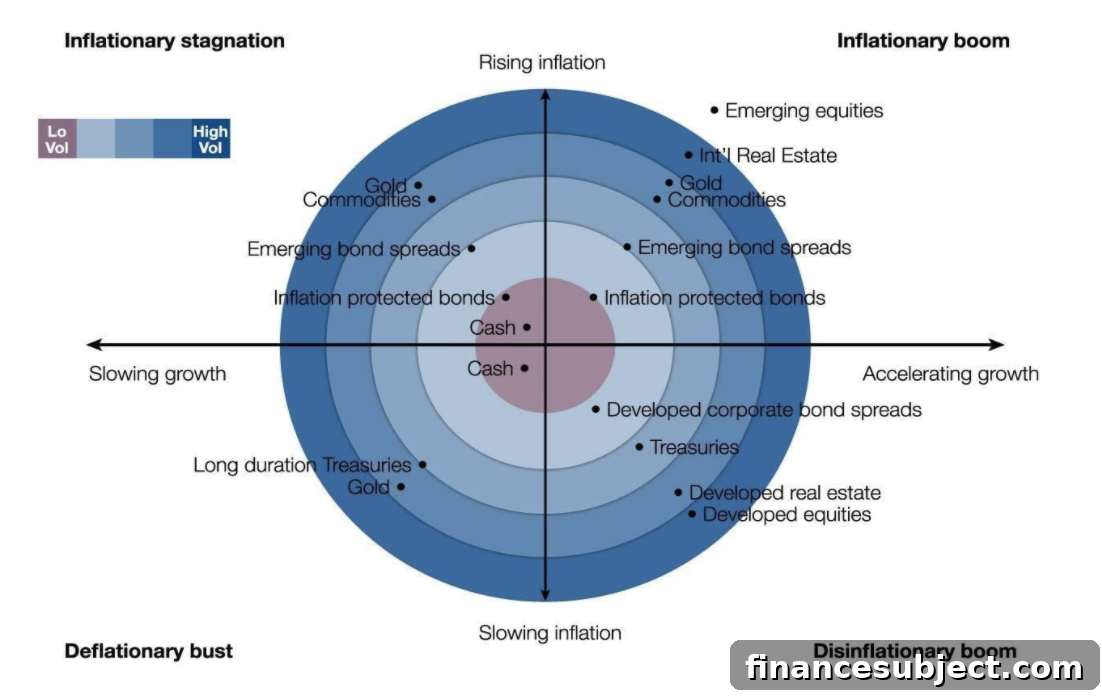
Consider the stagflation era of the 1970s and early 1980s, when high inflation combined with weak growth. During that time, few traditional assets performed well. Exposure to gold, commodities and real estate would have helped protect and improve returns, yet those assets are largely absent from the standard Couch Potato allocation. That omission highlights why a broader, “all-weather” approach can be useful, particularly for those near or in retirement.
For investors still in the accumulation phase, equities remain an excellent long-term hedge against inflation. Commodities can sometimes drag on returns during accumulation. But retirees and those in the retirement-risk zone face different priorities: preserving capital and income while managing inflation risk. For them, diversifying into real assets and a wider range of bonds can provide extra protection.
Asset performance in various economic conditions
All-weather ETF portfolios
We can improve diversification and reduce overall drawdown risk by adding a mix of assets that respond differently across economic cycles. The goal is to assemble a portfolio where at least one asset class tends to perform well regardless of whether the economy is expanding or contracting, and whether inflation is rising or falling. This is the principle behind strategies like the Permanent Portfolio and other all-weather models.
A balanced portfolio of stocks and bonds can still fail to protect capital for extended periods. For example, when both stocks and bonds decline together—an outcome seen periodically—a traditional 60/40 allocation may deliver poor results. That makes a case for including long-duration treasuries, short-term bonds, gold and commodities, and real estate to enhance resilience.
Below are the primary asset classes to consider for an all-weather ETF portfolio, together with suggested ETFs commonly used by Canadian investors. These are examples, not recommendations; always check suitability and fees before investing.
- U.S. Treasuries (long-term): Long-term U.S. government bonds can act as powerful stabilizers when equities fall, because their prices often rise more than a broad bond fund. (Suggested example: BMO Long-Term US Treasury Bond Index ETF — ZTL)
- Short-term bonds: Short-term government or aggregate bonds behave like cash during rising rate periods and can reduce volatility. (Suggested example: iShares Core Canadian Short Term Bond Index ETF — XSB)
- Long-term bonds (Canadian): Long-term domestic government bonds can provide convexity—strong upside when equities decline. (Suggested example: BMO Long Federal Bond Index ETF — ZFL)
- Gold and commodities: Real assets such as gold and a commodity basket tend to offer inflation protection and can perform well during geopolitical shocks. (Suggested example: Purpose Diversified Real Asset ETF — PRA)
- Real estate (REITs): Property exposure offers inflation linkage and low correlation with traditional equity and bond markets. (Suggested example: iShares Global Real Estate Index ETF — CGR)
- Other options: Investors might also consider inflation-linked bonds (TIPS or real return bonds) or a small allocation to digital assets such as Bitcoin if appropriate for their risk profile. These are not included in the sample portfolios below but can be layered in cautiously.
On the equity side, these all-weather portfolios separate Canada, the U.S., developed international and emerging markets into distinct ETFs. This avoids the heavy passive weighting toward the U.S. and allows more balanced regional exposure.
Advanced Conservative Portfolio
Advanced Conservative Portfolio (interactive content removed). See allocations below.
Equities — 30%
Canada (XIC): 10% — iShares Core S&P/TSX Capped Composite Index ETF
U.S. (XUS): 10% — iShares Core S&P 500 Index ETF
Developed International (XEF): 5%
Developing International (XEC): 5%
Real Estate — 10%
CGR (Global Real Estate): 10% — iShares Global Real Estate Index ETF
Fixed Income — 40%
Canadian long-term bonds (ZFL): 15% — BMO Long Federal Bond Index ETF
Canadian short-term bonds (XSB): 10% — iShares Core Canadian Short Term Bond Index ETF
U.S. Treasuries (ZTL): 15% — BMO Long-Term US Treasury Bond Index ETF
Real Assets — 20%
PRA (Purpose Diversified Real Asset ETF): 20%
Advanced Balanced Portfolio
Advanced Balanced Portfolio (interactive content removed). See allocations below.
Equities — 50%
Canada (XIC): 16.7%
U.S. (XUS): 16.7%
Developed International (XEF): 8.33%
Developing International (XEC): 8.33%
Real Estate — 10%
CGR: 10%
Fixed Income — 30%
ZFL (long-term bonds): 10%
XSB (short-term bonds): 10%
ZTL (U.S. Treasuries): 10%
Real Assets — 10%
PRA: 10%
Advanced Balanced Growth Portfolio
Advanced Balanced Growth Portfolio (interactive content removed). See allocations below.
Equities — 60%
Canada (XIC): 20%
U.S. (XUS): 20%
Developed International (XEF): 10%
Developing International (XEC): 10%
Real Estate — 10%
CGR: 10%
Fixed Income — 20%
ZFL (long-term bonds): 6.6%
XSB (short-term bonds): 6.6%
ZTL (U.S. Treasuries): 6.8%
Real Assets — 10%
PRA (Purpose Diversified Real Asset ETF): 10%
These sample portfolios are designed to increase resilience across economic regimes by combining equities, real estate, multiple bond types and real assets. They are examples intended for investors who want a more diversified, all-weather approach than a basic equities-plus-bonds Couch Potato mix. As always, consider your time horizon, risk tolerance and tax implications before implementing any allocation, and consult a financial professional if you’re unsure.