
Good reads from around the web.
I suspect many investors enjoyed excellent returns in 2016. Well-diversified passive portfolios in the UK often topped the 20% mark.
Our own model portfolio rose roughly 25% last year.
It’s tempting to feel particularly clever after such a year, but avoid the hubris. Don’t rush to change your lifestyle based on one strong year of markets, and resist treating TV dramas or glossy property ads as investment guidance.
For most UK investors, 2016’s gains were driven largely by the pound’s sharp fall, which boosted the value of overseas assets held in sterling and inflated the local-currency profits of many multinational companies.
Currency moves are among the most impartial market forces: they lift or lower portfolios regardless of individual stock-picking skill.
This chart of the FTSE 100 shown in pounds, dollars, and euros makes the point starkly:
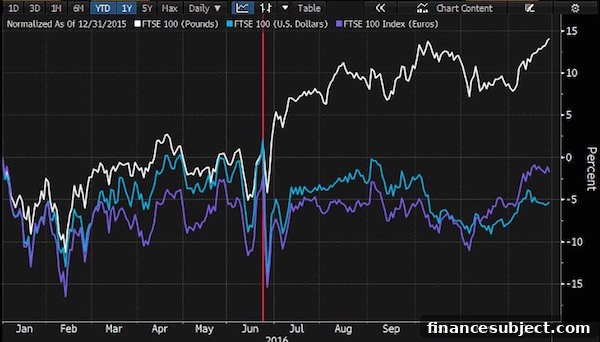
It was Brexit that did most of the heavy lifting. (Blue is the FTSE in dollar terms, white in pounds).
Source: 3652 Days
Put simply: if you were a global investor based in Britain, you likely got richer in 2016 because the UK’s currency weakened.
In the stocks
If you underperformed in 2016, it was often because you were picking individual stocks — where outcomes vary widely.
Investors focused on domestically oriented UK companies produced mixed results. Small-cap specialist Maynard Paton returned a little over 7%, which is respectable. Others, such as John Rosier, experienced losses. Even experienced stockpickers like John Lee achieved solid returns from UK holdings but still trailed a global index in sterling terms.
I mention these examples not to criticise — their writing and analysis are valuable — but to illustrate how passive, broadly diversified exposure sometimes outperformed active stock selection last year. My own performance was better than some active investors cited, yet still lagged a world index fund in sterling; a fair portion of my gains came from holding US and other overseas assets.
Active investing involves accepting the possibility of bad years. Those who claim never to lose are implausible — either extraordinary quants operating in very different risk regimes or operators with questionable practices. Meanwhile, many hedge funds again delivered returns that lagged simple benchmarks, despite high fees.
Pounded portfolios could recover
The big question for active UK investors is whether the pound will rebound. Long-term investors often ignore short-term currency swings, but the scale and political origin of the Brexit-driven fall make this episode unusual.
If sterling strengthens sharply, portfolios concentrated in UK domestic stocks could recover strongly. That potential recovery is why many active managers with home bias find the outlook so uncertain right now.
For passive investors — who make up a growing share of readers — the sensible approach is to enjoy the gains while acknowledging they may not persist. Behavioural research shows losses hurt more than gains please, so pausing to appreciate a good year can be helpful, but it’s not a guide for future allocation changes.
I remain more optimistic about long-term equity returns than the most pessimistic commentators, yet crashes are inevitable at some point. Historically, the long-run real return from equities tends to be in the 4–6% range after inflation. When even experienced investors talk about a “steady, unspectacular year” that ends with returns well above that band, it’s a reminder to stay cautious and avoid complacency.
Let’s remain sensible and stick to sound investing principles.
From the blogs
Curated reading to help you think about investing and personal finance.
Passive investing
- Most active funds are priced to fail – The Evidence-based Investor
- Couch Potato 2016 returns [Canadian but insightful] – Canadian Couch Potato
- Pensions, social security, and asset allocation [US perspective] – Oblivious Investor
Active investing
- Looking for the next Amazon – The Irrelevant Investor
- Active investing: seeking the elusive edge – Musings on Markets
- Searching for the growth stock Holy Grail – Investing Caffeine
- Soros on fallibility and reflexivity – Abnormal Returns
- Valuation and investment analysis – Bronte Capital
- Lessons from a legendary short seller – CFA Institute
- Are commodities still a good diversifier? [Very technical] – Dual Momentum
Other articles
- Why we use long words in long articles on Monevator – via Seth Godin
- How to sell books like Harry Dent – A Wealth of Common Sense
- Dreaming the dream – SexHealthMoneyDeath
- The Big Picture [US infographic, PDF] – CRSP
- Stress eases when you stop chasing the best – The Finance Buff
- Six lessons learned in Belize [Targeted at doctors but broadly relevant] – The White Coat Investor
- Monevator ranked 11th on a top 100 financial blogs list – Frugal Student
Product of the week: Resolving to join a gym? Cut the right kind of pounds by comparing the best-value local gyms in The Guardian’s guide.
Mainstream media money
Some items are accessible through search-result links that may bypass paywalls on desktop view. Note: access can vary by device and publisher.
Passive investing
- Jack Bogle: the secret to becoming a winning investor – MarketWatch
- Ignore short-term stock picking advice for 2017 – New York Times
Active investing
- Five economic terms everyone should use – Bloomberg
- Mini-bond firm may not survive, auditor warns – Telegraph
- The world’s cheapest markets in 2017 – Telegraph
A word from a broker
- Three sectors that led the market last year – TD Direct
- Will emerging markets continue to thrive in 2017? – Hargreaves Lansdown
Other worthwhile reads
- Can money make you happy? – FT
- New year’s resolutions for your money – FT
- Round £1 coins cease to be legal tender in October – ThisIsMoney
- The taxman’s new data tools – Telegraph
- How to tackle post-holiday debt – Guardian
- Is nighttime electricity cheaper? – Guardian
- Making homes more affordable for key workers – Guardian
- What history can teach investors in 2017 – The Washington Post
- Young Britons and inherited wealth – FT
- Debate over taxing inheritances – Guardian
- Solar could outpace coal within a decade – Bloomberg
- Fixing globalisation (podcast with Jim O’Neill) – BBC
- Swedish six-hour workday trial proves costly – Bloomberg
Book of the week: US readers have been talking about Amazon’s voice assistant, Alexa. The device is gaining traction in the UK too, with options like the Echo and the smaller Echo Dot becoming affordable ways to try voice-driven home assistants. Consider privacy and controls before you adopt one.
Like these links? Subscribe to get them weekly.
- I’ve hinted at my own returns here for context: I did better than some writers mentioned, but still underperformed a global index fund in sterling. Much of the gain came from holdings in US and other overseas assets.[↩]
- Long-run returns cited refer to real returns, after inflation.[↩]
- Some articles are accessible through search-result pages on desktop; access can vary by device. On mobile, using the browser’s “Request Desktop Site” option may help.[↩]
- Trialling a six-hour day with hands-on nurses may bias results; different occupations could yield different outcomes.[↩]