How Long Will Recovery Take? Doctor Answers (Weekend Reading)
What caught my eye this week.
I really hoped I wouldn’t be writing again about the UK’s fiscal and political turmoil so soon. But the story refuses to go away, and it continues to have immediate consequences for markets, households and public finances.
This week felt like a moment of truth and forced compromise: the government’s plans collided with political reality and were scaled back under intense pressure. Most notably, after senior Conservative MPs said they could not support it, Prime Minister Liz Truss backed away from abolishing the 45% top rate of income tax.
Instead the planned tax cut was itself withdrawn. That reversal represented a small measure of fiscal restraint, imposed more by the party than by the Treasury. Given the limited savings involved, the impact on financial markets — and on those watching gilt markets — was likely modest in absolute terms, but the underlying concerns about the public finances remain.
Bean counters
The Guardian reports comments from Sir Charles Bean, a former Bank of England deputy governor and ex-member of the independent Office for Budget Responsibility, who warned the independent forecaster would probably reveal a very large gap in the public finances.
Bean suggested the independent forecast could show a gap in the order of £60bn to £70bn compared with previous projections. That shortfall would leave the chancellor with three stark choices: reverse more of the announced tax cuts, implement deep public spending reductions, or accept a much larger increase in borrowing and risk further market disruption.
He warned many observers and MPs have yet to grasp how much the public finances have weakened since the spring, and that reversing recent tax measures could be politically damaging for the government.
It seems intentional that large spending cuts and the promised supply-side reforms were delayed until November, despite those measures being the items that alarmed markets most. One plausible interpretation is that the government hoped headline tax cuts would make later, tougher decisions feel more justified — creating a narrative of short-term relief before harder medicine.
But with rebellion inside the party and MPs worried for their seats, the politically painful choices the government says it wants to make now look much harder to implement in Parliament.
Bad medicine
Many readers may understand the real-terms freeze on benefits and the strain on public services such as the NHS, though only some will be affected directly. For most households, the impact will show up through tax and benefit mechanics rather than headline rate changes.
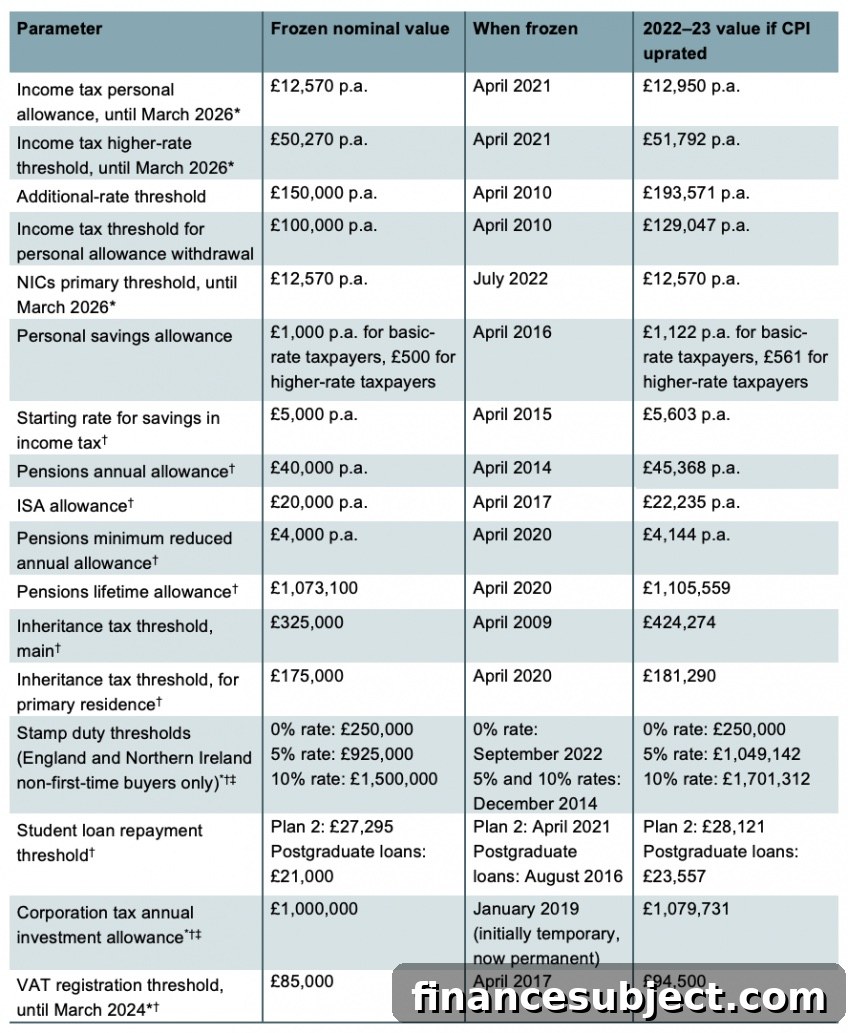
One important and under-appreciated mechanism is tax parameter freezes combined with high inflation. The Institute for Fiscal Studies (IFS) highlights how frozen allowances and gradual policy roll-outs will, on average, reduce household incomes far more than the limited headline tax cuts will restore.
Freezes to personal tax parameters alone will reduce households’ income by £1,250 on average by 2025–26.
Adding in freezes to benefits and gradual policy roll-outs brings that figure to £1,450, or 3.3% of income, and means a £41 billion boost to the exchequer.
That is double the £20 billion gain in household income (and loss to the exchequer) from the high-profile personal tax giveaways – the reduction in National Insurance contributions and 1p cut to the basic rate of income tax.
In other words, on average for every £1 households gain from high-profile cuts to rates of income tax and National Insurance, they lose £2 from the freezes and policy roll-outs.
My colleague, The Accumulator, has been warning about this for months and argued many people will end up paying more tax in real terms because thresholds remain frozen while inflation pushes incomes higher.
The IFS also illustrates what the tax bands would look like if they had simply been uprated with inflation — a useful way to see how much extra tax a typical household faces because of freezes.
Source: IFS
These mechanics are complex and opaque, which is exactly why politicians find it tempting to use freezes rather than obvious tax hikes: the effect is real but less visible.
First, do no harm
Who could blame ministers for trying to ease pressure on households in a weak economy? The UK is struggling with poor productivity, growing long-term commitments, and recent one-off spending such as energy support. Tax revenue as a share of national income is approaching its highest level since the post-war period.
Even if tax cuts were chosen for political reasons, they were intended to blunt economic pain. But the delivery has been clumsy. The mix of measures looks more like aggressive chemotherapy than a careful, staged treatment, and the sequencing has been counterproductive: ill-judged announcements have created market panic that undermines the policy goals.
While I have doubts about the policy package and its execution, I do not fully disagree with the diagnosis that the UK needs growth-enhancing reforms and a credible fiscal plan.
Post-mortem
The government’s handling quickly exhausted public sympathy, especially when senior figures tried to blame external factors for market turmoil. The Bank of England has been clear that the fiscal event — the Mini Budget — played a central role in the spike in gilt yields and the pressure on pension funds.
Deputy Governor Jon Cunliffe told Parliament that some pooled investments in liability-driven pension funds would have been at risk of being effectively worthless without the Bank’s intervention to buy gilts. The Bank’s letter to MPs linked the sudden market disruption directly to the fiscal announcements.
Source: Bank of England / UK Gov
We can only hope the political turbulence does not leave the country stuck in limbo. If the government loses the capacity to implement the controversial but necessary measures it has signalled, the economy could face an extended period of uncertainty until the next general election.
And that uncertainty matters now: it feeds through to mortgage markets, the housing market, pension funds, and longer-term borrowing costs.
Wrap up warm this winter — both literally and figuratively.
Eat The Rich or die trying (a review, of sorts) – Monevator
From the archive-ator: Mortgage risk checklist – Monevator
News
Note: Some links lead to search results. On desktop you may access articles without a subscription; try private/incognito mode if needed. Consider subscribing if you read these sites regularly.
Public won’t be told to curb energy use after No. 10 reportedly objects – BBC
Fitch cuts UK’s credit rating outlook to negative, citing fiscal risk – Business Standard
“Uninvestable” UK market loses £300bn in Liz Truss’s first month – Bloomberg via Yahoo – Yahoo Finance
Property sales collapsing at the fastest rate since the pandemic – Yahoo Finance
“Kicking myself I didn’t move faster”: fear and panic grips the house market – Guardian
Products and services
UK mortgage rates are soaring. What can you do? – Guardian
Time to give annuities another look as rates rise 50% – ThisIsMoney
Aldi was the cheapest supermarket in September – Which
Open a SIPP with Interactive Investor and pay no SIPP fee for six months. Terms apply – Interactive Investor
Comment and opinion
Time for investors to learn a new game – FT
Brighter prospects for bonds ahead – Vanguard
What the money is for – Of Dollars and Data
Invest now mini-special
The Investor Opportunity index hits a two-year high – The Reformed Broker
Naughty corner: Active antics
Global venture capital pullback is dramatic in Q3 2022 – Crunchbase
Covid corner
More than one million in the UK report Long Covid a year after infection – Guardian
Kindle book bargains
Mastering The Market Cycle by Howard Marks – £0.99 on Kindle
Go Big: How To Fix Our World by Ed Miliband – £0.99 on Kindle
Environmental factors
UK defies climate warnings with new oil and gas licences – BBC
Off our beat
Five short stories about expectations – Morgan Housel
And finally…
“For all that has recently been said about ‘the wisdom of crowds’, the authors prefer to fly with airlines which rely on the services of skilled and experienced pilots, rather than those who entrust the controls to the average opinion of the passengers.”
– John Kay, Radical Uncertainty
Like these links? Subscribe to get them every Friday! Note this article includes affiliate links to services such as Amazon and Interactive Investor. We may be compensated if you pursue these offers, but that will not affect the price you pay.
Some articles can only be accessed through search results on desktop. To view them on mobile, switch your browser to desktop mode (for example, in Chrome for Android use the menu and select “Request desktop site”).[↩]