
Heresy! Prepare the torches, because I’m about to do something that will make many passive investing purists bristle: I’m placing part of the Slow & Steady portfolio into an active fund.
Before the pitchforks appear, let me explain why this is not a betrayal of passive principles but a pragmatic decision to manage a specific risk: inflation.
When inflation runs higher and faster than expected, the most reliable protection is inflation-linked bonds. Stocks typically beat inflation over long time horizons, but they can suffer severe losses during periods of runaway price rises. Gold and commodities are not consistently dependable hedges either. For robust inflation protection, inflation-linked government bonds remain the best option.
That said, not all inflation-linked bond funds are equivalent. Three questions guided my choice:
- When is choosing an active fund acceptable?
- What makes this particular active fund a good fit for the Slow & Steady portfolio?
- What are the drawbacks of competing index trackers?
My support for index funds is pragmatic and evidence-based: low-cost, well-diversified investments and steady asset allocation tend to deliver better outcomes than high-cost active strategies for most investors. However, I will opt for an active fund when it meets several criteria:
- It is low cost.
- Its objectives align with my long-term asset allocation needs.
- Its strategy and constraints are transparent enough that I’m not exposed to unexpected risk-taking.
- It serves the portfolio’s needs better than available index trackers.
I believe the fund I’ve selected satisfies these standards.
What’s the active fund?
The fund is the Royal London Short Duration Global Index-Linked Fund, hedged to the pound.
This fund focuses on high-quality, low-volatility inflation-linked government bonds from around the world, and it is designed to protect a portfolio from high, unexpected inflation while keeping interest rate sensitivity relatively low.
Cost matters: the fund’s OCF is 0.25%, which is comparable to many global government bond index trackers hedged to sterling. It’s slightly higher than the Vanguard UK inflation-linked gilt fund it replaces in our model portfolio, but the Vanguard fund carries a meaningful vulnerability: high real interest rate risk because it is dominated by long-dated UK index-linked gilts.
To summarise the concern:
- UK index-linked gilt funds are heavy in long-duration bonds.
- Long-duration bonds suffer most if real interest rates rise.
- Real interest rates have been unusually low since the Global Financial Crisis, so the risk of a rebound exists.
- If rates rebound, the capital losses from long-duration linkers could outweigh their inflation-protection benefits.
The solution is a fund with shorter duration exposure. Short-duration inflation-linked bonds still provide inflation protection but carry less sensitivity to rising real rates. They can reinvest maturing bonds at higher yields more quickly, limiting losses when rates rise.
The Royal London fund’s average duration is around 5, meaning it would lose roughly 5% of value for a 1% parallel rise in interest rates—materially less sensitive than long-duration alternatives. Its portfolio is diversified across high-quality issuers, many with credit ratings comparable to or better than UK government bonds, and more than 20% of the fund’s holdings are in UK bonds, which helps align it with UK inflation exposure.
The fund has been in existence for several years and has adhered to its mandate of investing mainly in global inflation-linked securities and UK linkers. It can hold conventional government bonds and some corporate or lower-rated fixed income, but Royal London publishes sufficient detail for investors to monitor holdings and act if the strategy drifts.
This choice is not about chasing recent performance. It’s about fitting an inflation-protection role into our strategic allocation. Given current low yields and muted inflation expectations, I expect a modest negative return in the near term from this allocation; that’s an acceptable trade-off for the risk mitigation it offers.
Consequently, I’m keeping the inflation-linked bond allocation at 5% for now, with plans to increase it to 50% of the fixed income sleeve as our time horizon shortens. For the moment, the portfolio still benefits from conventional government bonds’ stronger capacity to cushion equity drawdowns in a recession.
Must you do this?
If you prefer to stay strictly passive, there is an index-track alternative: the Legal & General Global Inflation-Linked Bond Index Fund.
Trade-offs for the L&G index fund include:
- It’s an index tracker, so there’s no risk of mission creep.
- It excludes UK linkers entirely, so it’s less aligned with UK inflation.
- Its OCF is marginally higher at 0.27%.
- Its duration is higher (around 8), meaning greater interest rate sensitivity, though that may still fit investors with a long enough time horizon.
If you are uncomfortable using an active fund and have a time horizon longer than about eight years, the L&G fund is a viable passive option to research.
Note: the Vanguard UK inflation-linked gilt fund we previously held performed well over the last four years, but the decision to switch is driven by structural concerns about long-duration real-rate exposure, not by short-term results.
Using a carefully chosen active fund does not abandon passive investing principles in my view. We are not market-timing or chasing trends; we are selecting the best instrument available to meet a clear, long-term allocation need and to manage a foreseeable risk.
Hot! Hot! Hot!
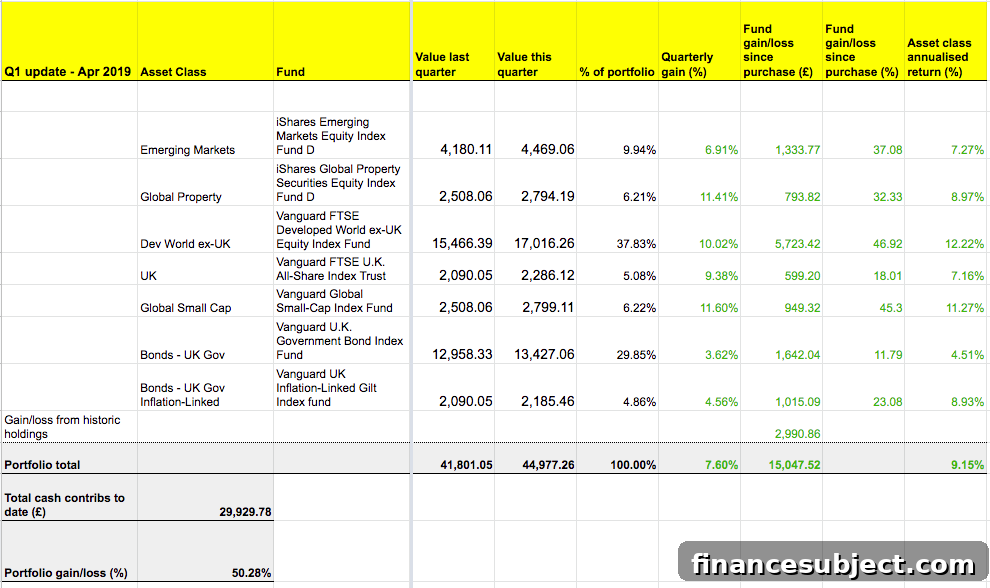
Hopefully the outrage has cooled. Whether I’m seen as a black sheep or merely a contrarian, the Slow & Steady portfolio has enjoyed a strong quarter and has recovered much of the losses it suffered between October and December. Its annualised return now sits at a healthy 9.15%.
The Slow & Steady portfolio is Monevator’s model passive investing portfolio. It was launched in 2011 with an initial investment and regular quarterly contributions. The portfolio is diversified across equity, property, government bonds, and inflation-linked bonds, with a long-term, disciplined approach to allocation and rebalancing.
New transactions
We are selling our Vanguard UK Inflation-Linked Gilt Index Fund holding and replacing it with the Royal London Short Duration Global Index-Linked Fund.
Every quarter we invest £955 of new cash split across seven funds according to our target allocation. The Royal London fund receives the portion allocated to inflation-linked bonds: £47.75 (5% of new cash). We rebalance using Larry Swedroe’s 5/25 threshold rule, which did not trigger this quarter. The trades this quarter are:
UK equity
Vanguard FTSE UK All-Share Index Trust – OCF 0.08%
Fund identifier: GB00B3X7QG63
New purchase: £47.75 — Buy 0.236 units @ £202.44 — Target allocation: 5%
Developed world ex-UK equities
Vanguard FTSE Developed World ex-UK Equity Index Fund – OCF 0.15%
Fund identifier: GB00B59G4Q73
New purchase: £353.35 — Buy 1.007 units @ £350.93 — Target allocation: 37%
Global small cap equities
Vanguard Global Small-Cap Index Fund – OCF 0.38%
Fund identifier: IE00B3X1NT05
New purchase: £57.30 — Buy 0.2 units @ £285.94 — Target allocation: 6%
Emerging market equities
iShares Emerging Markets Equity Index Fund D – OCF 0.26%
Fund identifier: GB00B84DY642
New purchase: £95.50 — Buy 59.95 units @ £1.59 — Target allocation: 10%
Global property
iShares Global Property Securities Equity Index Fund D – OCF 0.22%
Fund identifier: GB00B5BFJG71
New purchase: £57.30 — Buy 25.963 units @ £2.21 — Target allocation: 6%
UK gilts
Vanguard UK Government Bond Index – OCF 0.15%
Fund identifier: IE00B1S75374
New purchase: £296.05 — Buy 1.744 units @ £169.72 — Target allocation: 31%
UK index-linked gilts (sold)
Vanguard UK Inflation-Linked Gilt Index Fund – OCF 0.15%
Fund identifier: GB00B45Q9038
Sell all: £2,185.46 — Sell 10.964 units @ £199.34 — Target allocation: 5%
Global index-linked bonds (bought)
Royal London Short Duration Global Index-Linked Fund – OCF 0.25%
Fund identifier: GB00BD050F05
New purchase: £2,233.21 — Buy 2,157.691 units @ £1.04 — Target allocation: 5%
New investment = £955
Trading cost = £0
Platform fee = 0.25% per annum
This model portfolio is notionally held with Cavendish Online. Average portfolio OCF = 0.18%.
If you prefer a simpler route, consider an all-in-one fund such as Vanguard’s LifeStrategy series to achieve broad diversification with a single fund.
Take it steady,
The Accumulator