
Kyle Prevost, creator of 4 Steps to a Worry-Free Retirement, Canada’s DIY retirement planning course, shares financial headlines and offers context for Canadian investors.
2023 asset returns versus the last 10 years
As we begin a new year and market commentators publish their forecasts, it’s useful to review how returns have varied across asset classes. The chart below highlights equity returns on major U.S. exchanges and shows how volatile single-year returns can be.
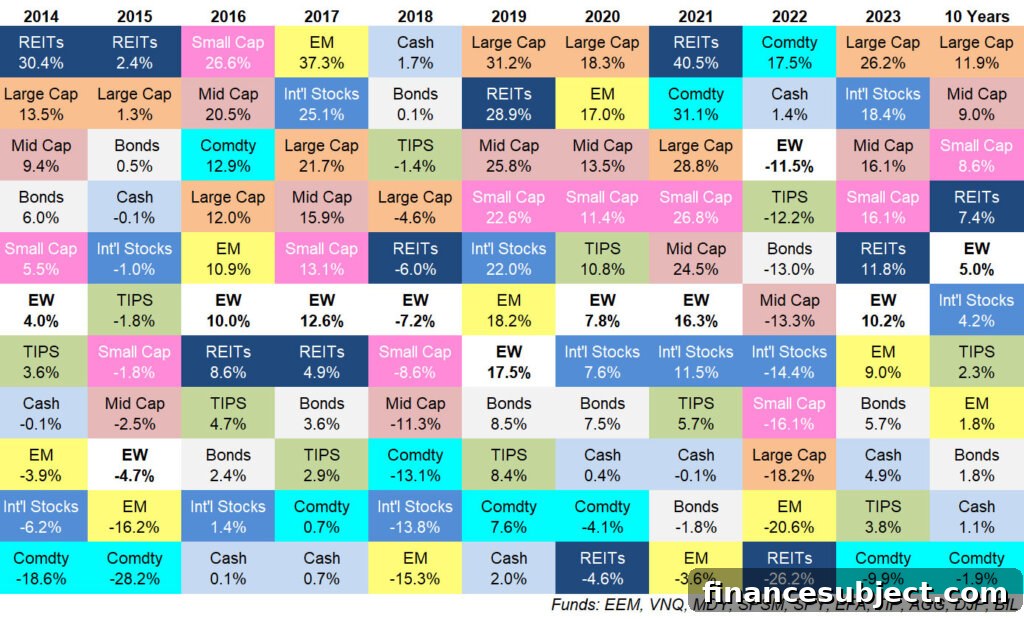
For a Canadian perspective, the table that follows shows annual returns for the Canadian total market. Use the horizontal scroll if viewing on a small screen to see the full 10-year summary.
| 2014 | 2015 | 2016 | 2017 | 2018 | 2019 | 2020 | 2021 | 2022 | 2023 | 10-year | |
| CAD total market | 10.55% | -8.32% | 21.08% | 9.10% | -8.89% | 22.88% | 5.60% | 25.09% | -5.84% | 11.75% | 7.62% |
Key takeaways from the returns data:
- 2022 was broadly negative for most assets, while 2023 saw a strong rebound for many classes.
- Commodities fell back significantly in 2023 after strong performance in prior years.
- Even with good commodity years in 2021–2022, the 10-year commodity return remains negative.
- Across asset groups, there is clear evidence of mean reversion over the last decade.
- Since the end of 2008, the S&P 500 has delivered an extraordinary cumulative return, underscoring long-term equity performance.
- Bonds have underperformed expectations over the last decade, barely beating cash on an annualized basis.
For Canadian stocks, the S&P/TSX Composite Index shows substantial growth since tracking began in 1998, with a long-term total return that has multiplied initial investments many times over. That history reinforces that, despite intermittent downturns, broad equity exposure has rewarded long-term investors.
When evaluating this type of chart, remember short-term forecasts based purely on the previous year are rarely accurate. One-year returns often behave like a random walk. Over time, equities—whether large-cap or small-cap, U.S. or Canadian—tend to deliver superior returns more frequently than other major asset classes.
On a related note, bitcoin spot exchange-traded funds (ETFs) began trading recently after approval, marking a notable development for investors interested in cryptocurrency exposure. I’ll cover that topic in more depth next week.
The small short? The big long?
Many people learned about short selling from the film The Big Short. Shorting a stock is a bet that its price will fall: if it does, the short seller profits; if the price rises, losses can be unlimited. Short positions require skill, discipline and often sophisticated risk-management tools.
Research from data providers shows short sellers suffered heavy losses in 2023 when several large-cap stocks rallied. Bets against companies such as Tesla, Nvidia, Apple, Meta Platforms, Microsoft and Amazon cost short sellers billions, despite occasional profitable trades during volatile episodes like the spring banking stress.
The disappointing results for professional short sellers and options traders are a useful caution for retail investors. Institutional traders enjoy advantages in talent, information and technology, yet they still face large losses. That’s a reminder that options and short-selling strategies are complex, risky, and far from a guaranteed way to outperform a diversified buy-and-hold approach.
If you’re curious about individual strategies like options trading for hedging or speculation, approach them with education, small position sizes and a clear understanding of the risks involved.
Looking back at Canadian real estate in 2023
After years of relentless price gains in many markets, Canada’s housing sector took a pause in 2023. Price movements varied by region, and some smaller markets experienced surprising appreciation driven by local supply shocks.
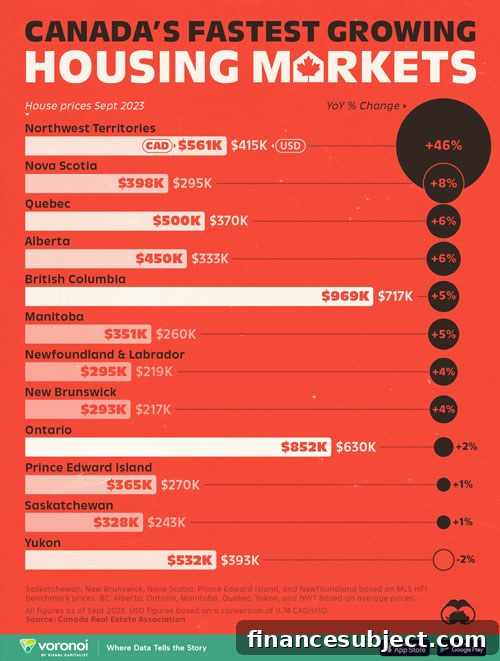
How to read the graphic:
- The white bar indicates the current median price in Canadian dollars.
- The adjacent number shows that price in U.S. dollars.
- The circle and its value show the percentage change in housing prices within the province for 2023.
Some northern regions, like the Northwest Territories, posted surprisingly large price gains. In small markets, a limited housing stock and localized events—such as destructive wildfires or a sudden halt in construction—can drive rapid price changes. Meanwhile, many Canadians still purchased homes at elevated prices despite concerns about affordability and higher mortgage rates.
First-time buyers remain under pressure, especially in provinces where internal migration has pushed demand higher without a corresponding rise in high-paying jobs. If interest rates fall in 2024, pent-up demand could reignite speculative buying and add upward pressure to prices in many markets.
For anyone considering where to buy, it’s important to balance local employment prospects, population trends and housing supply when evaluating long-term affordability and investment potential.
Your loonie won’t buy as many pesos as it used to
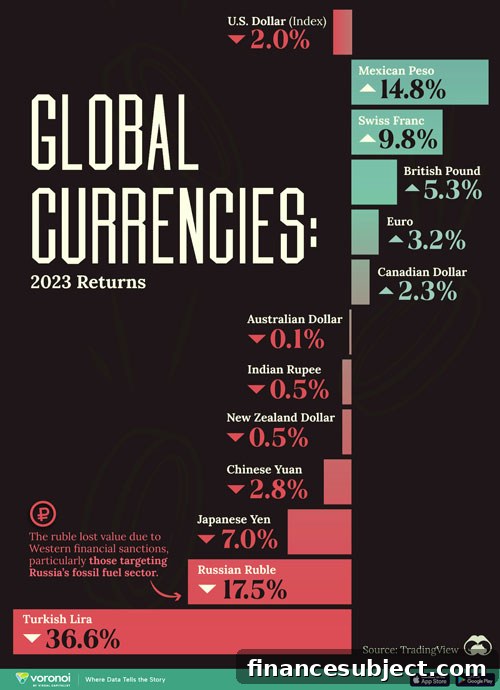
Currency moves can attract a lot of attention, but they should be viewed in context. The Canadian dollar recovered somewhat in 2023 after a weak 2022, but gains were modest against some major currencies.
Movements in exchange rates reflect a combination of economic growth, inflation, interest-rate differentials and commodity prices. Small gains or losses against a particular currency are normal. For Canadian travellers heading south, the loonie buying fewer Mexican pesos means vacations may cost a bit more than in previous years.
Other currency stories from the year included persistent weakness in the Japanese yen and relative stability between the Canadian dollar and the euro. Meanwhile, some emerging-market currencies continued to experience severe volatility tied to local economic and political conditions.
Monitoring currency trends matters for investors with international exposure and for Canadians who travel or buy imported goods. Over longer horizons, currency fluctuations are just one of many factors that influence portfolio returns and purchasing power.