
I’m pleased to welcome a new occasional contributor to Monevator. Lars Kroijer, a former hedge fund manager, now champions passive index investing as the best approach for most people. You can read more from Lars in his book, Investing Demystified.
The reality is that most investors — including many professionals — do not have a consistent edge in the stock market. Even fund managers who have shown skill in picking stocks often struggle to outperform the market once you factor in fees and expenses.
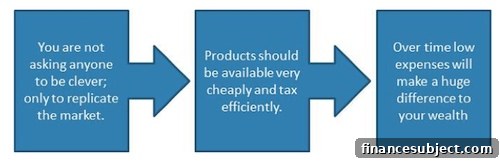
That’s not an argument for giving up. You don’t need to beat the market to succeed with investments. What matters is capturing the average returns of the major asset classes as cheaply and efficiently as possible.
I call people who accept this practical approach Rational Investors.
The way of the Rational Investor
In my book Investing Demystified, I outline how a Rational Investor behaves:
- Accept that you cannot reliably outperform the market and don’t assume you know someone who can.
- Build a portfolio of funds that track broad equity indices, exposure to higher-risk government and corporate bonds, and a holding of low-risk government bonds.
- Consider all your assets together in a single portfolio context.
- Reflect carefully on how much risk you can tolerate and plan accordingly.
- Use tax-efficient strategies where appropriate.
- Implement and maintain the portfolio with the lowest reasonable costs.
Keeping costs low is crucial for the Rational Investor. If you accept that beating the market is unlikely, it makes no sense to pay extra for the promise of outperformance. Your advantage over less rational investors is simply lower costs — and over time that can add up to a large difference in wealth.
Active management comes at a cost
Too few voices in finance highlight the importance of low fees for ordinary investors — perhaps unsurprising when those fees fund the industry itself. Fees are always relevant, but they become decisive when you’re aiming only to replicate market returns. You’re not asking a manager to be brilliant; you simply want reliable exposure to the market at minimal cost.
Because of this, the case for index-tracking products is strong: they should cost much less than active management.
Behavioral inertia keeps many investors in place or leads them to choose the familiar active funds. People will spend hours hunting for bargains on consumer goods but often accept expensive investment funds without question. Don’t fall into that trap.
The price of active management
The table below compares typical costs for an actively managed fund versus an index tracker that follows the same market.
| Active | Tracker | |||||
| Up-front fee | 2.00% 2 | 0.00% | ||||
| Annual | ||||||
| Management fee | 1.00% | 0.20% | ||||
| Other expenses 3 | 0.20% | 0.15% | ||||
| Trading costs: | ||||||
| Bid/offer | 0.35% | 0.25% 4 | ||||
| Commission | 0.15% | 0.10% 5 | ||||
| Price impact | 0.25% | 0.25% | ||||
| Transaction tax | 0.25% | 0.00% 6 | ||||
| Total per trade | 1.00% | 0.60% | ||||
| Turnover | 1.25x | 0.1x | ||||
| Total trading costs | 1.25% | 0.06% | ||||
| Additional taxes | 0.00% | (*) | 0.00% | |||
| —- | —- | |||||
| Annual cost | 2.45% 7 | 0.41% |
*Some very active strategies may incur additional taxes.
Front-end charges, once common, are becoming rarer. Still, as this example shows, you can save roughly 2% a year by choosing an index tracker over a typical active fund. That difference may seem small, but compound returns make it powerful over decades.
To illustrate, suppose you save 10% of a £50,000 income every year from age 25 to 67, investing aggressively in equities for this example. Assume a nominal return of 7% a year (derived from a 0.5% minimal risk rate, a 4.5% equity risk premium and 2% inflation).
After 42 years of disciplined investing, the cumulative effect of lower fees is substantial. In this scenario the index investor ends up about £643,000 better off than the investor who chose active funds — roughly £280,000 in today’s money after adjusting for inflation.
Even if you avoid a front-end fee, the long-term benefit to the index investor remains very large. For example, avoiding the up-front charge but paying higher annual fees still leaves a significant advantage for the low-cost tracker. And if the annual cost gap were 1.5% rather than 2%, the active route would still leave you several hundred thousand pounds worse off at retirement.
If you believe you have a reliable edge that can consistently overcome a 1.5–2% annual cost difference, you’re welcome to try. The evidence, however, favors the low-cost, market-tracking approach for most investors.
(I will cover which indices to track in a future piece.)
Note: Shouldn’t an active fund deliver higher returns? No — not reliably. Some active managers will outperform, but in aggregate active managers match the market before fees. It is the higher trading, management costs and other expenses that cause active funds to underperform index-tracking products after fees.
How to get an active manager’s sports car
By avoiding expensive active management you save meaningful sums over a lifetime. Imagine how much a few hundred thousand pounds more at retirement could improve quality of life or benefit your heirs.
Most of the investing public still uses active managers, either directly or via pensions. Over time, only a small fraction of those who choose active management will be lucky enough to pick managers who outperform net of fees. The rest pay large sums to the industry and retire with smaller portfolios as a result.
To put it bluntly: the extra fees paid by just one saver over a long investing lifetime could buy multiple luxury cars — a striking illustration of how much money flows to the industry through unnecessary costs.
Note: What about picking your own stocks? You don’t have to choose between an active manager and an index tracker. You can manage your own stock portfolio. But that choice still depends on whether you have an edge. For most people, selecting individual stocks without a proven edge is a losing strategy. Buying the market with index trackers is less hassle and more cost-effective for the majority.
Passive investing requires patience
Focusing on fees won’t give you overnight thrills. Index investors don’t chase stocks that double in a month. The benefits of lower expenses show up slowly but powerfully through compounding over years and decades.
Lower fees earn you “money while you sleep”: small advantages that build continuously. The early years show only a thin gap between an active and index approach. Over time, disciplined low-cost investing can result in a much larger retirement pot.
Ignore the siren songs of flashy managers
Once you appreciate compound interest, saving 2% or more in annual fees becomes significant. But it also requires discipline. In any single year you may not notice the fee difference amid market noise. Over the long run, however, lower fees usually translate into better outcomes.
Active funds will occasionally produce standout years, and successful managers will loudly promote those results. Don’t abandon a sensible index strategy unless you can clearly and convincingly demonstrate that you have a real, repeatable edge.
The odds are that you don’t — and by accepting that you’ll likely be wealthier in the long term.
Lars Kroijer’s Investing Demystified is available now. Lars is donating all his profits from the book to medical research.
- For UK investors, these would be UK government bonds, a.k.a. gilts.[↩]
- Do Not Pay This![↩]
- Audit, legal, custody, directors, etc.[↩]
- Rebalance at times of liquidity.[↩]
- Trackers don’t pay for research and similar costs.[↩]
- ETFs can often avoid stamp duty and similar transaction taxes.[↩]
- Or 4.45% annual cost if you pay an up-front fee.[↩]
- Some active funds have exit fees, though these are increasingly rare.[↩]