
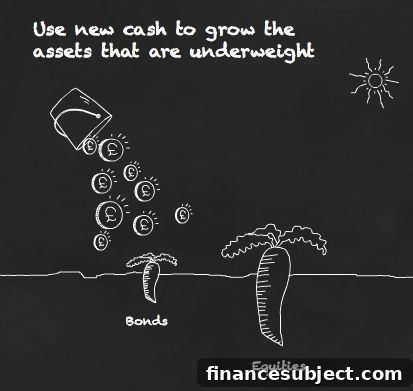
Investors with relatively small portfolios should rebalance using new contributions whenever possible to avoid letting trading costs erode their returns. Rebalancing with fresh cash is a simple, cost-effective way to restore your target asset allocation without paying both buy and sell fees.
Typical rebalancing advice tells you to:
- Sell assets that have outperformed.
- Buy assets that have underperformed.
But selling and buying the same pair of assets can mean paying fees twice: once to sell, once to buy. If your platform charges dealing fees for ETFs, shares, investment trusts or funds, those selling costs can be materially higher than the small purchase fees available through regular purchase plans. For example, you can often place new purchases for around £1.50 per trade on some plans, while selling may cost £5–£10 depending on your broker and the product. Rebalancing with new contributions avoids the selling leg entirely.
Why rebalance with new contributions?
When you put fresh money into your portfolio, you can allocate it to the assets that are below their target weights. This directs most of the new cash to underweight holdings and brings your overall allocation closer to your goal without incurring selling fees. The result: lower costs, less friction, and a tidier implementation of your long-term plan.
How to rebalance using new contributions
New contributions include any fresh cash you add plus recurring inflows such as dividend or interest payments. The process is straightforward:
- Add up the current total value of your portfolio before making purchases.
- Add the cash value of the new contribution to that figure to get the portfolio’s projected total after purchases.
- Apply your target asset allocation percentages to the projected total to determine the desired cash value for each asset.
- For each asset, subtract its current market value from its target value. The result is the amount of the new contribution you should allocate to that asset.
If the result for any asset is negative, the existing position is so overweight that even the new contribution can’t restore the target allocation. In that case you would need to sell an amount equal to the negative figure to rebalance fully.
A simple example
Current portfolio value = £10,000
New contribution = £5,000
New total portfolio value = £15,000
Target allocation = 60% equity, 40% bonds
Target values on a £15,000 portfolio = £9,000 equity, £6,000 bonds
Current values = £7,000 equity, £3,000 bonds
Amount of new cash to invest = £2,000 into equity, £3,000 into bonds
By directing the £5,000 new contribution into £2,000 of equity and £3,000 of bonds you return the portfolio to the intended 60:40 split without selling anything.
How often to rebalance this way
You don’t have to rebalance every single time you add money. Many investors choose a calendar-based approach — for example, rebalancing once a year — and then use the next 12 months of expected contributions to determine how much to allocate into each asset during that period. If you contribute monthly, monthly purchases serve as the practical mechanism for nudging allocations back toward target.
Perfect balance is rarely achievable except by chance, and that’s fine. Rebalancing to a range rather than to a precise target gives you flexibility and reduces trading costs. If you invest only in funds that avoid dealing fees for both buys and sells, you can be more active, but for most investors rebalancing once a year and using new contributions to top up underweight assets is a simple, low-cost strategy.
Finally, you can do the arithmetic yourself or use a rebalancing spreadsheet to automate the calculations if you prefer. The key takeaway: use new contributions to buy underweight assets and avoid unnecessary selling costs — it’s a small change that preserves capital and keeps your allocation on track.
Take it steady,
The Accumulator