
I have written extensively about return premiums—those so-called superheroes of passive investing that promise to outperform the market. But like any hero, they have weaknesses: circumstances in which they underdeliver or disappear right when investors expect them to save the day.
This article is an anti-hero guide. It highlights the key limitations and traps that can turn the comic-book fantasy of return premiums into a disappointing real-world outcome.
Looks good on paper
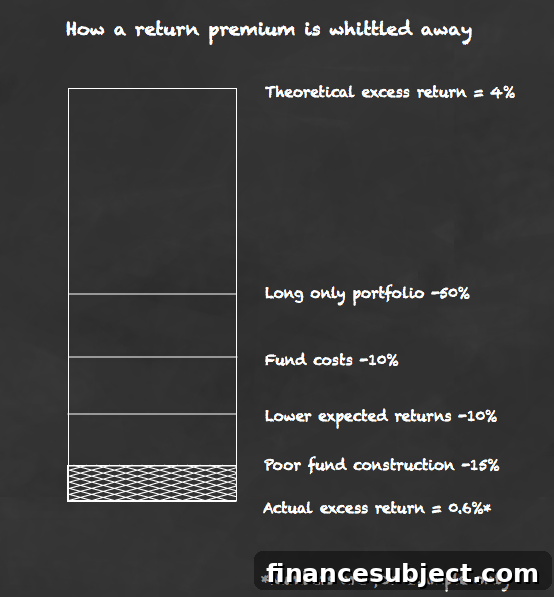
In academic studies the best return premiums (also called risk factors) have been shown to beat the market by roughly 4% per year. That’s an impressive number when presented in tables and charts.
However, those results come from academic simulations that assume conditions investors rarely face. The gap exists because academics are primarily testing financial theory rather than building practical investment products. Their models frequently:
- Use long-short portfolios
- Ignore trading costs and frictions
- Ignore taxes
Because of those assumptions, the headline numbers aren’t directly transferable to everyday, long-only investment products that most retail investors can access.
The long and the short of it
Most academic return premiums are demonstrated using long-short portfolios. These strategies buy stocks with desirable attributes and short-sell those with undesirable ones. For example, the value premium is typically illustrated as the return on high book-to-market stocks minus the return on low book-to-market stocks.
Retail investors in many regions, including the UK, usually only have access to long-only funds and ETFs. As a rule of thumb, long-only implementations often capture only about 50% of the academic premium because they can’t short the expensive side of a factor.
That halves our 4% hopeful premium:
4% × 0.5 = 2%
Next come real-world costs. Factor-focused funds tend to charge higher fees—typically in the range of 0.3% to 0.8%—because capturing a factor can require frequent turnover or exposure to less liquid securities. After subtracting an average cost, our remaining premium shrinks:
2% − 0.5% = 1.5%
Higher turnover strategies such as momentum or exposures to small, illiquid stocks increase trading spreads and slippage, eroding returns further. Worse still, many commercially available factor funds concentrate on large-cap stocks. Evidence suggests most of the value premium resides among smaller stocks: large-value U.S. equities may beat the S&P 500 by only around 0.5% per year, while small-value stocks have historically outperformed by a much larger margin—so a large-cap value fund may only capture a sliver of the total premium.
For example, if large-value returns are only 0.5% above the market, long-only capture cuts that to 0.25%, and an extra 0.2% cost for a factor fund reduces the realized premium to roughly 0.05%—a negligible result.
The size premium is particularly vulnerable because definitions of “small cap” vary widely between indices and funds. Tools like fund comparison utilities can help you identify what a given tracker actually holds and how closely it matches the factor exposure you expect.
No more heroes anymore
Another important hazard is crowding. When a factor becomes widely known and easy to access through funds and ETFs, large inflows can bid up the prices of the targeted securities, reducing future returns. This is a kind of self-inflicted problem: the more we make a premium available to the masses, the more capital chases it, the higher valuations climb, and the lower the future payoff.
Some practitioners now forecast much lower future returns for once-promising premiums. For instance, conservative estimates for the future small-value premium have dropped to the region of 1% per year. Academic research also suggests that discovery and commercialization of anomalies can reduce their effectiveness—one study estimates an average decline in returns of roughly 35% after an anomaly becomes widely known.
That doesn’t mean you should ignore return premiums. Factor-based investing can still be a useful part of a diversified, long-term portfolio. But you should have realistic expectations: the academic headline numbers are unlikely to fully survive real-world constraints, costs, and crowding.
Treat premiums as one tool in a broader passive investing toolbox, not as guaranteed superpowers. Expect modest, harder-to-capture advantages rather than cinematic levels of outperformance.
Take it steady,
The Accumulator
- The reality is more nuanced, depending on the specific premium, as academic studies explain.[↩]