
The life expectancy for a couple is significantly longer than for each partner individually — often by more than a decade. If you’re responsible for a retirement plan that must support two people, you need to understand the odds that one or both of you will live to an advanced age. Long lives can drain a portfolio as quickly as an old phone drains battery: slowly but relentlessly.
We’ve already discussed how to find reliable life-expectancy data for individuals, but planning for two people together requires a different approach. Combining survival probabilities gives a clearer picture of the financial horizon you should plan for.
Survival probability
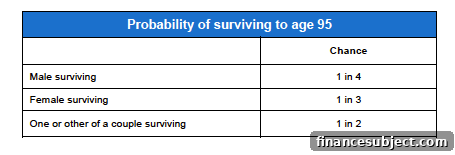
It’s a mistake to treat each partner’s life expectancy in isolation when you share finances. Research from a retirement study by Dr Paul Cox (Birmingham Business School) illustrates this well for heterosexual couples.
Source: Helping consumers and providers manage defined contribution (DC) wealth in retirement, 2015. Dr Paul Cox.
For example, the chance that at least one partner still needs income at age 95 is much higher than the individual probabilities for each gender. The combined survival probability matters because even if one partner passes away, the survivor will still need income — and often needs nearly as much as the couple did together.
The Cox study shows that for a UK couple born in 1950 who reached 65, the odds that one partner is still alive at advanced ages are substantial. For Gen X couples born in 1970, the Longevity Illustrator-style calculations suggest:
- Age 95 – approximately 60% probability that one partner survives
- Age 100 – approximately 36% probability that one partner survives
Cox estimates the probability of at least one member of a couple surviving to ages like 95 and 100 is rising over time — roughly 3% every five years. That means planning horizons that once seemed conservative may now be realistic necessities.
Given these odds, you may want to adopt a pragmatic tolerance for failure. For example:
“We’ll plan for a 50-year retirement because we accept a 10% chance that one of us will live beyond that, and a 90% chance that neither of us will.”
That acceptance then needs to be translated into a personalised projection for your shared life expectancy.
Enter the Longevity Illustrator
Tools such as the Longevity Illustrator use Social Security data to build survival probability estimates for couples. They aren’t crystal balls, but they provide useful, plausible time horizons for retirement planning.
By entering ages, genders and health information you can generate survival charts and tables showing the probability that either partner or both partners will still be alive at different future ages. That helps you gauge how long your portfolio might need to provide for one or two people.
Here’s a representative table for an everyday planning pair — a retirement-minded partner and their spouse:
With an acceptable failure rate set at 10%, the table might show a 10% chance that one partner survives 50 years beyond retirement, and roughly a 10% chance both survive about 42 years. That suggests you should size a portfolio and choose a sustainable withdrawal rate (SWR) to support two incomes for at least that duration if you want a high degree of confidence.
It’s sobering to see there may only be a 50% chance both partners survive 30 years — a reminder to make the most of the years you do have together.
Dr Cox’s UK context highlights how coupleship changes with age: between 80 and 84, two-thirds of men but only about one-third of women are in a couple; after 85 the proportion drops further for women because of the higher number of widowers. That shift affects income and living standards when a partner dies.
You can find appropriate mortality tables for your birth year and calculate more personalised probabilities if you want to get technical. For many people, the next practical steps are adjusting withdrawal rates and portfolio allocation to match the likely time horizon.
If you expect to draw from your investments for more than 30 years, consider reducing your SWR. There is solid evidence that a higher equity allocation can help wealth last 40–60 years, though it brings volatility along the way.
What does failure look like?
“Failure” rarely means instant poverty; running out of money depends on two events happening together:
1. Your portfolio depletes under your chosen withdrawal strategy.
2. One partner is still alive to experience the shortfall.
For example, if there’s a 10% chance one partner survives 50 years and a separate 10% chance the portfolio fails under your SWR, the combined probability of both events occurring is about 1% (0.1 × 0.1 = 0.01). That implies a 99% chance of avoiding both events together, assuming the inputs are accurate.
Even a low-probability failure doesn’t necessarily mean destitution — it usually means adjusting spending downwards later in life. In many cases the surviving partner’s expenses fall naturally, though not by half; single households typically need more than half the income a couple required to maintain the same standard of living.
Marriage, divorce and widowhood all affect retirement finances. Divorce later in life can reduce retirement income, and many people will receive minimal increases to the new State Pension if their partner dies, so don’t rely on that as the main safety net.
If your data points to long lives, consider putting an annuity review on your to-do list in your early seventies. Annuities remain the most efficient way, apart from the State Pension, to buy guaranteed lifetime income. They have trade-offs and are not right for everyone, but for those who live well into their eighties an annuity can be an effective solution.
Take it steady,
The Accumulator
Bonus appendix: Survival probability calculation for a couple
Here’s a simple way to calculate couple survival probabilities for an example 50-year horizon:
Suppose Jill has a 25% chance of being alive in 50 years, and Jack has a 10% chance.
Probability both are alive: 0.25 × 0.10 × 100 = 2.5%
To find the chance at least one is alive, calculate the scenarios where one survives and the other does not:
Jill alive, Jack not: 0.25 × 0.90 × 100 = 22.5%
Jack alive, Jill not: 0.10 × 0.75 × 100 = 7.5%
Add those plus the both-alive probability: 2.5% + 22.5% + 7.5% = 32.5% chance at least one partner is alive in 50 years.
Use these simple calculations alongside mortality tables and planning tools to set realistic retirement horizons and withdrawal strategies for couples.