
Highlights that caught my attention this week.
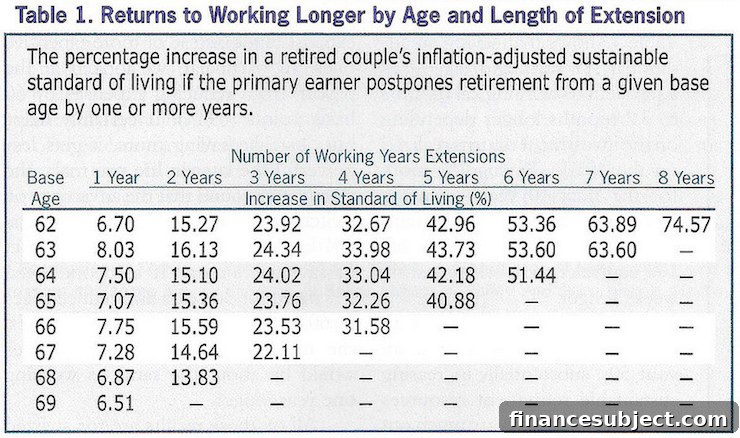
The relaunched US personal finance site Get Rich Slowly published compelling data on the advantages of delaying retirement by a year or two. The piece frames the gains not just as a larger nest egg but as an improvement in standard of living — a useful way to think about the trade-off of working longer.
One chart in particular illustrates how a single extra year of work can boost lifetime spending power:
It’s worth noting that UK and US retirement systems differ, so readers outside the US should interpret the numbers with care. Another important point the original article glossed over is simple arithmetic: the fewer years you expect to spend in retirement, the more each pound can support your lifestyle. Retirement savings are finite, and the length of retirement matters.
Even so, the core message is valuable: working a little longer can meaningfully increase your lifetime spending. That modest extension is often dismissed — especially by some adherents of the FIRE (Financial Independence, Retire Early) movement who favor an all-or-nothing exit — but for many people it’s a pragmatic choice worth considering.
Retirement Investing: One year can change everything
Take the case of Retirement Investing Today, who reported that working an extra year produced about £300,000 more than his £1 million target. That translates to roughly an extra £12,000 a year in retirement income — effectively a lifetime boost to spending power.
That kind of jump isn’t magic. It came after a decade of focused effort: advancing a career, saving aggressively, and investing consistently. For many readers the scale of that achievement will feel out of reach, but it’s the result of deliberate, sustained choices rather than a lucky windfall.
I supported his decision to work an extra year because it made sense to capitalize on a rare position. Once you’ve reached financial independence, the urge to tap an emergency or “F.U.” fund often fades. That last year at work may be less stressful and more deliberate than the years that came before.
Context matters. If you’re pursuing early retirement on a modest income, your plan must match your means. Conversely, someone with a substantial portfolio who takes a low-paid job could sensibly retire sooner. The point is that a small extension of working life can have a large impact on lifetime spending, especially for those who are already saving heavily.
I also think those who do retire early should consider keeping a small, paid engagement — even one day a week — if it suits them. Having some income can ease pressure, provide structure, and make it easier to enjoy discretionary spending. There’s no one-size-fits-all answer, but flexibility often pays off.
A little extra spending money goes a long way. You don’t need to be fanatic about frugality to benefit from modest additional earnings.
From Monevator
The Slow and Steady passive portfolio update: Q2 2018 – Monevator
From the archive-ator: Find out when you’ll make your million – Monevator
News
Note: Some links lead to search results. On desktop you may be able to view full articles without a subscription; privacy/incognito mode can help avoid some paywalls. Consider subscribing if you read these sources regularly. 1
Government borrowing is at an 11-year low – BBC
…but weak growth and tax receipts could squeeze the Chancellor – Guardian
Councils introduce landlord licensing schemes costing up to £1,000 – ThisIsMoney
Radical proposals to reduce the cost of buying a freehold – Guardian
Four-day workweek trial declared an “unmitigated success” – Guardian
Flat prices unchanged for a year, says ONS – BBC
Big Mac index suggests the US dollar is overvalued against the pound – ThisIsMoney
Cullen Roche on how the biggest perceived risk to the bull market has shifted – via Twitter
Products and services
Birmingham Midshires launches three competitive savings deals – ThisIsMoney
Concerns about ATM “deserts” lead to scaled-back fee cuts – Guardian
Ratesetter’s £100 bonus effectively boosts returns on £1,000 to about 13% – Monevator – Ratesetter [Affiliate link]
Know your rail compensation rights after commuter disruption [Search result] – FT
How to cut energy bills as prices rise – ThisIsMoney
Larry Swedroe: Why hedge funds are still trailing – ETF.com
Comment and opinion
Bonds behaving badly (Canadian perspective but relevant) – Canadian Couch Potato
Barry Ritholtz: Slower inflows to passive funds are not a crisis – Bloomberg
Merryn Somerset Webb on investment platforms [Search result] – FT
Understanding the yield curve as an economic indicator – Financial Samurai
“The market is rolling simply because it’s rolling” – a vintage market aphorism – A Wealth of Common Sense
It’s always a remix – The Reformed Broker
Gold bugs versus stock market bulls – Charlie Bilello
The bottom and the top in market cycles – The Irrelevant Investor
Priced out of parenthood: the economic pressures on having children – Guardian
Choosing an active fund manager: things to remember – Behavioural Investment
When will socially responsible investing become mainstream? – Quartz
Why mutual funds can’t be hedge funds – Morningstar
Four rules for selling shares – UK Value Investor
Five lessons from Howard Marks – The Value Perspective
Don’t dismiss factor investing yet – Bloomberg
Deep dive for investing nerds: “It was you, Charley” – Epsilon Theory
Kindle book bargains
Einstein: His Life and Universe by Walter Isaacson – £0.99 on Kindle
Alan Sugar: What You See Is What You Get by Alan Sugar – £0.99 on Kindle
The Honourable Company: History of the English East India Company by John Keay – £1.99 on Kindle
Moon Over Soho (a Rivers of London novel) by Ben Aaronovitch – £0.99 on Kindle
Brexit
An A–Z lexicon of Brexit: From Anxiety to Zuckerberg – Guardian
Brexit developments and commentary – DIY Investor
Fruit left to rot amid labour shortages – BBC
Prime Minister urges the EU to evolve its Brexit stance – BBC 2
Tory MP Anna Soubry criticises wealthy Brexiteers [Video] – BBC
Off our beat
Time is your most valuable asset – Of Dollars and Data
Do these 13 habits daily to boost productivity – Ryan Holiday
Always attend the funeral — wise advice worth revisiting – Epsilon Theory
The age of floating transport — Citymapper’s perspective – Medium
What really happened with Elon Musk’s Thai cave rescue involvement? – Quora
And finally…
“Basically, CEOs have five essential choices for deploying capital – investing in existing operations, acquiring other businesses, issuing dividends, paying down debt, or repurchasing stock – and three alternatives for raising it – tapping internal cash flow, issuing debt, or raising equity. Think of these options collectively as a tool kit. Over the long term, returns for shareholders will be determined largely by the decisions a CEO makes in choosing which tools to use (and which to avoid) among these various options. Stated simply, two companies with identical operating results and different approaches to allocating capital will derive two very different long-term outcomes for shareholders.”
– William Thorndike, The Outsiders
Like these links? Subscribe to get them every Friday!
- Some articles are only accessible through search results on desktop (mobile/tablet views may trigger paywalls). To work around this, switch your mobile browser to desktop mode. On Chrome for Android: press the menu and select “Request Desktop Site”.[↩]
- Or 450 million if you exclude Britain[↩]