
The first page of a Google search for the 60/40 portfolio paints a worrying picture: headlines suggest the 60/40 needs to be “rethought,” “may not have a future,” or simply isn’t “good enough” anymore.
So is the 60/40 portfolio dead or dying? Should investors abandon a Vanguard LifeStrategy 60 fund or any other classic 60% equities / 40% bonds allocation?
There is certainly cause for concern, but the alarmist media coverage mixes a kernel of truth with a lot of opinionated clickbait and poor advice. Let’s cut through the noise and focus on what really matters.
There are legitimate reasons to be cautious today. In this article I’ll outline the scale of the issue; in the follow-up piece I’ll examine sensible ways to respond.
What is a 60/40 portfolio? The classic 60/40 portfolio allocates 60% to equities and 40% to bonds. The equity portion aims to capture long-term growth from global stock markets, while the bond portion—typically high-quality government bonds—provides diversification and downside protection. The approach is rooted in Modern Portfolio Theory and became a default for advisors, workplace pensions, and DIY investors due to its simplicity, historical performance, and balanced risk/return profile.
Why the 60/40 might be underpowered now
There are several reasons the traditional 60/40 allocation may deliver weaker results over the coming decade. High equity valuations have historically correlated with lower subsequent returns over five to ten years. At the same time, government bond yields—which often indicate future bond returns—remain very low.
The US equity market dominates global indices and is trading at elevated valuation metrics such as the cyclically-adjusted price-to-earnings ratio (CAPE). Meanwhile, many government bonds still show negative real yields after inflation. Combined, rich equity valuations and low or negative bond real yields do not bode well for the classic 60/40 outcome.
Managing expectations with expected returns
The financial industry expresses these concerns through expected return forecasts, typically projecting average annualised returns over a 10-year horizon. Current estimates for a 60/40 mix fall well below its historical performance, and look particularly poor compared with the strong returns of the past decade.
Below I compare several credible expected-return forecasts and show a simple method to compute your own estimate. I’ll also discuss how reliable these forecasts tend to be.
Industry forecasts for the 60/40
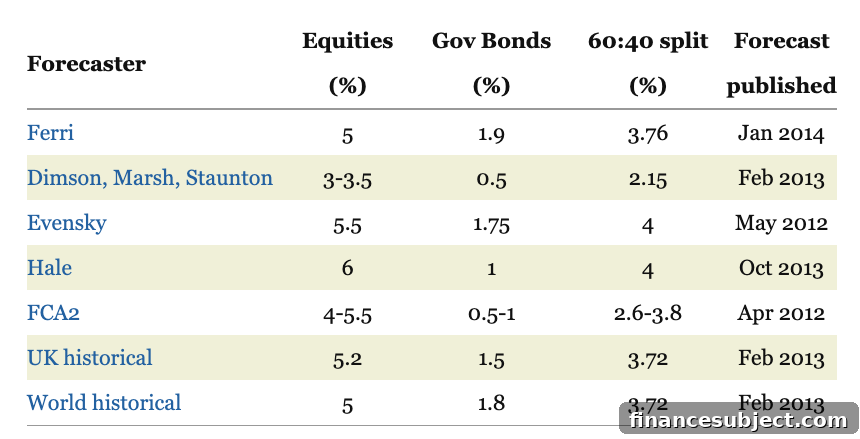
Here are three 10-year annualised real-return forecasts for a 60/40-style portfolio from established sources:
Vanguard: 2.6% real (4.6% nominal)
Vanguard’s median nominal expected return for a global portfolio is 4.6%. Subtracting an approximate 2% inflation assumption yields a 2.6% real return.
Dimson, Marsh, Staunton: 1.6%
The respected academics provide a low single-digit real forecast. They do not always specify exact portfolio weights or ranges in short summaries, but their long-run work typically uses developed-world equities and long government bonds as reference points.
Research Affiliates: 0.58%
This estimate, calculated from Research Affiliates’ expected-return tool for a global equity and gilt mix, is the most pessimistic of the three.
How to estimate expected returns yourself
If you prefer to do your own maths, you can estimate a 10-year real return for a 60/40 portfolio by combining simple equity and bond projections.
Equities
1) Use a valuation-based approach such as the Gordon Equation. 2) Start with the current dividend yield for the main equity fund in your portfolio (or a weighted average of funds). 3) Add a consensus real earnings growth estimate.
Example: Vanguard FTSE All-World ETF dividend yield ≈ 1.38%. Add a 1.4% real earnings growth estimate to get ≈ 2.8% real annual return for the equity portion.
Bonds
1) Take the 10-year gilt yield (a nominal figure). 2) Subtract an assumed average inflation rate to convert it to a real yield.
Example: 10-year gilt yield ≈ 1.0% minus a 2.0% inflation assumption = –1.0% real expected return for the bond portion.
Combine the two as a weighted average: 60% × 2.8% + 40% × (–1.0%) = 1.28% real annualised for the 60/40 portfolio in this simplified model.
A range of disappointing forecasts
Putting the numbers together gives a range of expected real returns for a 60/40 portfolio:
- Vanguard: 2.6%
- Dimson, Marsh, Staunton: 1.6%
- DIY example above: 1.28%
- Research Affiliates: 0.58%
The long-term historical average real return for a 60/40 portfolio is around 3.4%, so even the midpoint forecasts represent a substantial decline from history. The contrast is starker if you anchor to the last decade: a fund like Vanguard LifeStrategy 60 delivered about 8.9% nominal annualised over the past ten years (roughly 6.5% after inflation), far above these expected-return figures.
How reliable are these forecasts?
Forecasts are often wrong. Historical examples show many 10-year expected-return estimates missed the mark—sometimes by a wide margin. Forecasting equity returns is challenging: studies show even the better metrics explain only part of the variation in future returns. In short, expected returns are useful as guides, not certainties.
That said, widespread warnings from credible institutions deserve attention. The signals pointing to weaker future returns today are stronger than those a decade ago, so prudence is warranted.
So what should investors do?
There is no one-size-fits-all answer. A 60/40 portfolio could still perform reasonably, but investors should be aware that future returns may be lower than historical norms. If you’re concerned, take measured actions rather than panicking into faddish strategies. In the next article I’ll review practical, non‑destructive options you can consider to adjust risk, diversify, or set more realistic expectations.
Take it steady,
The Accumulator
- Real returns subtract inflation from your ‘nominal’ investment results. Real returns are a more accurate portrayal of your capital growth in relation to purchasing power than standard nominal returns.[↩]