
This post is one of a series reflecting on returns in the decade after the financial crisis.
Many leading proponents of passive investing — authors and advisers such as Paul Merriman, William Bernstein, Larry Swedroe, Rick Ferri, and Michael J. Mauboussin, along with Tim Hale (though not John Bogle or Lars Kroijer) — have long argued that investors can potentially boost long‑term returns by adding exposure to well‑known return factors: value and small‑cap stocks.
Implementing those ideas has never been easier. A portion of a portfolio can be tilted toward cheaper, out‑of‑favour companies (value equities) or toward smaller companies (small caps) via broadly available index funds and ETFs. The theory and historical studies suggest these tilts should deliver higher returns over long horizons, but they also come with higher risk and longer stretches of underperformance than many investors expect.
I read the books and I understood the warnings about patience. That was useful, because that is exactly what I experienced: a long period of disappointment from my own value allocation.
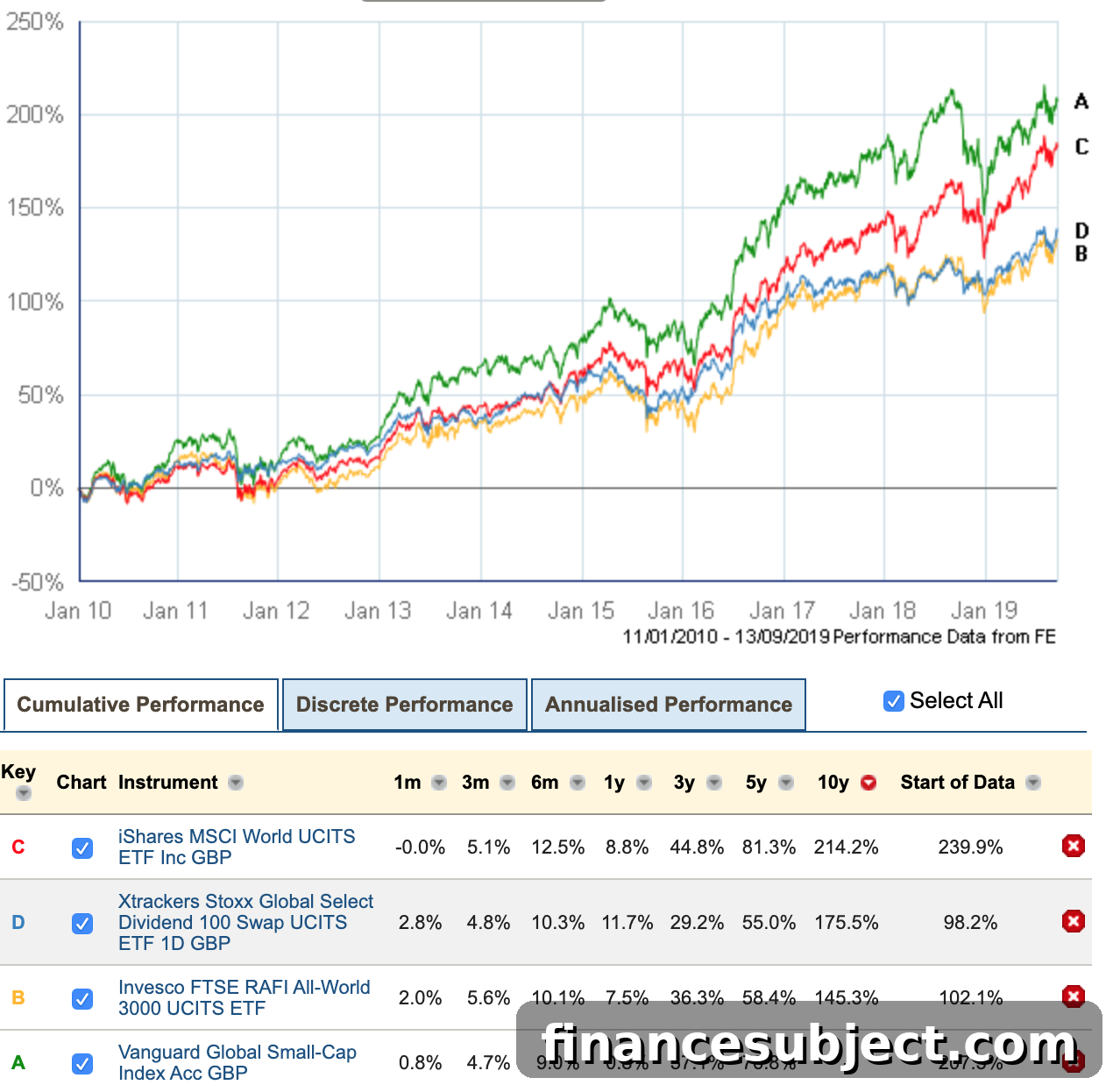
Trustnet supplies the chart that tells our story1:
In my case the disappointment came from the value factor, represented in the chart by the Invesco FTSE RAFI All‑World 3000 ETF (yellow line). Over the period shown it managed an annualised return of about 9.4%, lagging the MSCI World Index’s roughly 12.1% (red line). That performance is a reminder that factor premiums don’t arrive on a neat, predictable schedule — they can be muted for an entire decade or more.
Small‑cap exposure told a slightly different story. Vanguard’s Global Small Cap index fund (green line) wasn’t launched until January 2010, but it has marginally outperformed the MSCI World since its inception. That suggests small‑cap premium potential may still exist, at least in part, even after factor investing has grown in popularity.
Of course, a decade is only one stretch in a much longer investing lifetime. Academics and practitioners emphasize that value and size premiums are long‑term phenomena that can fail to materialise for ten, twenty years or longer. Knowing that from books is different from living through it with your own capital: you feel the impact much more personally when your portfolio underperforms for an extended period.
Voices like Rick Ferri have reminded investors that factor tilts should be viewed as multi‑decade commitments. Others, including Jack Bogle, have cautioned that implementing active tilts can introduce higher fees and complexity without guaranteed reward. These are important trade‑offs: taking on more concentrated risk in pursuit of higher expected returns requires both conviction and the ability to endure long stretches of underperformance.
I won’t pretend otherwise — it stung. But that is part of investing reality. The potential premium comes with volatility and patience as the price of admission. So here’s to hoping the next decade brings fewer disappointments and more of the extra returns theory promises.
Dividends didn’t quite deliver either
Another approach that failed to shine over this period was dividend‑focused investing. At the time a global high‑dividend tracker was a common choice for income‑seeking investors who were disappointed by low bond yields after the Global Financial Crisis. However, concentrating on high‑yielding stocks typically biases a portfolio toward older, more mature companies that may offer less capital‑growth potential.
Over the decade, our example high‑dividend ETF returned about 10.7% annualised, again below the MSCI World’s roughly 12.1%. That outcome underlines a familiar investing lesson: chasing yield alone can leave you behind in terms of total return. Dividends are an important component of long‑term returns, but a narrow focus on dividend yield can sacrifice growth and result in lower overall performance.
Investment strategies that sound attractive in theory — tilting to value, buying small caps, or chasing high dividends — each carry real costs and risks. They can work over long time horizons, but they can also underperform for an extended period. The right approach for any investor depends on their objectives, time horizon, risk tolerance, and willingness to stick with a strategy through difficult stretches.
Until next time, take care,
The Accumulator
We’ll continue to look back over the last ten years to assess how other passive‑friendly strategies have performed. Subscribe to get all the posts.