
This post is one of a series looking at returns in the decade after the financial crisis.
Professional forecasters had a field day in 2009. Predictions always sound most convincing when the world seems to be falling apart, and in the wake of the crisis the ETF industry was ready to offer products that matched every plausible growth story. A broad range of focused ETFs let investors place bets on the trends that looked most likely to shape the next decade.
What connects the trackers in this article is that each offered exposure to a widely discussed structural theme by 2009: the digital economy, ageing populations, water scarcity, clean energy, timber, infrastructure and precious metals. Below I compare how those sector bets performed versus a plain MSCI World index tracker (the black line A in the original charts).
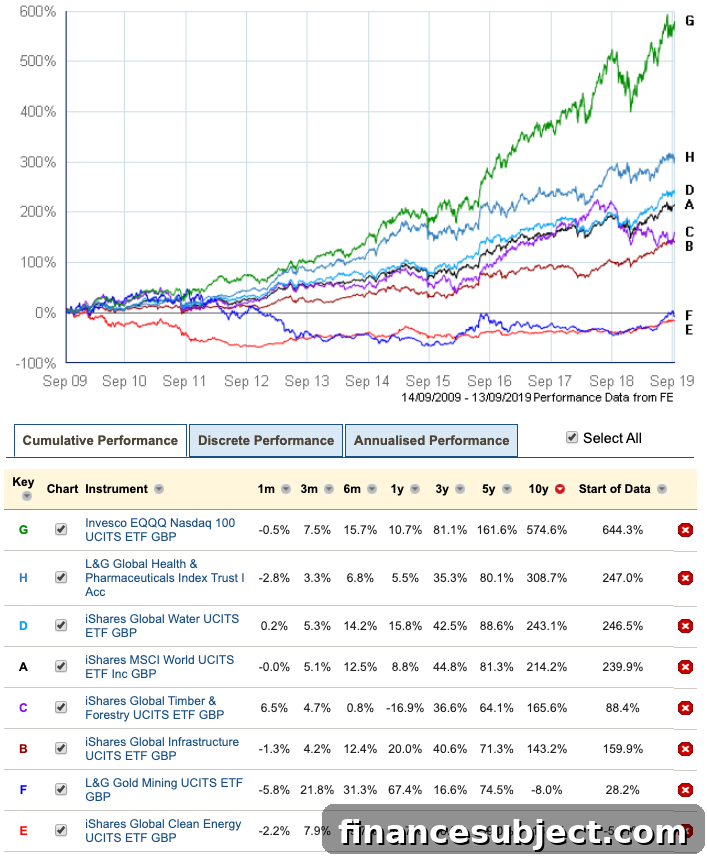
You didn’t have to be a visionary to see that the digital economy was expanding rapidly. The biggest technology companies were already automating processes and reshaping industries. If you had expressed that view via Invesco’s Nasdaq 100 ETF, with its strong bias to big tech, you would have been richly rewarded. Over the decade that ETF produced roughly 21% annualised returns — about a 574% cumulative gain — far outpacing both the S&P 500 and the MSCI World.
That outcome is a useful reminder that even widely acknowledged trends can still deliver outsized returns when a handful of dominant companies capture the lion’s share of market gains. It’s also a warning: expensive-looking growth stocks can keep outperforming for long stretches.
Demographics was another dominant theme. An ageing global population seemed to point to rising healthcare spending and long-term demand for pharmaceuticals and medical services. L&G’s Global Health & Pharmaceuticals Index Trust rewarded investors handsomely, returning around 15.1% annualised over the ten years. In this case, a consensus view translated into strong returns.
The water theme combined population growth with environmental stress. The iShares Global Water ETF, which targets companies involved in water infrastructure and technology, slightly outperformed the MSCI World, delivering roughly 13.1% annualised and ending the decade ahead of the broad world index.
Not all climate- or environment-related themes succeeded. The iShares Global Clean Energy ETF, for example, lagged over the decade and finished with a negative annualised return of about 1.7%. Despite headlines about wind and solar growth, the clean-energy equity basket underperformed — a reminder that media attention is not the same as investment return.
Timber was an idea I almost bought into. The rationale was that forestry and related businesses could offer diversification: returns partly driven by biological growth cycles, commodity prices and political factors rather than by the business cycle. In practice the iShares Global Timber & Forestry ETF tracked world equities closely rather than diversifying them. On a ten-year basis it underperformed the MSCI World, producing roughly 10.3% annualised versus about 12.1% for the world index. One practical issue is that many companies in the timber ETF are more focused on processing and downstream activities than on ownership of standing timber, which reduces the pure-commodity diversification some investors expected.1
Infrastructure was another crowded theme. The post-crisis narrative that governments and emerging markets would spend heavily on roads, airports and energy projects should have supported this sector, but the infrastructure ETF I reviewed failed to beat the MSCI World over the decade.
Finally, gold miners — and precious metal equities more broadly — present a distinct case. Over the decade the L&G Gold Mining ETF had a slightly negative annualised return, but that tells only part of the story. Precious metal equities have historically offered low correlation with broad equities, and when they fall hard they can later recover spectacularly. They also carry extreme volatility.
Between 1963 and the early 2000s, precious metals equities experienced several severe drawdowns. There were multiple losses exceeding 35%, and for long stretches the real return was effectively nil or negative. That history suggests these stocks can wither away for years before reverting to any long-term mean.
Because of this volatility, some investors have argued that a small allocation to gold mining equities can produce a rebalancing bonus: buy when the sector collapses and sell when it surges. The practical difficulty, however, is whether most investors have the discipline to stick with such a volatile holding through large and sustained losses.
Trustnet’s discrete annual returns for the last five individual years of the decade show how extreme the swings can be for gold mining equities. In that period the L&G Gold Mining ETF was either the best or worst performer among the selected ETFs in each year. The table below illustrates those swings compared with the iShares MSCI World ETF.
| Year | L&G Gold Mining ETF return (%) | iShares MSCI World ETF return (%) |
| 2018-19 | -35.8 | 0.7 |
| 2017-18 | 133 | 24.3 |
| 2016-17 | -5.5 | 19 |
| 2015-16 | -26.3 | 11.9 |
| 2014-15 | 67.4 | 8.8 |
Source: Trustnet
Out of the sector strategies reviewed, I’d say precious metal equities are the only one that deserves serious consideration as a potential diversifier — but only for investors who can tolerate extreme volatility and the psychological stress of deep drawdowns. If you cannot afford to lose the money you allocate or lack the discipline to rebalance through steep losses, this is not the place to experiment.
In short: some consensus themes delivered excellent returns over the decade, notably big tech and healthcare; others disappointed despite plausible narratives. Sector ETFs can outperform the broad market, but they can also underperform badly. For most investors, a core allocation to a low-cost MSCI World tracker, supplemented with small, well-understood tilts for conviction or diversification, remains a pragmatic approach.
Take it steady,
The Accumulator
We’ll continue the ten-year retrospective to examine how other passive-friendly strategies have fared. Subscribe to get all the posts.
- Note: On a look-through basis the timber ETF’s holdings are only partly exposed to standing trees. Many companies in the index focus on wood processing facilities and other downstream activities, which reduces the ETF’s sensitivity to timber prices and the pure diversification some investors expect.