
Good reads from around the web.
I was saddened to learn this week that Jim Slater has died at the age of 86.
For more than five decades Slater was a prominent figure in the UK investing world. His influence on private investors and on British stock-picking culture was significant, and his passing leaves a gap.
Unlike the United States—where names like Peter Lynch and Warren Buffett became widely known—Britain has produced fewer celebrity investors. A few, such as Antony Bolton, have written books and attracted attention, but the UK rarely turns money managers into mass-market personalities.
Today many of the country’s top active investors remain private, preferring to operate out of sight. They do not usually share the practical guidance that Slater made his hallmark.
Investing made accessible
Jim Slater stood out because he explained investing in plain, practical terms. He rose from modest beginnings at a time when the City was dominated by old networks, and he championed a systematic, evidence-based approach to stock selection when tip-driven investing was the norm.
He began publishing investment ideas in the 1960s and later reached a broad readership with his best-known work, The Zulu Principle, a handbook for identifying growth stocks.
When the types of companies Slater described are in favour, his Zulu method can perform exceptionally well, and it has inspired a number of successful followers—among them his son Mark, who manages a fund built on those principles.
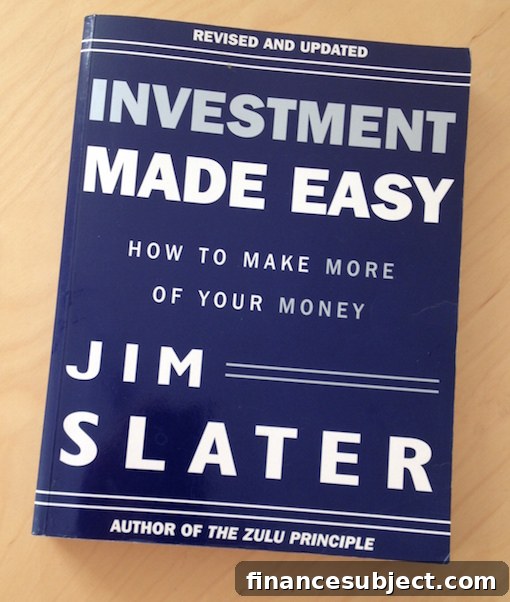
Personally, my introduction to Slater’s ideas came from a more modest book, Investment Made Easy, which I bought in the mid-1990s. That practical primer covered inflation, bank accounts, funds, shares, common investing ratios, and even the pros and cons of home ownership.
A book that changed my life.
Investment Made Easy felt like a guidebook to a new world of financial thinking. I returned to it years later when putting together a series on investing for beginners, and I still find Slater’s observations on bull and bear markets useful—often more illuminating than many numerical indicators.
One practical recommendation that stuck with me was his view on the tax benefits of owning a home in the UK. It’s rare to find an investing author who advises readers to consider buying a house as part of financial planning, yet Slater placed such real-world choices at the centre of his counsel.
Fluctuat nec mergitur 1
Not everyone knew the full arc of Slater’s career. Some investors remember him for the corporate restructuring and deal-making of the 1960s and 1970s—activities that later drew criticism and helped create his controversial reputation among certain circles.
Slater’s business ventures in that era eventually failed under heavy debt, and accusations were circulated at the time, although some were dismissed. That past is part of his complex legacy, yet it doesn’t erase the practical education he provided to countless private investors.
Even later in his career Slater promoted active strategies involving leverage—his original book was revised at one point to show how an interest-only mortgage and an equity ISA could, with risk, accelerate wealth creation. Some readers adopted those techniques; others considered them too aggressive.
Passionate even at 80
I had the chance to meet Slater at a private-investor conference a few years ago. He was warmly received, engaged with the audience, and still sharp enough to discuss small-cap stocks by name. At the time he was interested in gold miners—another reminder that even veteran investors continue to explore different ideas.
I’ve also met his son Mark and found him thoughtful and committed to the Zulu approach. They are different personalities, but the family’s influence on UK stock picking endures.
My condolences to Mark and the rest of the Slater family.
From the blogs
Curated reading and useful links on investing and personal finance.
Passive investing
- UK investors are decades behind the US [Video] – T.E.B.I.
- Five things Smart Beta won’t do for you – The Reformed Broker
- ‘Fading affect bias’ and bear markets – Bason Asset Management
Active investing
- Making predictions is easy. Managing money is hard – A Wealth of Common Sense
- What’s gone wrong with Rolls-Royce? – Richard Beddard
- Dying unicorns – Investing Caffeine
- Strive to be good if you want to be great – The Reformed Broker
- Is your smartphone hurting your returns? – Abnormal Returns
- Imperial Tobacco’s debt-fueled dividend growth – UK Value Investor
Other articles
- Understanding bond duration and risk – Vanguard
- Focus, festivity, and flow – Mr Money Mustache
- How to manage Christmas expenses – Simple Living in Suffolk
- Cord-cutting and savings – SexHealthMoneyDeath
- Market noise in a single observation [Tweet] – Morgan Housel
Product of the week: The Telegraph’s survey highlights Secure Trust Bank’s new 120-day notice account, paying 1.91%.
Mainstream media money
Selected mainstream coverage and analysis on investing and markets.
Passive investing
- Where Vanguard leads, fees fall – MarketWatch
- Why stock pickers tend to underperform: the maths – Bloomberg View
- Putting valuation metrics in perspective – ETF.com
Active investing
- Three lessons from Yale’s endowment – Morningstar
- Has the share buyback boom hurt long-term investment? – Reuters
- Are asset-light giants like Facebook changing investment horizons? – Telegraph
- Why Nike should consider buying Lululemon Athletica – Bloomberg
- A one-person venture capital approach – TechCrunch
- Ten high-conviction ideas from top US stock pickers – Morningstar
- Could supermarkets become major dividend payers? – ThisIsMoney
Other reading worth your time
- Fund costs and charges explained [Search result] – FT
- Speculation around CGT changes – ThisIsMoney
- First crowdfunding outcomes: winners and losers – Telegraph
- Why the booze cruise to Calais is back – Guardian
- Debate over foreign buyers of UK property – Guardian
- An interview with Ben Bernanke [Podcast] – Wall Street Week
Book of the week: Martin Ford’s Rise of the Robots, winner of the 2015 Financial Times and McKinsey Business Book of the Year, examines automation and the risks it poses to jobs.
Enjoy these links? Subscribe to receive a weekly digest of curated investing and personal finance reads.
- ‘Tossed but not sunk’ – the motto of the indestructibly beautiful city of Paris.[↩]
- Note: some articles may be accessible only via desktop search results due to site subscription barriers on mobile. To view, switch your mobile browser to request the desktop site. [↩]