
Good reads from around the web.
I don’t believe active investing will inevitably swallow most of our savings like some great whale scooping up krill. Still, trends matter: the movement toward passive investing is clear.
The reasons are familiar:
- Low-cost index funds and trackers offer undeniable advantages in fees and simplicity.
- Active investing is effectively a zero-sum game once costs and fees are accounted for.
- For many investors, combining a global equity index tracker with a bond tracker is a simple, hard-to-beat portfolio.
There are, however, important caveats.
A large share of passive fund growth has been through ETFs, and much ETF trading is active. So the headline growth in passive assets can mask continued active trading. Radio 4’s Moneybox (which I listen to after writing these round-ups) also reminds me that many people still fall for bad financial advice — stories of savers losing life savings to phone scams, chasing unrealistic guaranteed returns, or piling into speculative booms are depressingly common.1
Hedge funds are another puzzle. Despite weak aggregate performance for many hedge strategies, they still manage significant assets — a reminder that capital flows don’t always follow logic. If the wealthy will direct capital into questionable places, why shouldn’t the rest of us choose alternative approaches?
And then there’s the reality that conspicuous consumption — lavish homes, ostentatious cars, elective surgery — often accompanies great wealth. ‘Discerning buyer’ is not always the adjective that comes to mind.
The world’s greatest active investors
Whether passive investing will ultimately sideline active management is still uncertain. But even if active strategies hold only a minority of assets, there will always be people who try to beat the market personally.
This blog reflects that tension. I’m well-informed about the case for passive investing — having championed it for years — yet I still run an active portfolio myself. That contradiction is intentional: I understand the evidence but remain fascinated by finding market opportunities and testing my own analysis.
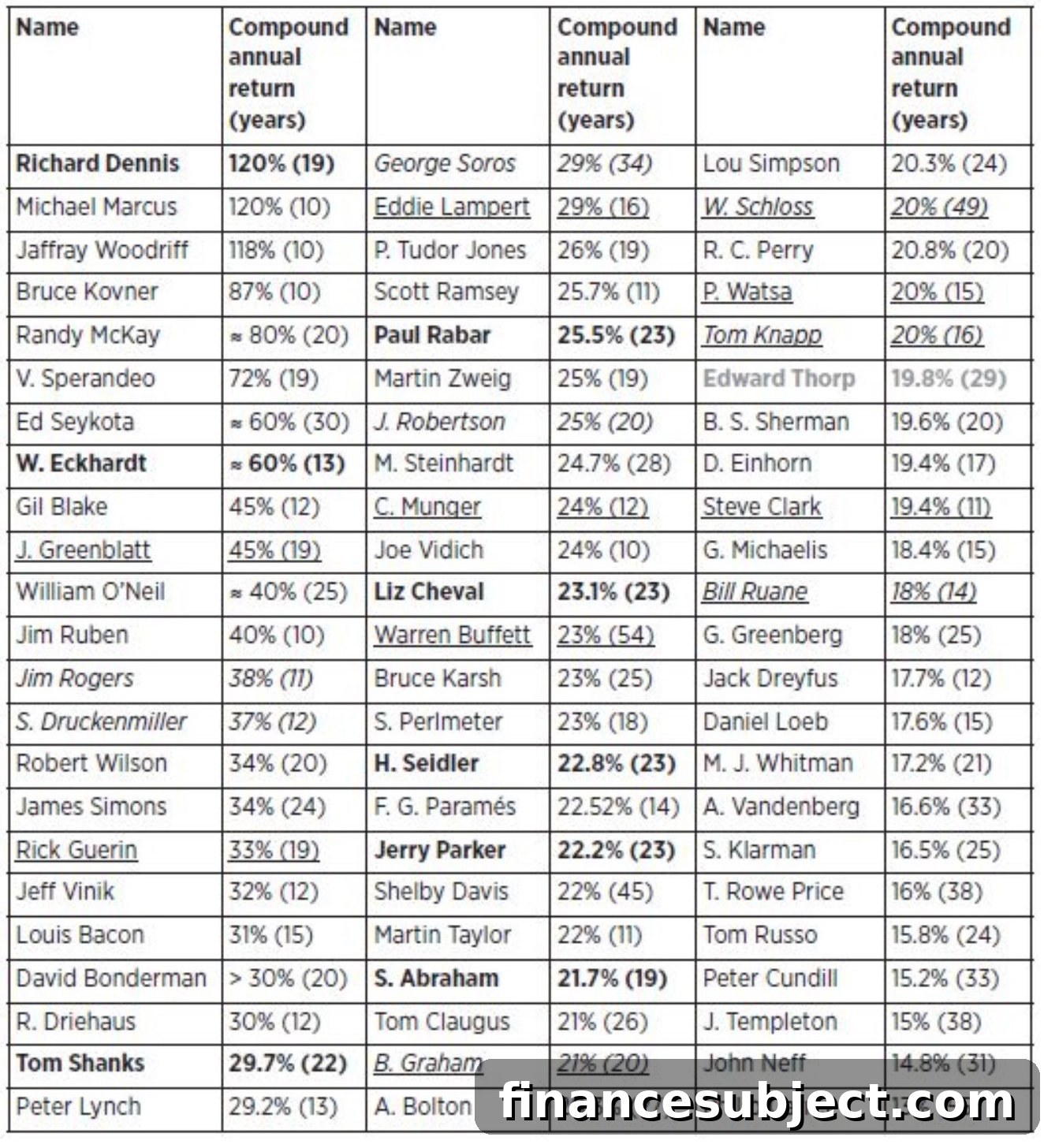
The table below, shared by fellow investor Richard Beddard, shows why that fascination persists:
Returns of (apparently) the greatest fund managers of all time, to 2014.
These results are drawn from Frederik Vanhaverbeke’s 2014 book, Excess Returns. The data is a reminder that exceptional outperformance has occurred — even if rare, and even if many caveats apply.
Critics will point to survivorship bias, lucky streaks, easier conditions in past markets, or structural advantages unavailable to ordinary investors. Those critiques are valid. I’ve written about them before. Still, the table demonstrates what is possible, however unlikely, and it helps explain why some investors keep trying to outperform.
If you can’t join ’em, beat ’em
When I was 16 I bet my father I could run a four-minute mile. I never came close — a later hospital stay didn’t help — but I did run competitive times: a near-11-second 100m was decent for my build. Age and genetics moved the goalposts, but the lesson stuck: some goals are realistic, some aren’t, and some are worth pursuing for the challenge.
The same applies to investing. Most people will be better off with low-cost passive funds, but some of us enjoy the intellectual contest of stock selection and strategy. Warren Buffett is a reminder that long-term active success is possible; yet he is also an exception, not a template for all investors.
Active investing requires humility, discipline, and consistency. If you choose that route, be realistic about odds and costs.
From the blogs
Useful reads and thoughtful commentary collected from expert bloggers and practitioners.
Passive investing
- Best strategies for moving money into the market — Elm Funds.
- Two-year update on a Vanguard UK equity income fund — DIY Investor (UK).
- New returns data that reinforce the challenges facing active managers — Evidence-based Investor.
Active investing
- Practical search techniques for investment ideas — Wexboy.
- Seven traits linked to successful active investing — What Works On Wall Street.
- Why inflation can benefit value investors — The Value Perspective.
- An argument that active managers should be free to select stocks — Enterprising Investor.
- How to avoid dividend and yield traps — UK Value Investor [PDF].
- Ten long-term UK shares to consider for an ISA portfolio — Part One and Part Two.
- Charlie Munger on the craft of stock picking — Investing Caffeine.
- Thoughts on market gravity and Apple — Asymco.
Other articles
- Long-term investing is largely about managing your own behaviour — Financial Samurai.
- Reflections on surprising market and personal lessons from Wall Street — What I Learned on Wall Street.
- Podcast: Why is life so hard? — Freakonomics.
- Life lessons from older generations — A Wealth of Common Sense.
- Act on your wish list now to regret less later — Behaviour Gap.
- Podcast: Robert Shiller on inequality and automation — Wharton.
Product of the week: A two-year fixed mortgage under 1% is tempting — but it usually requires a large deposit and fees, so check the fine print before committing.
Mainstream media money
Selected mainstream pieces and search-result tips to help you read paywalled articles from desktop view.
Passive investing
- A critique of DALBAR’s timing analysis — Advisor Perspectives.
- Further examination of fund investors’ timing — Morningstar.
Active investing
- Case for an improving global economy — The Economist.
- Reappraising Japan as an investment opportunity — Financial Times.
- Lessons from active fund management and the cost of inconsistency — Bloomberg.
- How tax changes prompted dividend activity — Financial Times.
- Twenty surprising facts about Warren Buffett — Entrepreneur.
- Podcast: Why the long bond bull market may persist — Bloomberg.
Broker insights
- Common questions about ISAs answered — Hargreaves Lansdown.
- A closer look at top UK equity fund managers — TD Direct.
Other noteworthy pieces
- Ways to boost income from cash savings — ThisIsMoney.
- Government U-turn on planned self-employed NIC changes — BBC.
- Using ISAs to mitigate inheritance tax — Telegraph.
- Space as an emerging investment frontier — Financial Times.
- A podcast mention of this blog — ThisIsMoney show.
- Discussion about Bitcoin’s cost and friction — Financial Times.
- On punctuation errors with real financial cost — BBC.
- Five phrases to avoid when talking to women in tech — Recode.
- Views on Iceland’s economic recovery — Bloomberg.
- Tourism pressures in New Zealand — Bloomberg.
Book/film pick: I recently rewatched The Big Short and enjoyed it even more the second time. The film’s characters and the story around the financial crisis are an entertaining reminder of how personalities and incentives shape markets. It also nudged me to finally read Michael Lewis’s The Undoing Project about behavioural finance.
Like these links? Subscribe to receive a weekly round-up.
- No, there’s been no Kazakhstan vodka boom. The line was a tongue-in-cheek example of speculative fads and poor investment decisions.[↩]
- Some paywalled articles can be accessed via search-result previews on desktop browsers. If you encounter a firewall on mobile, try switching your browser to desktop view to read the piece.[↩]