
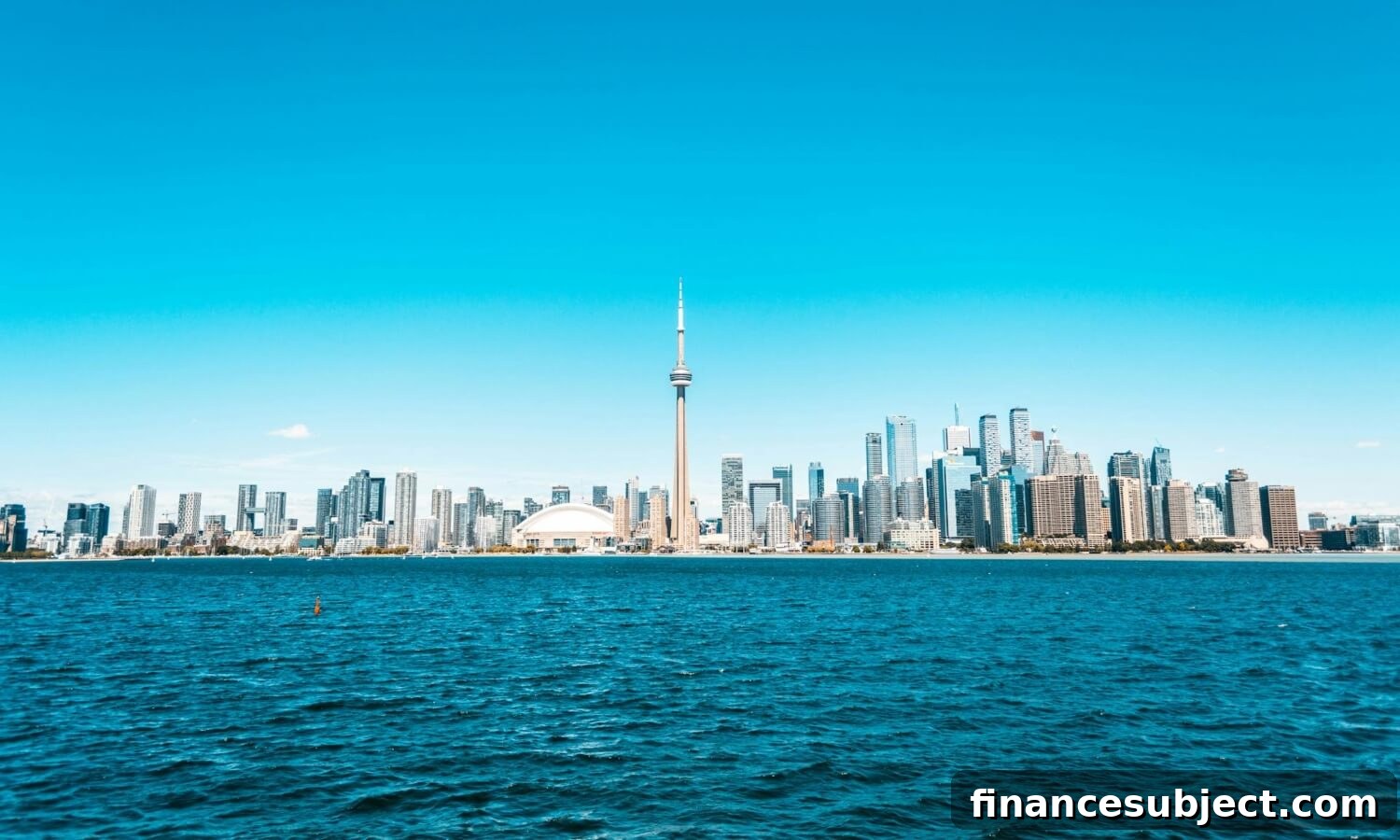
Toronto is Canada’s largest city, celebrated for its iconic skyline, diverse neighbourhoods and outstanding dining scene. As one of the world’s most multicultural cities and a major economic hub, Toronto combines strong employment opportunities and access to top universities with waterfront living on Lake Ontario. While housing affordability remains a significant challenge for many buyers, the city’s long-term growth prospects and rich cultural life keep it at the centre of real estate searches across the country.
- The 50 best neighbourhoods in Toronto
- Closer look at the top three neighbourhoods
- Real estate trends in Toronto
- Methodology
Best places to buy
Where to Buy Real Estate in 2026
Best places to buy real estate in Toronto
Below are the top 50 Toronto neighbourhoods for real estate purchases in 2025. The table lists each neighbourhood’s benchmark price in 2024, recent price growth and several scores that reflect value, local economics, accessibility and family-friendliness. Scan the list to compare opportunities across the city, from more affordable pockets to high-value central neighbourhoods.
| Rank | Neighbourhood | City | Benchmark price (2024) | 1-year | 3-year | 5-year | Value | Economics | Accessibility | Children (%) |
|---|---|---|---|---|---|---|---|---|---|---|
| 1 | Black Creek | Toronto | $705,222 | 14% | 6% | 51% | 5.0 | 2.1 | 3.0 | 26% |
| 2 | West Humber-Clairville | Toronto | $869,927 | 10% | 18% | 50% | 4.8 | 1.0 | 3.3 | 19% |
| 3 | Kingsview Village-The Westway | Toronto | $869,862 | 11% | 10% | 54% | 4.7 | 2.4 | 3.3 | 29% |
| 4 | Pleasant View | Toronto | $1,110,443 | 10% | 16% | 42% | 4.3 | 1.8 | 2.7 | 34% |
| 5 | Victoria Village | Toronto | $985,574 | 9% | 9% | 41% | 4.2 | 1.6 | 3.3 | 31% |
| 6 | University | Toronto | $1,439,821 | 13% | 20% | 31% | 4.2 | 2.7 | 3.3 | 13% |
| 7 | Milliken | Toronto | $1,002,229 | 6% | 6% | 47% | 4.0 | 0.5 | 2.8 | 28% |
| 8 | Rouge E10 | Toronto | $1,209,712 | 9% | 0% | 54% | 3.9 | 0.9 | 1.2 | 20% |
| 9 | Brookhaven-Amesbury | Toronto | $902,077 | 10% | -4% | 26% | 3.9 | 2.5 | 3.3 | 28% |
| 10 | Mount Olive-Silverstone-Jamestown | Toronto | $697,553 | -1% | 7% | 47% | 3.9 | 1.7 | 3.3 | 57% |
| 11 | Thistletown-Beaumonde Heights | Toronto | $1,143,116 | 8% | 7% | 39% | 3.8 | 1.8 | 3.0 | 23% |
| 12 | Markland Wood | Toronto | $1,064,318 | 7% | 7% | 30% | 3.8 | 3.8 | 3.3 | 9% |
| 13 | Crescent Town | Toronto | $662,917 | -2% | 9% | 37% | 3.7 | 1.7 | 4.1 | 72% |
| 14 | Junction Area | Toronto | $1,175,084 | 11% | -2% | 25% | 3.7 | 3.2 | 3.3 | 25% |
| 15 | New Toronto | Toronto | $1,216,063 | 7% | 2% | 42% | 3.7 | 2.8 | 3.8 | 19% |
| 16 | Agincourt South-Malvern West | Toronto | $787,004 | 2% | 3% | 34% | 3.7 | 3.2 | 3.0 | 32% |
| 17 | Bathurst Manor | Toronto | $1,353,985 | 6% | 8% | 47% | 3.6 | 3.1 | 2.6 | 32% |
| 18 | Oakridge | Toronto | $897,805 | 8% | -7% | 27% | 3.6 | 2.3 | 3.5 | 28% |
| 19 | Woburn | Toronto | $842,115 | -1% | 8% | 39% | 3.6 | 2.9 | 2.6 | 33% |
| 20 | Humbermede | Toronto | $867,159 | -5% | 18% | 46% | 3.6 | 2.0 | 2.9 | 31% |
| 21 | Humberlea-Pelmo Park W4 | Toronto | $1,186,714 | 6% | 4% | 33% | 3.5 | 2.6 | 3.5 | 78% |
| 22 | Little Portugal | Toronto | $923,904 | 5% | 4% | 16% | 3.5 | 1.1 | 4.5 | 6% |
| 23 | Kennedy Park | Toronto | $797,227 | 4% | -5% | 30% | 3.5 | 2.1 | 3.3 | 29% |
| 24 | Oakwood Village | Toronto | $1,193,236 | 10% | 0% | 18% | 3.5 | 1.0 | 0.2 | 32% |
| 25 | Downsview-Roding-CFB | Toronto | $920,361 | 3% | 0% | 28% | 3.5 | 5.0 | 3.3 | 38% |
| 26 | Weston | Toronto | $795,434 | 0% | 3% | 33% | 3.5 | 2.5 | 3.7 | 20% |
| 27 | Humber Summit | Toronto | $953,030 | 1% | 0% | 39% | 3.4 | 3.3 | 2.7 | 38% |
| 28 | Malvern | Toronto | $712,805 | -3% | 2% | 40% | 3.4 | 1.8 | 2.5 | 19% |
| 29 | Glenfield-Jane Heights | Toronto | $825,986 | -2% | 2% | 43% | 3.4 | 2.7 | 2.8 | 28% |
| 30 | Westminster-Branson | Toronto | $846,907 | -1% | 3% | 39% | 3.4 | 2.2 | 3.3 | 29% |
| 31 | Bendale | Toronto | $834,279 | -2% | 3% | 37% | 3.4 | 2.5 | 3.1 | 47% |
| 32 | Hillcrest Village | Toronto | $1,131,744 | 3% | 7% | 32% | 3.4 | 0.8 | 2.9 | 32% |
| 33 | Lansing-Westgate | Toronto | $1,513,796 | 4% | 19% | 33% | 3.4 | 2.7 | 3.2 | 30% |
| 34 | Niagara | Toronto | $792,633 | 2% | 1% | 15% | 3.4 | 2.9 | 2.0 | 47% |
| 35 | Humberlea-Pelmo Park W5 | Toronto | $881,612 | 0% | -1% | 36% | 3.3 | 2.6 | 3.3 | 78% |
| 36 | Yonge-St. Clair | Toronto | $1,856,491 | 11% | 11% | 30% | 3.3 | 2.8 | 4.5 | 13% |
| 37 | Rustic | Toronto | $1,235,428 | 3% | 8% | 34% | 3.3 | 1.6 | 2.8 | 26% |
| 38 | Etobicoke West Mall | Toronto | $749,026 | -4% | 4% | 36% | 3.3 | 2.9 | 3.0 | 35% |
| 39 | Steeles | Toronto | $928,865 | 2% | -3% | 29% | 3.3 | 3.4 | 2.9 | 36% |
| 40 | Mimico | Toronto | $871,414 | -1% | 4% | 24% | 3.3 | 3.0 | 3.4 | 22% |
| 41 | Briar Hill-Belgravia | Toronto | $907,706 | 1% | 3% | 19% | 3.3 | 2.9 | 3.3 | 39% |
| 42 | Eglinton East | Toronto | $718,362 | -1% | -5% | 28% | 3.3 | 2.7 | 3.3 | 31% |
| 43 | York University Heights | Toronto | $776,620 | -1% | 0% | 27% | 3.3 | 1.0 | 3.2 | 25% |
| 44 | East York | Toronto | $1,349,264 | 7% | 2% | 26% | 3.3 | 2.8 | 3.3 | 42% |
| 45 | Flemingdon Park | Toronto | $554,564 | -4% | -4% | 27% | 3.2 | 2.4 | 2.9 | 33% |
| 46 | Runnymede-Bloor West Village | Toronto | $1,572,469 | 10% | 1% | 23% | 3.2 | 4.1 | 3.3 | 39% |
| 47 | Dufferin Grove | Toronto | $1,295,323 | 9% | -5% | 16% | 3.2 | 2.7 | 3.3 | 35% |
| 48 | Leaside | Toronto | $2,207,502 | 11% | 20% | 31% | 3.2 | 2.2 | 3.3 | 22% |
| 49 | Mount Pleasant East | Toronto | $1,654,447 | 6% | 14% | 24% | 3.1 | 3.5 | 3.9 | 29% |
| 50 | Rockcliffe-Smythe | Toronto | $893,949 | 1% | -3% | 24% | 3.1 | 1.7 | 2.7 | 39% |
Source: Toronto Regional Real Estate Board
Return to top.
Top three neighbourhoods in Toronto
1. Black Creek
Black Creek, located in northwestern Toronto, ranks highest this year for overall value. At the end of 2024, its benchmark home price was $705,222 — a 51% increase over five years but still substantially below the Toronto average. For buyers seeking relative affordability with upside potential, Black Creek stands out.
The neighbourhood includes community assets such as Black Creek Community Farm, a nine‑acre urban farm with seasonal greenhouses, events and local produce, plus the Village at Black Creek, an open-air museum that interprets local and Indigenous history. Transit access is solid as well: Pioneer Village Station on Line 1 (Yonge–University) connects the community to downtown and regional bus service.
2. West Humber–Clairville
West Humber–Clairville, also in the city’s northwest, is convenient for drivers and frequent travellers. Its location near Highway 427, Steeles Avenue and Toronto Pearson International Airport makes commuting straightforward. The area boasts natural attractions such as the Humber Arboretum and the Humber River, plus nearby shopping at Woodbine Mall and Fantasy Fair. The average benchmark price at the end of 2024 was $869,927, reflecting strong five-year gains.
3. Kingsview Village–The Westway
Kingsview Village–The Westway in Etobicoke appeals to buyers focused on families and long-term stability. Home to more than a dozen local schools, the neighbourhood offers a classic suburban atmosphere with wider streets, larger lots and a quiet residential character. Its benchmark price was $869,862 at the end of 2024, up 54% over five years, and it shows particular strength among households with children — nearly 30% of local households include kids.
Return to top.
What’s happened in the Toronto real estate market?
In 2024, Toronto’s housing market moved at a steadier pace compared with earlier years of rapid appreciation. There was no widespread spring surge in activity, and buyers generally faced a calmer market with more room for negotiation. In many cases, sellers who needed to complete a sale were prepared to accept lower offers, giving strategic buyers opportunities to purchase at more favourable prices.
Condominiums became an attractive alternative for buyers priced out of detached homes. An oversupply of condo listings helped balance the market and strengthen buyers’ negotiating positions. Presentation mattered: well-staged units often drew quick offers, while poorly presented properties tended to linger on the market.
Many single renters and first-time buyers turned to studios, one-bedroom units or one-bedroom-plus-den condos priced between $400,000 and $600,000. With average rents near $2,000 per month for a two-bedroom in 2024, buying a smaller condo offered a realistic path to homeownership for those seeking stability and long-term equity.
Two-bedroom condos remained in demand, particularly among buyers looking for longer-term investment or additional living space. When a two-bedroom unit was within budget, it often sold quickly.
Resource highlight
You’re 2 minutes away from getting the best mortgage rates.
Answer a few quick questions to get a personalized quote, whether you’re buying, renewing or refinancing.
Powered by ratehub.ca
Return to top.
What’s next for real estate in Toronto?
Affordability will remain a primary factor shaping Toronto’s housing market in 2025. New rules introduced in 2024 expanded access to longer mortgage terms and increased the mortgage default insurance cap to $1.5 million (from $1 million), which changes financing options for many buyers. These policy changes are already influencing purchase decisions across price bands.
Some agents report that many buyers have taken advantage of the $1.5-million insurance cap, keeping the $900,000–$1.5-million segment competitive with limited supply and frequent bidding. For buyers who struggle to enter Toronto’s higher‑priced market, family assistance — sometimes called the “Bank of Mom and Dad” — continues to be a common strategy to increase purchasing power.
Others will opt to remain in condos or townhomes, or broaden their search beyond the city limits. Rising living costs and higher household debt are also encouraging buyers to explore ways to maximize affordability, including longer amortizations, larger family contributions and flexible housing types.
Return to top.
Newsletter
Get free MoneySense financial tips, news & advice in your inbox.
Read more about buying a home:
- The complete guide for first-time home buyers in Canada
- Buying a second home: How it works in Canada
- Mortgage affordability calculator
- How changes to the Home Buyers’ Plan could affect your down payment
This article was created by Zoocasa.
This is an unpaid article written by a content partner based on its expertise and edited by MoneySense.
This article is presented by Ratehub.ca.
This editorial content or content package is presented with financial support from an advertiser. The advertiser has no influence on the creation of the content.