

Mortgage rate comparison tool
Adjust the filters to compare rate types, terms and lenders.
Why trust us
MoneySense is an award-winning personal finance magazine that has helped Canadians manage money since 1999. Our editorial team of trained journalists works with leading personal finance experts to evaluate financial products and services. To help you find competitive options, we compare offers from more than a dozen major institutions — including banks, credit unions and card issuers. Learn more about our advertising and trusted partners.
5-year fixed rates in more detail
Five-year fixed-rate mortgages are the most common mortgage term in Canada. In recent years, changes in the economy, the housing market and household finances have prompted many Canadians to re-evaluate their mortgage choices. For example, when interest rates fell to historic lows in 2020, many borrowers favored variable-rate mortgages to save on interest; that trend reversed after rates began rising in early 2022. Below we explain how five-year fixed mortgage rates are set, what might influence them going forward, and how to compare offers to find the best rate.
5-year fixed mortgage rate highlights
- Fixed mortgage rates tend to track five-year Government of Canada bond yields. Rapid changes in inflation, the Bank of Canada’s policy rate, and other economic indicators have made bond yields—and therefore fixed rates—more volatile in the short term.
- Historically, variable rates have often been lower than fixed rates. Currently, variable rates (which move with the central bank’s benchmark rate) are above many fixed rates, but the relationship can shift depending on the economic cycle.
Frequently asked questions about fixed rates
Have questions about fixed-rate mortgages? Here are answers to common questions Canadians ask about five-year fixed mortgages.
The rate table at the top of this page shows current five-year fixed mortgage rates from a range of lenders. As of March 12, 2025, one of the most competitive five-year fixed rates for borrowers with less than 20% down was 4.59%. For borrowers with at least 20% down, some of the best rates were about 3.94%. The rate you qualify for depends on the lender, your down payment, whether you require mortgage default insurance, and other elements of your financial profile.
Variable-rate borrowers faced rising costs when the Bank of Canada raised its policy rate in 2022. Many now carry rates higher than current fixed offers. Before switching, consider early-break penalties on your existing mortgage—our mortgage penalty calculator can estimate those costs. Locking into a fixed rate removes the chance of benefiting from future rate drops but provides payment certainty. Switching can make sense if you prefer predictable payments and can justify the break costs; consult a mortgage broker or financial advisor to weigh the trade-offs.
Fixed mortgage rates are closely tied to five-year Government of Canada bond yields. Bond prices and yields move with investor expectations about inflation and central bank policy. Other influences include labour market strength, demand for safe assets versus riskier investments, and the federal government’s creditworthiness. Lenders set fixed mortgage pricing based on these market rates plus their own costs and desired profit margins.
Forecasts vary. Some observers are watching how U.S. tariffs and global trade developments affect inflation in both the U.S. and Canada. If tariffs raise prices, inflation could rise; if they lead to an economic slowdown, inflation may fall. The Bank of Canada’s policy rate was 2.75% as of June 4, 2025, and the path for bond yields—and therefore fixed mortgage rates—will depend on incoming economic data and central bank actions later in the year.
How much does the average house cost in Canada?
Recent data from Ratehub.ca indicate that it became easier to qualify for a mortgage on the average-priced home in several markets as mortgage rates eased. Since June 2024, cumulative Bank of Canada rate cuts totaling 225 basis points lowered the benchmark policy rate from about 5% to 2.75%, and lenders have passed through some of those reductions. Canada’s prime rate also fell, affecting variable mortgage rates, and declining bond yields have helped pull down many fixed mortgage rates, with the average five-year fixed rate around 3.99% in recent reporting.
For more on qualifying, see: How much income do I need to qualify for a mortgage in Canada?
Trending mortgage articles on MoneySense:
- Why are mortgages so expensive in Canada
- Renewing your mortgage? A guide for Canadians
- Should you pay off your mortgage early?
- How to get a mortgage with bad credit
- What to do when your mortgage renewal is declined
Where are fixed mortgage rates going in 2025?
Predicting fixed mortgage rates for 2025 is challenging. In early March 2025, the Government of Canada’s five-year bond yield fell to 2.63%, prompting some experts to expect further declines in fixed rates. Signs of a slowing economy and hints that central banks may be done raising rates contributed to that drop. The future path of fixed rates will depend on inflation, labour market trends and central bank decisions over the coming months.
Why do fixed rates change? Economic indicators to watch
The bond market reacts to investor expectations about the economy, which drives bond prices and yields. Two key indicators to monitor are the Bank of Canada’s policy rate and the national rate of inflation, both of which influence bond yields and fixed mortgage pricing.
The Bank of Canada’s benchmark interest rate
The Bank of Canada’s policy rate is a major influence on borrowing costs across the economy, affecting savings accounts, GICs and variable mortgage pricing. Bond prices and yields move inversely: when policy rates fall, bond prices usually rise and yields fall, and fixed mortgage rates often follow lower yields.
What is the current benchmark interest rate?
- On June 4, 2025, the Bank of Canada held its benchmark rate at 2.75%. The next policy announcement is scheduled for July 10, 2025.
Canada’s rate of inflation
Inflation, measured by the Consumer Price Index (CPI), directly affects investors’ demand for bonds. Higher inflation makes fixed-income investments less attractive, pushing bond yields—and often fixed mortgage rates—higher. As of the latest reports, Canada’s annual CPI was 1.7% in April, down from 2.3% in March. The Bank of Canada targets around 2% inflation, so further declines could increase the likelihood of additional policy easing.
A guide to fixed mortgage rates
- What is a five-year fixed mortgage rate?
- Should you switch from a variable to a fixed rate?
- How to compare five-year fixed mortgage rates
- How five-year fixed mortgage rates are determined in Canada
- The pros and cons of five-year fixed rate mortgages
- Is a fixed-rate mortgage better?
- What happens when my mortgage term ends?
- Should you choose a five-year fixed mortgage rate?
- How fixed mortgage rates vary by province
What is a five-year fixed mortgage rate?
A five-year fixed-rate mortgage has a term of five years during which your interest rate is locked. In Canada, mortgage terms range from six months to ten years, with five years the most common. Fixed rates provide payment predictability because your interest rate and regular payments remain unchanged for the term.
Fixed mortgages can be open or closed. Open mortgages allow extra payments or lump-sum prepayments without penalty, while closed mortgages typically limit prepayments and impose penalties for early repayment. Closed terms usually offer lower rates because they give lenders greater certainty.
How to compare five-year fixed mortgage rates
Use the rate comparison tool to view current five-year fixed rates from multiple lenders. Enter the purchase price and down payment to see tailored rates, and add filters for rate type, amortization, occupancy status, payment frequency and property location. The tool can also help you compare rates for mortgage renewal, refinancing or converting to a HELOC.
Mortgage renewal: When your term ends you must renew the mortgage balance for another term. Shop around before renewing—better rates may be available.
Mortgage refinance: Refinancing replaces your existing mortgage with a new contract, often to access equity or secure a lower rate. Beware of break penalties and closing costs when refinancing.
HELOC: A home equity line of credit lets you borrow against your home’s equity. Interest on a HELOC is usually higher than variable mortgage rates but lower than many unsecured lines of credit.
Plan your next move with these mortgage calculators
- Mortgage affordability calculator
- Mortgage payment calculator
- Mortgage insurance calculator
- Mortgage refinance calculator
- Mortgage renewal calculator
- Mortgage penalty calculator
Back to guide.
How are five-year fixed mortgage rates determined in Canada?
Three main factors influence five-year fixed mortgage rates:
- Five-year government bond yields: Lenders price fixed mortgages relative to bond yields. When bond yields fall, fixed mortgage rates often fall as well; when yields rise, fixed rates typically increase.
- Competition among lenders: Slower housing markets or aggressive strategies from smaller lenders can push rates down, while tight markets and less competition can keep rates higher.
- Your financial profile: Your credit score, debt servicing ratios and down payment size affect the rate you’re offered. Strong credit and a larger down payment usually qualify you for better pricing.
The pros and cons of five-year fixed rate mortgages
Pros:
- Predictability: Fixed payments make budgeting easier and protect you from rising rates during the term.
- Competitive offers: Lenders often offer competitive fixed rates to attract borrowers, especially during softer markets.
- Protection against rate hikes: If interest rates rise during your term, a fixed rate can save money compared with a variable rate.
Cons:
- Higher exit penalties: Breaking a fixed-rate mortgage usually incurs a larger penalty than breaking a variable-rate mortgage.
- Potentially higher cost: If market rates decline during your term, you may pay more interest than borrowers with variable-rate mortgages.
- Less flexibility: Closed fixed terms often limit prepayment options without penalty.
Back to guide.
Is a fixed-rate mortgage better?
There’s no single answer. A fixed-rate mortgage suits borrowers who prioritise payment certainty and who prefer not to worry about rate swings. Borrowers with strong finances and higher risk tolerance might benefit from variable rates when they are lower. Your choice should reflect your financial situation, tolerance for rate volatility and long-term plans. Speak with a mortgage broker or advisor to choose the right product.
Back to guide.
What happens when my mortgage term ends?
When your mortgage term ends, you can renew the existing mortgage or move to a different lender. A renewal statement from your lender will show your outstanding balance, proposed new rate and any fees. Shop around before renewing to secure the best available rate for your situation.
Back to guide.
Should you choose a five-year fixed mortgage rate?
Choosing a five-year fixed mortgage depends on whether you value stability over possible savings from a variable rate. Fixed terms can protect you from rising rates and make budgeting easier, while variable rates may be less expensive if interest rates fall. Base your decision on your risk tolerance, finances and how long you plan to stay in the mortgage.
Back to guide.
How fixed mortgage rates vary by province and territory
Mortgage rates are affected by local housing demand, supply, lender competition and economic conditions. With a large share of Canadian mortgages coming up for renewal over the next two years, lenders are competing aggressively for business, which can result in more competitive pricing across provinces.
Below are typical ranges and examples from several major markets.
5-year fixed mortgage rates Quebec
3.94% to 6.69%
Quebec’s competitive market, experienced lenders and many credit unions (including the large Desjardins network) contribute to a wide range of mortgage options and rates.
5-year fixed mortgage rates Ontario
3.84% to 6.69%
Ontario’s high house prices and active market attract many lenders, producing competitive rates across the province.
5-year fixed mortgage rates for BC
3.84% to 6.69%
British Columbia’s large mortgage population and expensive housing markets create strong competition among national banks, credit unions and alternative lenders.
Fixed mortgage rates for the rest of Canada
Regional differences persist, but online mortgage platforms have improved access to competitive rates for buyers outside major urban centres. With many mortgages due for renewal, competition could help borrowers secure better terms nationwide.
5-year fixed mortgage rates for Montreal
3.94%
Montreal faces higher home prices than much of Quebec, which can affect affordability, but local programs and a competitive lender mix help buyers explore options.
5-year fixed mortgage rates for Vancouver
3.84%
High property prices in Vancouver make it a competitive market where lenders actively target borrowers with attractive offers.
5-year fixed mortgage rates for Toronto
3.84%
Toronto’s large and active market often yields some of the most competitive mortgage rates in the country.
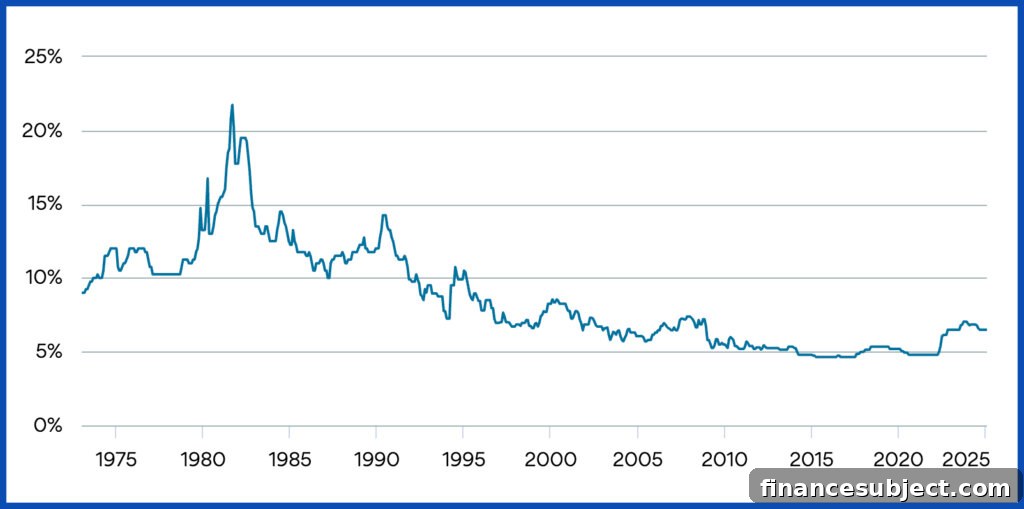
Historical 5-year mortgage rates
Mortgage rates in Canada have tracked broad economic trends. When inflation is high, the Bank of Canada typically raises interest rates to cool demand, and lenders increase mortgage rates. When inflation and growth slow, the central bank lowers rates to stimulate borrowing, and lenders follow with lower mortgage pricing. This dynamic explains long-term swings in five-year fixed rates.
For instance, the 1970s and 1980s featured high inflation and very high mortgage rates, with five-year rates reaching double digits and peaking in some periods above 20%. Rates trended downward from the 1990s into the 2000s and 2010s as inflation and policy rates stabilized, and the 2020s saw historically low policy rates during the COVID-19 pandemic followed by rapid hikes in 2022 and subsequent easing into 2024–2025. As of March 2025, the Bank of Canada’s policy rate was 2.75%.
Back to guide.
Read more about mortgages:
- Watch: What is mortgage affordability?
- The complete guide for first-time home buyers in Canada
- Should you get a 30-year mortgage?
- Buying a second home: How it works in Canada