

Welcome to the Canadian Crypto Observer. Financial journalist and author Aditya Nain provides timely analysis of market-moving headlines to help Canadian investors navigate the cryptocurrency landscape.
When the previous edition of this column was published, the geopolitical landscape had just shifted dramatically. Since then, global tensions have continued to escalate, with the United States and Israel undertaking military action against Iran amid concerns about Iran’s nuclear ambitions. In a hyper-connected global economy, these developments matter for Canadian investors because they can ripple through financial markets—including globally traded, institutionally held assets such as Bitcoin (BTC).
BTC extends losses—what’s next for the crypto market?
Bitcoin’s price has retraced sharply from its peak in October 2025. Based on a seven-day moving average, BTC has declined roughly 47% from that all-time high. Though this decline has not yet reached the 70%–80% drawdowns seen in some previous bear markets, a near-50% drop underscores Bitcoin’s volatility and reinforces that it is a high-risk asset generally suited to investors with a strong tolerance for large swings.
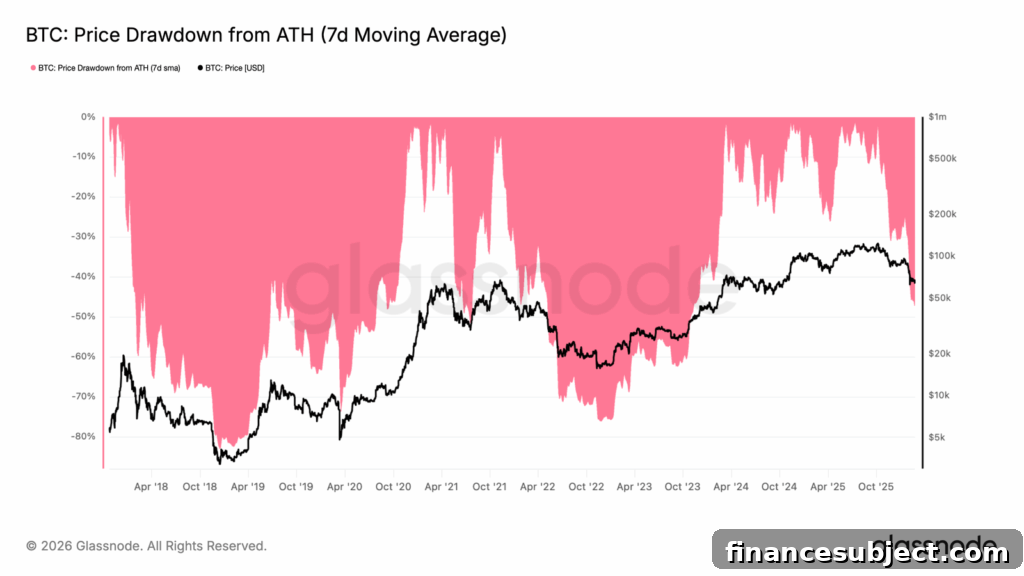
Source: Glassnode as of Feb. 25, 2026
On-chain research from Glassnode indicates the market has not yet shown a clear recovery signal. Their analysis of historical BTC cycles suggests that prolonged trading between roughly $60,000 and $70,000 increases the probability of further downside. In particular, the $70,000 level appears to be an important technical threshold; sustained trading convincingly above that mark would be a positive sign for investor confidence.
When will BTC recover and start climbing again?
With hindsight, October 2025 marked a peak for Bitcoin, and the subsequent months have moved the market into a bear phase. A near-50% fall over about five months is dramatic but not unprecedented in cryptocurrency cycles. Comparable cyclical capitulations have occurred before, and while they are painful for holders, they are part of crypto’s historical pattern.
Looking at past cycles, BTC has tended to find a market bottom roughly twelve months after its all-time high. Examples include the December 2017 high followed by a December 2018 bottom, and the November 2021 high followed by a November 2022 bottom. Whether history repeats itself is uncertain—markets are shaped by new macroeconomic and geopolitical factors—but the pattern provides a reference point for investors considering timing and risk management.
| All-time high | Market bottom | |
|---|---|---|
| Previous two BTC market cycles | December 2017 | December 2018 |
| November 2021 | November 2022 | |
| Current BTC market cycle | October 2025 | ? |
Historical analogues are informative but not definitive. Investors should be cautious about relying solely on past patterns when making portfolio decisions and should consider a broader set of signals, including macroeconomic trends and on-chain metrics.
Between geopolitics and interest rates
Two major forces are likely to shape BTC’s trajectory in the near term: geopolitical risk and the path of interest rates. Heightened geopolitical tension can prompt some investors to seek hard assets like gold or Bitcoin as hedges. However, the degree to which capital flows into these assets will depend on inflation expectations and central bank policies.
For example, an escalation that disrupts oil supplies could lift inflation expectations and push central banks—primarily the U.S. Federal Reserve—toward a more hawkish stance. Higher interest rates and tighter liquidity tend to make risk assets less attractive and can lead investors to favor cash and bonds over equities, commodities, and cryptocurrencies.
Given this uncertainty, many investors may find it more practical to manage crypto exposure through disciplined portfolio allocation rather than attempting to predict short-term price direction. For most diversified investors, Bitcoin allocations commonly range from about 2% to 10% of total portfolio value, depending on risk tolerance, investment horizon, and conviction.
Crypto price swings are common
Cryptocurrencies such as BTC, ETH, XRP, SOL, and BNB remain speculative and highly volatile. Even stablecoins, which aim for price stability, can carry risk if they are not fully backed or if market stress strains their peg. Investing in digital assets exposes holders to market, technological, and regulatory risks, and requires ongoing vigilance against scams and security vulnerabilities.
Anyone considering crypto should align those investments with their overall financial plan, time horizon, and risk tolerance. Regular review, clear position sizing, and safe custody practices are essential to manage the unique risks of the crypto ecosystem.
Newsletter
Get free MoneySense financial tips, news & advice in your inbox.
Read more about crypto:
- Will bitcoin crash in 2025?
- Bitcoin tops USD$100,000 for the first time
- Price of bitcoin hits new high after Trump victory, and more crypto news
- How to protect your crypto from hacks