
There is a squirrel that works the strip of grass outside my car most mornings. I watch it during the twenty quiet minutes I keep for myself before the day begins, coffee in hand. For weeks I observed the same routine: bury something, pause, then dart off a few feet to bury the next. It looked like the most diligent creature alive.
What I later learned is that squirrels forget. They bury far more than they ever retrieve, and many of those acorns are never found again. Some are left to sprout into trees that might feed a squirrel generations from now. The diligence I admired was genuine, but so was the forgetting — and the two are inseparable.
I have thought about that small act of forgetting more than I expected, because it feels so human. We spend large parts of our lives preparing for the future: saving, investing, delaying gratification, and making responsible decisions over and over. At some point, responsibility itself can become the goal. We turn into the squirrel, so focused on storing acorns that we forget to eat.
When the memory matters more than the money
Last week I wrote about my daily $1.92 Tim Hortons decaf and argued that sometimes the spreadsheet is wrong. That morning ritual wasn’t really about the coffee; it was about carving out twenty uninterrupted minutes, squirrel and all. While I was writing, I talked with my colleague Jessica about a larger version of the same dilemma: once-in-a-lifetime purchases that conventional personal finance wisdom tends to dismiss. For her it was flying to Europe for Taylor Swift’s Eras Tour. I laughed when she told me — partly because I had recently done something that felt remarkably similar.
Jessica had missed out on domestic tickets and couldn’t justify the higher North American prices. One night she watched fans’ videos online and felt, in her words, “just dying inside” that she wasn’t there. European tickets were a fraction of the cost, so she pulled up flights and sat with the idea for about ten minutes. Then she asked herself a single question: am I more likely to regret spending the money, or regret missing the concert? She booked the flight and, she admits, cried out of pure excitement.
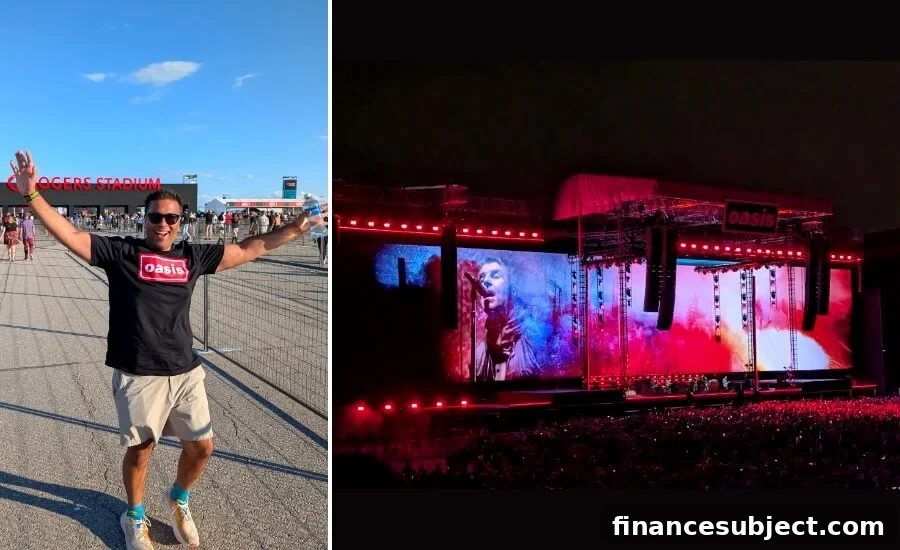
My version was Oasis. Not one night, but two — back-to-back, in the most expensive seats I could buy, with more merchandise than I have ever purchased for anything else. I dragged my wife to the first night (even though she isn’t a big fan), made my friend Katy stand beside me for two hours at the pop-up shop in London last summer, and queued again in the Toronto sun for merch a few days before the show.
If you knew me twenty years ago, that would have sounded unlikely.
The cost of always being responsible
In my early twenties a string of badly timed investments forced me to start over financially. Then came the life of a perpetual entrepreneur: aspiring to something bigger while living far smaller than most people imagined. Those years taught me discipline, resilience and resourcefulness, but they also left me with a relationship to money built almost entirely around caution. Pay the bills immediately, prioritize savings and investments, and allow whatever remains — if anything — for occasional treats.
Most people would call that responsible, and they’d be right. But responsibility has a shadow side we seldom discuss. When it becomes your whole financial identity, it can convince you that spending on yourself always requires a defense.
While friends and family upgraded cars and renovated patios, I felt like the squirrel hoarding against some imagined harsh season always just over the horizon. For years I lived this way: always storing, always preparing, until eventually I could no longer remember what I was preparing for.
Then Oasis announced their reunion.
Not a purchase, a milestone
I first saw Oasis in 2005 while studying in Cardiff, Wales. A few years later they broke up and, like so many fans, I assumed that chapter had closed. Between that night and these recent concerts almost everything in my life changed. I moved countries, got married, became a father and built businesses that sometimes succeeded and sometimes failed. I lived through financial setbacks that reshaped how I think about money, and I enjoyed professional successes that once felt impossible. Twenty years had passed.
So these tickets were not merely admission to a show; they were a way to acknowledge the distance between the person I had been and the person I had become. Could I have bought cheaper seats? Certainly. Gone one night instead of two? Absolutely. Skipped the merch? Without question. The optimizer inside me catalogued every cheaper option. For once it lost. Not because I abandoned sound financial principles, but because I recognised I wasn’t buying a product — I was marking a milestone. That distinction matters.
We often describe investing as putting money into assets that yield financial returns: stocks, real estate, a business, or education. Those are valuable investments. But somewhere along the way many of us started believing they are the only investments that count. What if that isn’t true? What if some of the most meaningful expenditures are the ones that produce no return a spreadsheet can measure?
Some things don’t need to earn their keep
Jessica still thinks about that weekend almost daily. She describes the show the way people describe nights that rearrange something in them: tens of thousands of fans inside the stadium, more gathered on the hills, all singing together. When certain songs play now, she’s instantly transported back.
More important, the trip changed how she sees herself. Her twenty-something self would never have flown across the world for a concert alone. Her thirty-something self felt confident enough to spend the money and do something gloriously impractical because she wanted to. She didn’t bring home a setlist so much as the realization she didn’t need anyone else’s permission to have an adventure.

That observation resonated because I had become very good at giving others permission to enjoy life — my wife, my daughter, our friends, even strangers. The person I rarely allowed that generosity toward was myself.
It would be tempting to justify the Oasis nights as a conventional investment. In the months after the concerts I returned happier, my work felt lighter, creativity returned, and my business performed unusually well. But that wasn’t the reason I went. If I require a productivity spike to validate an experience, I’m still letting the spreadsheet decide whether I can live. Some things are valuable simply because they enrich your life. Not every meaningful purchase needs to earn its keep in dollars and cents.
This isn’t a call to recklessness. Don’t finance experiences you can’t afford, ignore debts, or trade long-term security for a weekend of thrills. I paid for the concerts outright; they didn’t compromise my family’s savings, goals or future. Intentionality and affordability still matter. The squirrel must still gather acorns for winter. But it also needs enough food to thrive until winter arrives.
The regret test
When I asked Jessica how she decides whether a big indulgence is worth it, she had a simple rule: ask, “Will I regret not doing this?” Not the short-term fear of missing out, but the long-term question: in a year, will I still be thinking about what I passed up? If the answer is yes, she concludes it’s probably worth it. She knew skipping the Eras Tour would leave a persistent regret. The Oasis concerts would have done the same for me. Some opportunities don’t return, and pretending they do is its own cost.
Personal finance tends to celebrate the saver, the optimizer, the person who extracts every last dollar of future value from the present. Those habits deserve praise. So do the moments when someone deliberately chooses to enjoy the life they have spent years building.
That instinct may be common. A recent survey showed that many people would rearrange discretionary spending to attend the World Cup or other once-in-a-lifetime events. They aren’t just buying tickets; they are buying memories, connection, and the future certainty that they were there. That doesn’t mean every experience is worth any price, but it suggests people intuitively grasp a side of money conventional advice can miss.
So, what is money actually for?
I don’t think money exists only to maximize net worth. It creates security, opens opportunities and allows us to care for the people we love. Sometimes, once bills are paid and savings are growing, money is also permission — permission to stop being the thief of your own joy.
The squirrel outside my car will keep burying acorns and forgetting some of them. Those forgotten acorns may grow into trees the squirrel never sees. It’s wise to store for winter. I no longer believe that wisdom should require living a whole summer hungry.
I keep asking myself the same question: what is money actually for?
Read more about spending and saving:
- In defense of the “dumb” purchase
- Trust, money, and AI: What Canadians are really wrestling with
- The debt gap nobody talks about
- Canadians are quietly overspending on convenience