

Kyle Prevost, creator of 4 Steps to a Worry-Free Retirement, Canada’s DIY retirement planning course, summarizes this week’s financial headlines and provides context for Canadian investors.
Hits keep coming for TD
Falling interest rates are generally seen as helpful for bank profits, and most of this week’s reports from Canada’s major banks reflect that trend. Still, TD Bank continues to lag its peers.
Canadian bank earnings highlights
Performance for the three months ending October 31, 2024:
- BMO Financial Group (BMO/TSX): Adjusted EPS $1.90 (analysts: $2.39) and revenue $8.96 billion (est. $8.36 billion). Shares rose about 4.2% on Thursday.
- CIBC (CIBC/TSX): EPS $1.91 (est. $1.78) and revenue $6.62 billion (est. $6.52 billion). Shares gained roughly 4.4% on Thursday.
- National Bank (NA/TSX): Adjusted EPS $1.83 (in line with estimates) and revenue $2.84 billion (est. $2.79 billion). Shares fell about 3.8% on Wednesday.
- RBC (RY/TSX): Adjusted EPS $3.07 (est. $3.01) and revenue $15.07 billion (est. $14.67 billion). Shares were essentially flat on Tuesday.
- Scotiabank (BNS/TSX): Adjusted EPS $1.57 (est. $1.60) and revenue $8.53 billion (est. $8.63 billion). Shares slipped about 1.7% on Tuesday.
- TD (TD/TSX): Adjusted EPS $1.72 (est. $1.81) and revenue $13.88 billion (est. $12.37 billion). TD shares dropped roughly 7% on Thursday and are down over 13% year-to-date.
TD emerged as the biggest disappointment this reporting period. The bank not only missed earnings expectations, it also declined to provide forward guidance for 2025—a move markets read as uncertainty about the near-term outlook. That lack of guidance, combined with recent regulatory penalties and a large money-laundering fine, has weighed on the stock.
Despite these setbacks, TD remains a profitable North American bank with long-term strength; the key question for investors is where the current valuation floor might sit, given that growth could be restrained for a while.
At the opposite end of the spectrum, CIBC delivered a standout year. After beating expectations this quarter, its shares are up more than 46% year-to-date; including dividends, that’s nearly a 50% total return for 2024.
What is provision for credit losses (PCL)?
Provision for credit losses (PCL) is an expense companies record to recognize expected bad debt, reducing reported earnings in the period it is booked.
Across the banks, provisions for credit losses were slightly higher than some forecasts but still within expected ranges. Dividend increases were common: RBC and National Bank raised theirs by $0.04, TD and BMO by $0.03, and CIBC by $0.07. Scotiabank paused its dividend this quarter.
For investors, the takeaways are mixed: the Canadian banks broadly remain profitable and dividend-focused, but individual performance and near-term outlooks differ significantly.
Dollarama ends the year with a mediocre quarter
Dollar stores in Canada and the U.S. reported results this week, and the U.S. chains slightly outperformed Dollarama on the day.
Dollar store earnings highlights
Note: Dollarama reports in Canadian dollars; Dollar Tree and Dollar General report in U.S. dollars.
- Dollarama (DOL/TSX): EPS $0.98 (in line with estimates) and revenue $1.56 billion (est. $1.57 billion).
- Dollar Tree (DLTR/NASDAQ): EPS $1.12 (est. $1.08) and revenue $7.57 billion (est. $7.44 billion).
- Dollar General (DG/NYSE): EPS $0.89 (est. $0.94) and revenue $10.18 billion (est. $10.14 billion).
Although Dollarama’s quarter was only modest, the company had an excellent year overall—its shares are up nearly 48% for 2024. By contrast, Dollar Tree and Dollar General are down roughly 48% and 43% year-to-date, respectively.
Dollarama also announced plans to build a new distribution centre in Calgary to support Western Canadian expansion. With a high price-to-earnings ratio above 35, the stock may face pressure if future growth slows.
U.S. dollar stores are concentrating on cost-cutting measures and closing underperforming locations to protect margins. Tariffs on imports from major suppliers such as China and Mexico remain a key risk for discount retailers that rely on low-cost goods.
Why are CEOs selling their shares?
Insider trading disclosures—distinct from illegal insider trading—offer insight into executive sentiment because companies must report when executives and board members buy or sell company shares. Executives are often paid in stock and may sell shares for routine reasons like diversifying or funding personal expenses.
Still, spikes in insider sales can raise questions. For example, a handful of senior executives at Goldman Sachs sold more than USD$28 million in stock since November 6, 2024, amid speculation about regulatory changes that could affect bank profitability. Similarly, a Tesla board director sold about USD$34.6 million of Tesla shares in the same period. Large, public insider sales don’t prove anything on their own, but they are data points investors should consider alongside broader market signals.

The loonie versus the greenback
Canadians heading to the U.S. have felt the squeeze: the Canadian dollar no longer buys as much U.S. currency as it once did. The loonie has been weakening and now trades near levels last seen early in the 2020 pandemic.
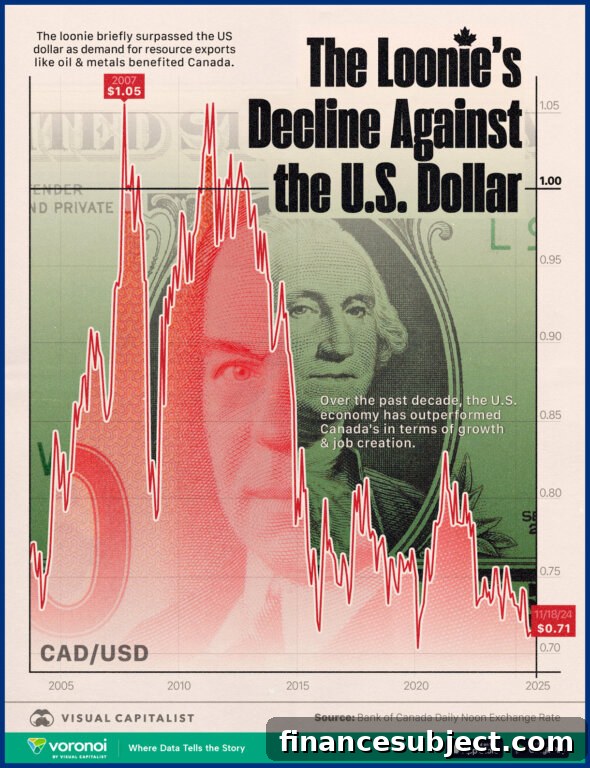
Since the recent U.S. election, the Canadian dollar has declined about 1.5%. Long-term forces are at play: Canada’s fortunes were stronger in the late 2000s when commodity prices and foreign investment boosted the currency, while U.S. tech-driven productivity gains have since attracted massive capital flows south of the border.
Looking ahead, factors such as U.S. economic strength, Canadian productivity challenges, tariff risks, and potential Bank of Canada rate cuts could push the loonie lower in 2025. A lower Canadian dollar affects travel budgets, import prices, and returns for investors holding U.S. assets.
More about investing:
- Boost your portfolio: Why and how to increase small-cap exposure with ETFs
- WeBull Canada review
- Best robo-advisors in Canada
- Scared of selling? When holding on to stocks can hurt you financially
- Bitcoin tops USD$100,000 for the first time