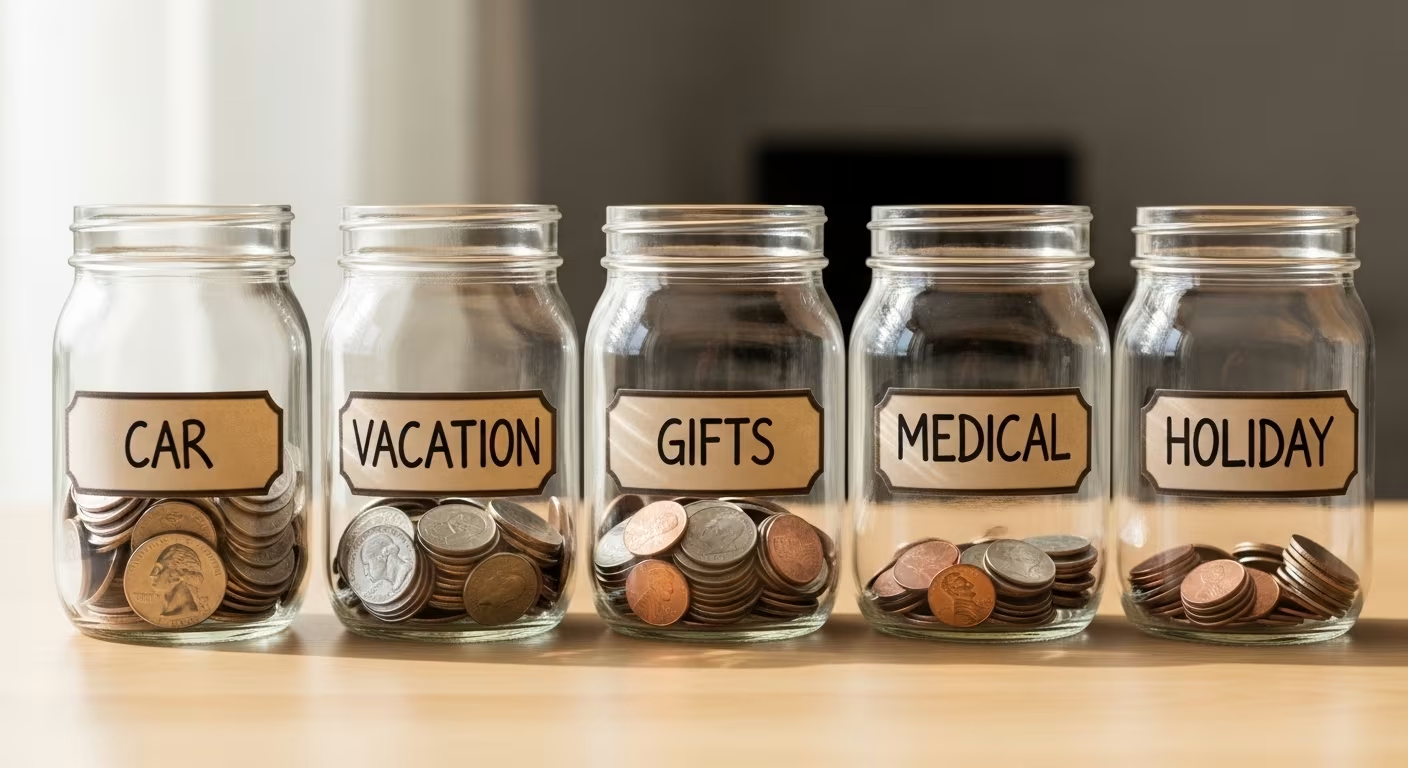
If you've ever been blindsided by a "surprise" expense that wasn't really a surprise—car registration, holiday gifts, annual insurance premiums—you need sinking funds. A sinking fund is money you set aside monthly for expenses that are irregular but predictable. It's not an emergency fund; it's a planning fund.
What Is a Sinking Fund?
A sinking fund is dedicated savings for a specific, known future expense. Instead of scrambling to find $600 for car repairs or $1,200 for holiday gifts, you save a little each month so the money is ready when you need it.
Example: You know Christmas will cost $1,200.
- Without sinking fund: December arrives, you panic, credit card gets charged.
- With sinking fund: Save $100/month starting January. December arrives, $1,200 is ready.
The expense isn't a surprise—it happens every year. A sinking fund turns it from a crisis into a planned expense.
Sinking Funds vs. Emergency Funds
Emergency funds are for unexpected, unpredictable events:
- Job loss
- Medical emergency
- Sudden home repair
- Unexpected car breakdown
Sinking funds are for expected, predictable events:
- Annual car registration
- Routine car maintenance
- Holiday gifts
- Vacation
- Insurance premiums
- Home maintenance
The distinction matters. Using your emergency fund for predictable expenses depletes protection for actual emergencies.
Sinking Funds vs. Savings Goals
Savings goals and sinking funds overlap but serve different purposes:
Savings goals are often aspirational and flexible:
- Down payment on a house
- New furniture
- Dream vacation
Sinking funds are for certain expenses:
- Car maintenance will be needed
- Property taxes will be due
- The roof will eventually need replacement
Sinking funds prioritize certainty over aspiration.
Essential Sinking Fund Categories
1. Car Maintenance and Repairs
Cars need maintenance and eventually break down. The average car owner spends $1,200-$1,800/year on maintenance and repairs.
Monthly contribution: $100-$150
2. Home Maintenance and Repairs
The general rule: budget 1-2% of home value annually for maintenance.
For a $300,000 home: $3,000-$6,000/year
Monthly contribution: $250-$500
3. Holiday and Gift Expenses
The average American spends $800-$1,000 on holiday gifts, plus birthdays, anniversaries, and other occasions.
Monthly contribution: $75-$125
4. Medical Expenses
Even with insurance, copays, deductibles, and out-of-pocket costs add up.
Monthly contribution: $50-$100 (more if you have known conditions)
5. Annual Subscriptions and Memberships
Amazon Prime, gym memberships, professional dues, software subscriptions—annual charges add up.
Monthly contribution: Calculate annual total ÷ 12
6. Travel/Vacation
If you take annual vacations, save monthly rather than financing on credit.
Monthly contribution: Annual travel budget ÷ 12
7. Insurance Premiums
Some insurance is billed quarterly or annually. Paying monthly often costs more; save and pay in full.
Monthly contribution: Annual premium ÷ 12
8. Property Taxes (if not escrowed)
If your mortgage doesn't include property tax escrow, save monthly.
Monthly contribution: Annual tax ÷ 12
9. Back-to-School
School supplies, clothes, fees—these hit every fall.
Monthly contribution: Annual school costs ÷ 12
10. Pet Expenses
Vet visits, grooming, medications—pets have predictable costs.
Monthly contribution: $30-$75 depending on pet
11. Clothing
Rather than reactive shopping, budget monthly for clothing needs.
Monthly contribution: Personal estimate based on needs
12. Technology Replacement
Phones, computers, and other electronics need replacement every few years.
Monthly contribution: Estimated cost ÷ expected lifespan in months
How to Set Up Sinking Funds
Step 1: Identify Your Categories
Review last year's expenses. What "surprised" you that actually happens regularly? Those need sinking funds.
Step 2: Estimate Annual Amounts
For each category, estimate the annual cost. Use last year's spending as a baseline.
Step 3: Calculate Monthly Contributions
Divide annual estimates by 12. This is your monthly contribution per category.
Example calculation:
| Category | Annual Cost | Monthly Save |
|---|---|---|
| Car maintenance | $1,500 | $125 |
| Home maintenance | $3,600 | $300 |
| Holidays/gifts | $1,000 | $83 |
| Medical | $800 | $67 |
| Vacation | $2,400 | $200 |
| Annual subscriptions | $600 | $50 |
| Total | $9,900 | $825 |
Step 4: Set Up Your System
Option 1: Single account with tracking
- One savings account holds all sinking funds
- Spreadsheet or app tracks each category's balance
- Simple to manage, requires discipline
Option 2: Multiple accounts
- Separate savings account per category
- Some banks (like Ally) allow multiple "buckets" in one account
- Clearer but more complex
Option 3: Use a budgeting app
- YNAB is designed for this approach
- Automatically tracks categories
- Most intuitive for sinking fund management
Step 5: Automate Transfers
Set up automatic transfers on payday:
- Paycheck arrives
- Sinking fund contributions transfer automatically
- No willpower required
Managing Sinking Fund Timing
Some categories have specific timing:
Holidays: Build fund January-November, spend in November-December, reset.
Car registration: Build throughout year, empty when registration due.
Vacation: Build until trip, spend, restart.
Other categories are ongoing:
Car maintenance: Continuous saving, spend when needed, continue saving.
Home maintenance: Same—ongoing contribution, withdrawal when needed.
What If You Can't Fund Everything?
If $825/month for sinking funds isn't realistic:
- Prioritize essentials: Car maintenance, home maintenance, and medical come first.
- Start smaller: Begin with 50% of ideal amounts, increase over time.
- Build gradually: Add one category at a time as budget allows.
- Combine with emergency fund: Until sinking funds are built, emergency fund may cover some irregular expenses.
When to Use a Sinking Fund
Use it when: The expense is what you saved for.
Don't use it when: The expense is genuinely unexpected (that's emergency fund territory).
Gray area: A car repair might be car maintenance (sinking fund) or a true breakdown (emergency fund). Use judgment.
Replenishing After Use
When you spend from a sinking fund:
- Continue normal contributions: Don't stop saving.
- Increase temporarily if needed: If funds were depleted beyond normal, boost contributions temporarily.
- Reassess annual estimate: Did the expense exceed your estimate? Adjust next year's plan.
Sinking Funds in Practice
Sarah's approach: Sarah saves $850/month across eight sinking funds. When her car needed $900 in repairs, she paid cash from her car maintenance fund. No stress, no credit card. Her fund dropped from $1,200 to $300, but monthly contributions will rebuild it.
Marcus's approach: Marcus uses YNAB to track 12 sinking fund categories in one savings account. When property taxes come due ($2,400), the money is waiting. No scrambling, no debt.
The difference: People without sinking funds experience these same expenses as financial emergencies. They charge credit cards, pay interest, and stay in the paycheck-to-paycheck cycle. Sinking funds break that cycle.
Common Mistakes
Under-estimating amounts: Review actual spending, not hopeful estimates.
Forgetting categories: Annual subscriptions, professional dues, and infrequent expenses get overlooked.
Spending the money on other things: Keep sinking funds separate and untouchable.
Not adjusting over time: Review and update estimates annually.
Creating too many categories: Start simple. 5-10 categories is manageable; 25 is overwhelming.
Sinking Fund Categories and Monthly Amounts
Here is a practical sinking fund framework with suggested monthly allocations based on a $50,000 annual income:
| Category | Annual Cost | Monthly Savings |
|---|---|---|
| Car maintenance/repair | $1,200 | $100 |
| Holiday gifts | $600 | $50 |
| Annual subscriptions | $360 | $30 |
| Medical copays/dental | $480 | $40 |
| Home repair | $1,200 | $100 |
| Clothing | $600 | $50 |
| Vacation | $1,800 | $150 |
| Pet expenses | $480 | $40 |
Total: $560/month allocated across 8 sinking funds, covering $6,720 in annual irregular expenses that would otherwise hit your budget as surprises.
Sinking Funds vs. Emergency Fund: The Critical Difference
Emergency funds cover unpredictable events: job loss, sudden illness, major appliance failure. Sinking funds cover predictable but irregular expenses: Christmas gifts, car maintenance, annual insurance premiums. The mistake most people make is using their emergency fund for predictable expenses, which depletes it and leaves them vulnerable to actual emergencies.
The car analogy: You know your tires will need replacing eventually. That is a sinking fund expense (predictable, just irregular). A deer hitting your car is an emergency fund expense (unpredictable). Conflating the two leads to chronic financial instability.
Where to Keep Sinking Funds
Separate savings accounts are ideal — many banks allow multiple named savings accounts at no extra cost. Ally Bank, Capital One 360, and SoFi all offer this feature. Name each account for its purpose: Car Fund, Holiday Fund, Vacation Fund. Seeing separate balances grow toward specific goals is psychologically motivating in a way that a single account with mental accounting never matches.
Within your budgeting app: YNAB and EveryDollar support sinking fund categories natively. Each dollar assigned to a sinking fund category rolls over month-to-month, building toward the target amount. This digital envelope approach eliminates the need for multiple bank accounts if you prefer simplicity.
Automating Sinking Fund Contributions
The moment you set up sinking funds, automate the contributions. Most banks allow scheduled recurring transfers on payday. Split your direct deposit or set up automatic transfers to each sinking fund account the day after payday. If you use YNAB or EveryDollar, create recurring scheduled transactions for each sinking fund category so the allocation happens before you are tempted to spend.
The target date approach: For each sinking fund, calculate the target date and work backward. If Christmas is in 10 months and you want $600 for gifts, you need $60/month starting now. If car insurance is due in 6 months at $1,200, save $200/month. This backward calculation removes guesswork and creates specific, actionable monthly amounts.
Annual Sinking Fund Audit
Every January, review your sinking funds against last year's actual expenses. Did you overshoot or undershoot any categories? Were there expenses that surprised you and need their own fund? This annual calibration makes each subsequent year more predictable. After two to three years of tracking, your sinking fund allocations become remarkably accurate, and financial surprises essentially disappear from your life.
Pro tip: Name your sinking fund accounts with the target amount and date. Seeing Car Repair Fund: $800 of $1,200 by June creates both clarity and motivation that a generic Savings label never provides.
Getting Started Today
- This week: List expenses that "surprise" you regularly
- Calculate: Annual cost and monthly contribution for each
- Open: A high-yield savings account (earn 4-5% while saving)
- Automate: Set up transfers for at least your top 3 categories
- Track: Use a spreadsheet, app, or your bank's bucket feature
Sinking funds transform predictable expenses from budget-breakers into planned line items. When you know December holidays are coming and the money is waiting, financial stress decreases dramatically.
Start with one or two categories. Build from there. In a year, you'll wonder how you ever lived without them.
Comments (0)
No comments yet. Be the first to share your thoughts!
Leave a Comment