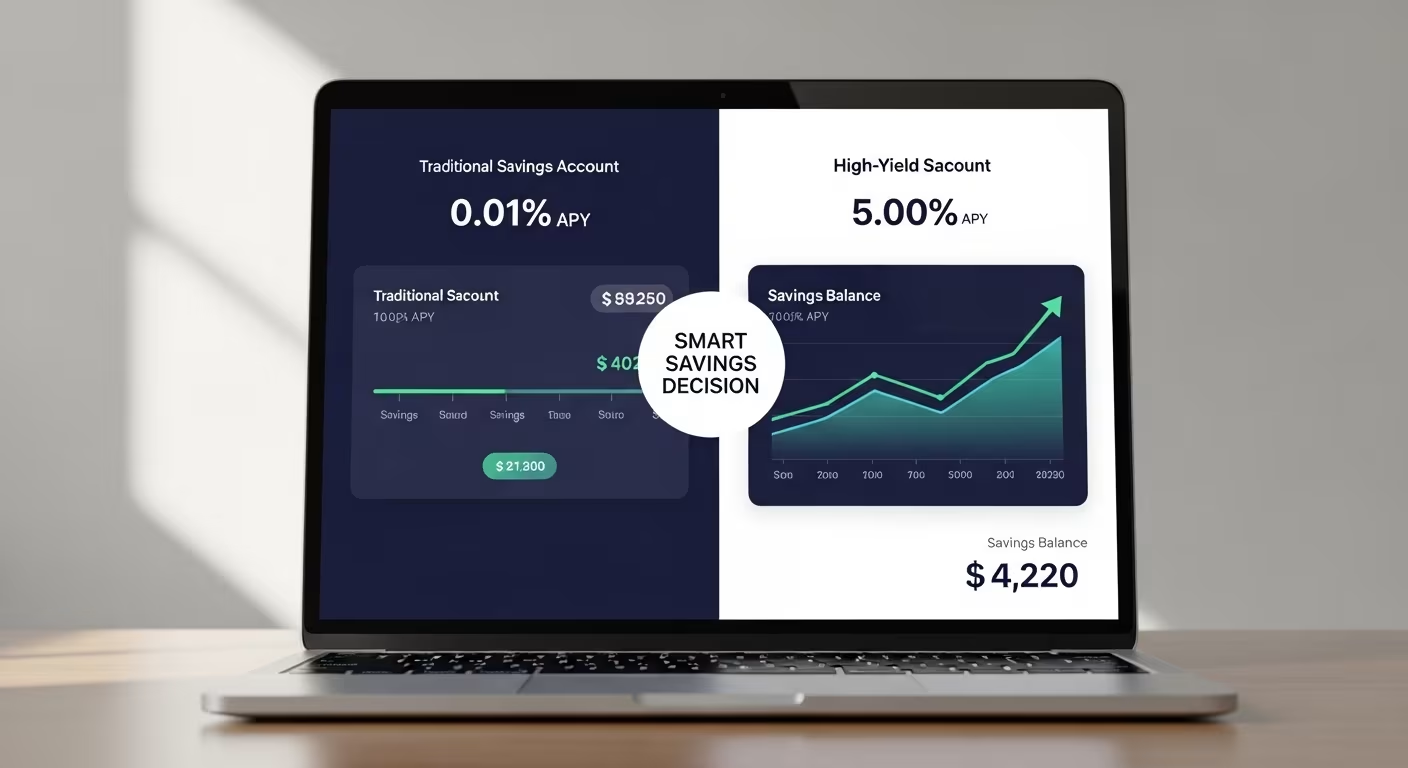
Keeping emergency funds and savings in a traditional bank account earning 0.39% APY while high-yield savings accounts offer 4-5% is leaving hundreds of dollars on the table annually. High-yield savings accounts (HYSAs) provide the same FDIC insurance and liquidity as traditional savings while paying dramatically higher interest.
What Is a High-Yield Savings Account?
A high-yield savings account is a savings account that pays significantly higher interest than traditional banks. While the national average savings rate in 2026 is approximately 0.39% APY, high-yield accounts pay 4-5% APY—more than 10× the average.
Example comparison (on $15,000 savings):
- Traditional bank (0.39% APY): $58.50/year
- High-yield account (4.50% APY): $675/year
- Difference: $616.50/year
That's real money earned just by moving your savings to a different account.
How High-Yield Savings Accounts Work
The Basics
High-yield savings accounts function like regular savings:
- FDIC insured up to $250,000
- Deposit and withdraw anytime
- No risk to principal
- Interest compounds (usually daily or monthly)
Why They Pay More
Online banks and credit unions offer higher rates because they have lower overhead costs:
- No physical branches to maintain
- Smaller staff requirements
- Lower real estate expenses
- Fewer legacy systems
These savings get passed to customers as higher interest rates.
How Interest Is Calculated
Most HYSAs use daily compounding:
- Daily rate = Annual rate ÷ 365
- Interest calculated on daily balance
- Interest credited monthly
- Next month, interest earns interest (compounding)
Example: $10,000 at 4.50% APY
- Daily rate: 0.0123%
- Daily interest: $1.23
- Monthly interest: ~$37
- Annual interest: ~$459 (slightly more due to compounding)
Are High-Yield Savings Accounts Safe?
The most common concern: "Is my money safe in an online bank?"
Yes. All reputable high-yield savings accounts are FDIC-insured (banks) or NCUA-insured (credit unions) up to $250,000 per depositor, per institution. This is the exact same insurance that covers Chase, Bank of America, and Wells Fargo.
If the bank fails, the FDIC guarantees your money. In the history of FDIC insurance (since 1933), no depositor has ever lost a penny of insured funds.
For amounts over $250,000: Spread across multiple banks, or use services like IntraFi (formerly CDARS) that distribute your deposit across multiple banks to maintain full FDIC coverage up to $150 million.
Tax Implications of High-Yield Savings Interest
Interest earned in high-yield savings accounts is taxable as ordinary income. At 5.00% APY on a $50,000 balance, you’d earn roughly $2,500/year in interest. Depending on your tax bracket (22-37% federal), you’d owe $550-925 in federal taxes on that interest.
The bank will send you a 1099-INT form for any interest over $10. Factor taxes into your effective return—a 5.00% APY becomes roughly 3.15-3.90% after federal taxes, depending on your bracket.
Tip: Consider I Bonds for some of your savings if you want tax-deferred growth. Series I Bond rates track inflation, and you don’t pay federal tax until you redeem them.
Top High-Yield Savings Accounts in 2026
Rates change frequently. These accounts consistently rank among the best:
Online Banks
| Bank | APY (March 2026) | Minimum Balance | Fees | Notable Feature |
|---|---|---|---|---|
| UFB Direct | 5.01% | $0 | None | Consistently top-tier rate |
| Bread Savings | 4.90% | $0 | None | CIT Bank subsidiary |
| LendingClub | 4.75% | $0 | None | No max balance cap |
| Bask Bank | 4.75% | $0 | None | Texas Capital subsidiary |
| Popular Direct | 4.70% | $0 | None | FDIC insured, online-only |
| Marcus by Goldman Sachs | 4.50% | $0 | None | Strong brand reputation |
| Ally Bank | 4.35% | $0 | None | Excellent app and customer service |
| SoFi | 4.50% | $0 | None | Requires direct deposit for best rate |
| Synchrony Bank | 4.50% | $0 | None | Also offers CDs |
| Wealthfront Cash | 4.50% | $0 | None | Integrates with investment portfolio |
Rate context: The Federal Reserve’s benchmark rate remained in the 4.25-4.50% range through early 2026. Online banks typically offer rates within 0.25-0.75% of the federal funds rate. Traditional brick-and-mortar banks average just 0.46% APY—roughly 10x less than the best online options.
Credit Unions
Credit unions often match or beat online bank rates. Check local credit unions for competitive options.
Fintech Options
- Betterment Cash Reserve: Competitive rates, multiple bank partners
- Wealthfront Cash Account: High APY, portfolio integration
What to Use High-Yield Savings For
Emergency Fund
The primary use case. Your 3-6 months of expenses should sit in a HYSA:
- Fully liquid (withdraw anytime)
- Earning significant interest
- FDIC protected
- Separate from checking (harder to spend)
Short-Term Savings Goals
Goals you'll need within 1-3 years:
- Vacation fund
- Down payment savings
- Wedding fund
- Car purchase
- Large purchases
Cash Buffer
Keep 1-2 months of expenses in HYSA as checking account backup and bill-paying buffer.
What NOT to Use High-Yield Savings For
Long-Term Investing
Over periods of 5+ years, stock market returns historically exceed savings rates. Money that won't be needed for 5+ years belongs in investments, not savings accounts.
Daily Spending
Keep daily transaction money in checking. Savings accounts have transfer limits and aren't designed for frequent transactions.
Chasing Highest Rates
If your current HYSA pays 4.25% and another offers 4.40%, the difference on $20,000 is $30/year. Not worth the hassle of opening new accounts and transferring constantly.
How to Choose a High-Yield Savings Account
Key Factors
APY: Higher is better, but don't chase tiny differences. Look for accounts in the top tier (within 0.25% of the highest available).
Fees: Should be zero. Don't accept monthly maintenance fees, minimum balance fees, or excess withdrawal fees.
Minimum balance: Should be $0 or very low. No reason to lock up money to earn interest.
FDIC/NCUA insurance: Verify the account is insured. All legitimate banks and credit unions are.
Mobile app quality: You'll access this account digitally. Read reviews about app reliability.
Transfer speed: Some banks take 1-3 business days for external transfers. Faster is better for emergencies.
Customer service: When you need help, can you reach someone? Check reviews.
Less Important Factors
Brand name: Unknown banks often pay higher rates. FDIC insurance makes them equally safe.
Physical branches: Online-only is fine for savings accounts you rarely access.
Bundled products: You don't need the bank's credit card or investing platform. Focus on the savings account.
Opening a High-Yield Savings Account
Requirements
- Social Security number
- Government-issued ID
- U.S. address
- Linked bank account for transfers
- Initial deposit (often $0-$100)
Process (Usually 10-15 Minutes)
- Visit bank website or download app
- Click "Open Account" or "Get Started"
- Enter personal information
- Verify identity (SSN, ID upload or questions)
- Link external account for funding
- Make initial deposit
- Set up online access
After Opening
- Set up automatic transfers from checking
- Download mobile app
- Enable 2-factor authentication
- Add account to your net worth tracking
Maximizing Your High-Yield Savings
Automate Transfers
Set up automatic transfers from checking to HYSA:
- Day after payday
- Fixed amount monthly
- Builds savings without effort
Use Multiple Accounts
Many banks allow multiple savings accounts (often called "buckets"):
- Emergency fund
- Vacation
- Car fund
- House down payment
Each goal has its own account/bucket with a clear purpose.
Review Rates Quarterly
HYSAs adjust rates as the Federal Reserve changes interest rates. If your bank's rate drops significantly below competitors, consider switching.
Maintain Appropriate Balance
Too little: Emergency fund too small to handle real emergencies
Appropriate: 3-6 months expenses for emergency fund, plus goal-specific savings
Too much: Money that could be invested sits in savings earning less
Common Questions
Are Online Banks Safe?
Yes. FDIC insurance covers up to $250,000 regardless of whether the bank has physical branches. Online banks like Ally, Marcus, and Discover have existed for decades.
What If I Need Money Fast?
Most HYSAs allow ACH transfers within 1-3 business days. For true emergencies, many offer same-day transfers or links to checking accounts for instant access.
Will I Pay Taxes on Interest?
Yes. Savings account interest is taxable income. Banks send 1099-INT forms for interest over $10. Report all interest on your tax return.
Can Rates Go Down?
Yes. HYSA rates are variable and change with Federal Reserve policy. When the Fed lowers rates, savings rates decrease. When rates rise, savings rates increase. In 2026, rates remain elevated following years of rate increases.
What About CDs?
Certificates of Deposit lock money for a fixed term (months to years) in exchange for guaranteed rates. CDs make sense if:
- You want to lock in today's rate
- You won't need the money during the term
- The CD rate exceeds the HYSA rate
In 2026, many CDs offer slightly higher rates than HYSAs for longer terms.
High-Yield Savings vs. Other Options
vs. Checking Account
Checking: Daily transactions, bill pay, lower/no interest HYSA: Savings, higher interest, less frequent access
Use both: Checking for daily money, HYSA for savings
vs. Money Market Accounts
Similar to HYSAs. Some money market accounts offer check-writing or debit cards. Rates are comparable. Choose based on features and rates.
vs. Series I Bonds
I Bonds earn inflation-adjusted rates (currently competitive with HYSAs). Differences:
- $10,000/year purchase limit
- 1-year minimum holding
- Penalty for withdrawing before 5 years
- Interest is tax-deferred
Consider both: I Bonds for long-term inflation protection, HYSA for accessible savings
vs. Brokerage Accounts
Brokerage accounts invest in stocks/bonds with higher potential returns but also risk. HYSA is guaranteed; brokerage is not.
Use both: HYSA for emergency fund and short-term goals; brokerage for long-term investing
When to Switch Your High-Yield Savings Account
Banks regularly adjust rates. Your 5.00% APY today could be 3.50% in six months. Here’s when to consider switching:
- Your rate drops more than 0.50% below competitors: Shop around quarterly
- Customer service deteriorates: Read recent reviews on Bankrate or NerdWallet
- Your needs change: Some banks offer joint accounts, sub-accounts for goals, or better integration with investment platforms
- New promotional rates appear: Some banks offer bonus APY for the first 6-12 months
Switching is easy: Open the new account online (10-15 minutes), initiate an ACH transfer from old to new, wait 2-3 business days, close the old account. No fees, no penalties on savings accounts.
Getting Started Today
Step 1: Calculate Your Savings Target
Emergency fund: 3-6 months of expenses Short-term goals: Total dollar amounts needed
Step 2: Choose a Bank
Compare top HYSAs. Select one with competitive rate, no fees, and good reviews.
Step 3: Open the Account
10-15 minute process. Have ID and linked bank account ready.
Step 4: Transfer Existing Savings
Move money from low-yield savings to your new HYSA.
Step 5: Automate Future Savings
Set up recurring transfers from checking to HYSA.
Step 6: Watch Your Money Grow
Check monthly as interest compounds. The difference versus traditional savings is visible quickly.
Earning 4-5% on your savings versus 0.39% is one of the easiest financial optimizations available. The money is equally safe, equally accessible—just earning significantly more. There's no reason not to switch.
Comments (0)
No comments yet. Be the first to share your thoughts!
Leave a Comment