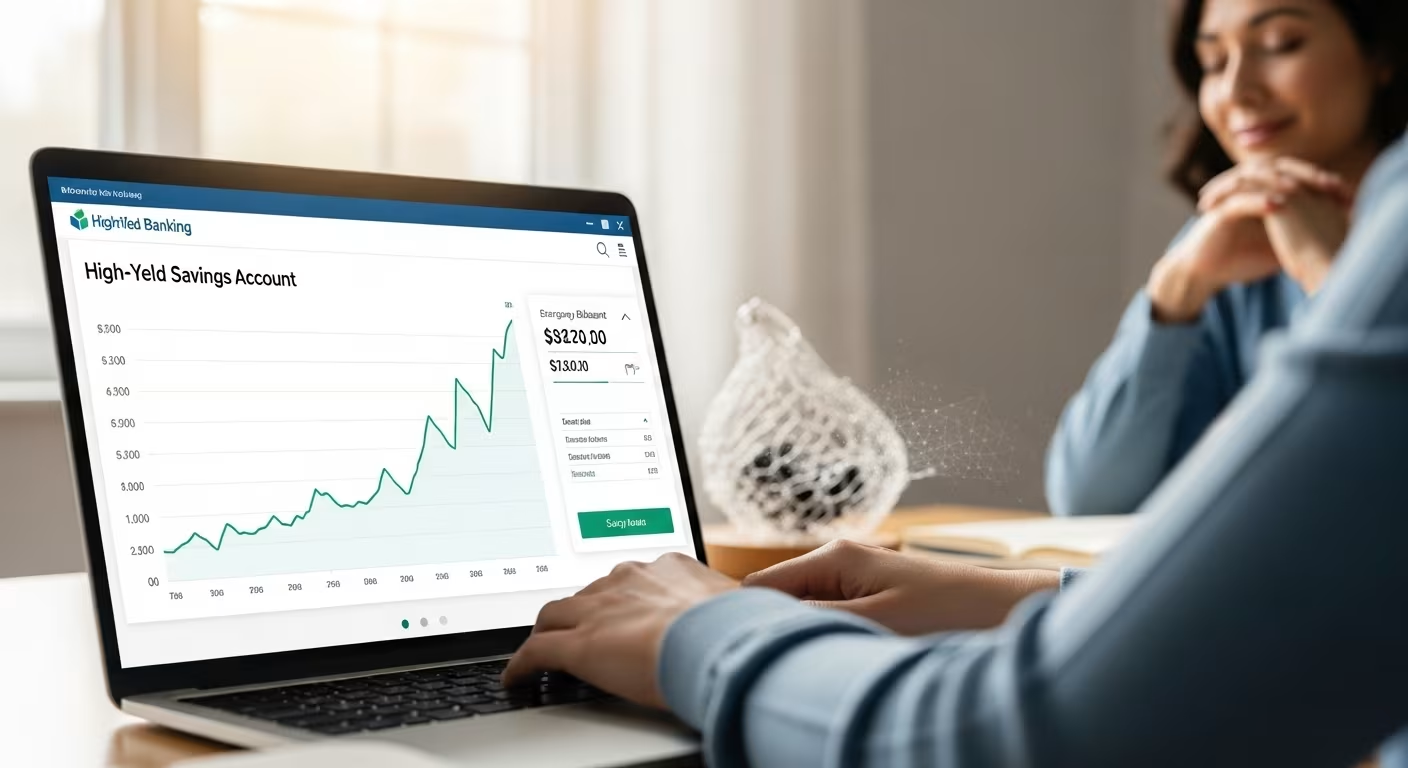
An emergency fund is the foundation of financial security. It's the money that stands between you and disaster when the unexpected happens—job loss, medical emergency, car breakdown, or home repair. Without one, a single surprise expense can spiral into credit card debt, missed payments, and financial stress that takes years to recover from.
In 2026, with high-yield savings accounts offering 4-5% APY and economic uncertainty always present, building and properly placing your emergency fund matters more than ever.
Why You Need an Emergency Fund
The Statistics Are Stark
According to recent data, approximately 44% of Americans couldn't cover a $1,000 emergency without borrowing. This leaves millions of people one unexpected expense away from debt or financial crisis.
Consider what happens without an emergency fund:
- Car repair ($800) goes on a credit card at 23.77% APR
- That $800 becomes $1,000+ with interest and minimum payments
- Medical bill ($2,000) gets added to the balance
- Debt snowballs; stress compounds
- Financial recovery takes years
An emergency fund breaks this cycle before it starts.
What Qualifies as an Emergency
True emergencies:
- Job loss or significant income reduction
- Medical expenses not covered by insurance
- Essential car repairs (needed for work)
- Home repairs that can't wait (burst pipe, roof leak)
- Unexpected family crisis requiring travel
- Emergency pet care (if pet is family)
Not emergencies:
- Vacation deals
- Sales you don't want to miss
- New phone because yours is two years old
- Concert tickets
- Routine car maintenance (should be a sinking fund)
The distinction matters. Emergency funds should only be touched for genuine emergencies.
How Much Do You Need?
The Standard Recommendation: 3-6 Months of Expenses
Financial advisors typically recommend saving 3-6 months of essential living expenses. This provides cushion for most job losses (average unemployment lasts 3-4 months) and absorbs major unexpected expenses.
Calculate your number:
List monthly essential expenses:
- Housing (rent/mortgage): $1,600
- Utilities: $200
- Groceries: $500
- Transportation: $300
- Insurance: $400
- Minimum debt payments: $300
- Essential subscriptions/services: $100
Monthly essentials total: $3,400
Emergency fund target:
- 3 months: $10,200
- 6 months: $20,400
Factors That Determine Your Number
Lean toward 3 months if:
- You have very stable employment
- Your industry has low unemployment
- You have multiple income sources
- You have accessible assets beyond savings
- Your expenses are highly flexible
Lean toward 6+ months if:
- Your income is variable or commission-based
- You work in a volatile industry
- You're the sole income provider
- You have dependents
- You have health conditions requiring ongoing care
- You're self-employed
- You own a home (more things can break)
The Starter Emergency Fund
If you're just beginning or paying off high-interest debt, start with a mini emergency fund of $1,000-$2,000. This prevents small emergencies from becoming credit card debt while you focus on other financial priorities.
Once high-interest debt is paid, expand to the full 3-6 months.
Where to Keep Your Emergency Fund
High-Yield Savings Accounts: The Best Option
In 2026, high-yield savings accounts offer compelling returns:
- Top rates: 4-5% APY
- National average: 0.39% APY
- Difference: 10x more interest
On a $15,000 emergency fund:
- Traditional savings (0.39%): $59/year interest
- High-yield savings (4.5%): $675/year interest
That's an extra $616 annually for simply choosing the right account.
Top high-yield savings accounts in 2026:
- Varo Money: Up to 5.00% APY
- Newtek Bank: 4.20% APY (waitlist due to demand)
- Openbank: 4.09% APY ($500 minimum)
- Marcus by Goldman Sachs: 3.65% APY
- Ally Bank: 3.20% APY (highly rated service)
All are FDIC-insured up to $250,000, making them as safe as traditional bank accounts.
What to Look for in an Account
Must-haves:
- FDIC insurance
- No monthly fees
- No minimum balance fees
- Easy transfers to your main bank (1-2 business days)
- Mobile app access
- Competitive APY
Nice-to-haves:
- ATM card for true emergencies
- Check writing ability
- Joint account option
- Good customer service ratings
Where NOT to Keep Emergency Funds
Checking account: Earns nothing and too easily spent. Keep emergency funds separate.
Certificate of Deposit (CD): Locks money for months/years with early withdrawal penalties. Emergencies don't wait for CD maturity.
Investment accounts: Stock market losses during an emergency (which often coincide with market downturns) could reduce your fund when you need it most. Emergency funds should never be invested in stocks.
Under the mattress: No interest, no protection, and can be lost or stolen.
Crypto or speculative assets: Far too volatile for emergency savings.
How to Build Your Emergency Fund
Step 1: Open a Separate Account
Don't mix emergency savings with spending money. Open a dedicated high-yield savings account at an online bank. The separation creates a psychological barrier that helps you not spend it casually.
Step 2: Set a Monthly Goal
Calculate how much you can save monthly and when you'll reach your target:
| Monthly Savings | Time to $10,000 | Time to $20,000 |
|---|---|---|
| $200 | 50 months | 100 months |
| $400 | 25 months | 50 months |
| $600 | 17 months | 33 months |
| $800 | 13 months | 25 months |
| $1,000 | 10 months | 20 months |
Even $200/month builds a meaningful emergency fund over time.
Step 3: Automate Transfers
Set up automatic transfers from checking to your emergency fund account. Schedule them for the day after payday. Money you don't see, you don't spend.
Step 4: Accelerate with Windfalls
Add unexpected money directly to your emergency fund:
- Tax refunds
- Work bonuses
- Gifts
- Side hustle income
- Sold items
- Rebates or rewards
Step 5: Cut Temporarily
While building your initial emergency fund, temporarily reduce discretionary spending:
- Pause subscriptions
- Reduce dining out
- Skip the vacation this year
- Delay major purchases
Once funded, you can return to normal spending.
Maintaining Your Emergency Fund
When to Use It
Only tap your emergency fund for true emergencies. Ask yourself:
- Is this unexpected?
- Is this necessary?
- Is this urgent?
If all three answers are yes, it's probably an emergency. If you're unsure, wait 24 hours before deciding.
Replenishing After Use
When you use your emergency fund, pause other financial goals and rebuild it immediately. Don't wait. An empty emergency fund leaves you vulnerable to the next crisis.
Annual Review
Each year, review your emergency fund target:
- Have your expenses increased?
- Has your job stability changed?
- Have you added dependents?
- Do you need more or less cushion?
Adjust your target accordingly.
High-Yield Savings Account Rates in 2026
As of March 2026, the best high-yield savings accounts offer up to 5.00% APY — dramatically higher than the national average of 0.39% for traditional savings accounts. Top options include Varo Money (up to 5.00%), Axos Bank (up to 4.21%), and Newtek Bank (up to 4.20%). Following three Fed rate cuts in 2025 and hold decisions in 2026, these rates remain historically attractive.
The math is compelling: A $15,000 emergency fund earning 4.50% APY generates $675 annually in interest. In a traditional savings account at 0.39%, that same amount earns just $58.50. The difference — over $600 per year — is essentially free money for choosing the right account. All deposits are FDIC-insured up to $250,000.
Emergency Fund Tiers: A Progressive Approach
Rather than the overwhelming goal of saving 6 months of expenses, use a tiered approach:
Tier 1 — Starter Fund ($1,000-$2,000): Cover minor emergencies (car repair, medical copay). Build this before aggressive debt payoff. Target timeline: 1-3 months.
Tier 2 — Basic Safety Net (1 month of expenses): Covers a full month if income stops. Target timeline: 3-6 months after Tier 1.
Tier 3 — Standard Fund (3 months of expenses): Adequate for most stable-income households. Target timeline: 6-12 months after Tier 2.
Tier 4 — Full Security (6 months of expenses): Recommended for single-income households, self-employed individuals, or those in volatile industries. Target timeline: 12-24 months after Tier 3.
Tier 5 — Extended Runway (9-12 months): For freelancers, business owners, or those approaching major life transitions (career change, new baby). This level provides genuine financial freedom.
Emergency Fund Investment Strategy
Once your emergency fund reaches Tier 3 (3 months), consider splitting it strategically: keep one month of expenses in a checking account for immediate access, two months in a high-yield savings account earning 4-5% APY, and any additional months in a money market account or short-term CD ladder for slightly higher yields.
Critical rule: Never invest your emergency fund in the stock market. Emergencies do not wait for market recoveries. The purpose of this money is instant accessibility, not growth. Liquidity and safety are the only two criteria that matter.
2026 contribution limits to know: 401(k) limit is $24,500 with $8,000 catch-up for ages 50+. IRA limit is $7,000 with $1,000 catch-up. HSA limit is $4,300 individual or $8,550 family. After your emergency fund is funded, redirect that monthly savings toward these tax-advantaged accounts.
Emergency Fund FAQ
Q: Should I pay off debt or build an emergency fund first? A: Build a $1,000-$2,000 starter emergency fund first. Then attack high-interest debt. Then expand to full 3-6 month emergency fund.
Q: Does my emergency fund count toward net worth? A: Yes, it's an asset. But don't include it in investable assets—it's a safety net, not an investment.
Q: Should I use a money market account instead? A: Money market accounts can work, but most high-yield savings accounts offer similar or better rates with easier access.
Q: Can I keep my emergency fund with my main bank? A: You can, but keeping it at a separate institution creates helpful psychological distance and often yields better interest rates.
Q: Is $1,000 enough to start? A: $1,000 is better than $0 and protects against minor emergencies. But expand to 3-6 months as soon as possible.
Q: What about keeping some cash at home? A: A small amount ($500-$1,000) for absolute emergencies (natural disasters, bank outages) is reasonable. But most of your fund should be earning interest.
Taking Action
- Today: Open a high-yield savings account (takes 15 minutes)
- This week: Set up automatic monthly transfers
- This month: Add any extra money to the account
- This year: Reach at least your starter emergency fund goal
An emergency fund won't make headlines. It's not exciting or glamorous. But when that unexpected expense hits—and it will—you'll be grateful you built this foundation.
Start today. Your future self will thank you when the car breaks down, the medical bill arrives, or the job disappears. Financial security begins with this one simple account.
Comments (0)
No comments yet. Be the first to share your thoughts!
Leave a Comment