

Welcome to the Canadian Crypto Observer. Financial journalist and author Aditya Nain provides clear perspective on market-moving headlines to help Canadian investors navigate the cryptocurrency market.
As discussed in the previous edition of this column, October and November historically rank among Bitcoin’s strongest months—October and November have averaged notable gains over time. In line with that seasonal pattern, the crypto market began October with a sharp move higher. Bitcoin (BTC) rose from roughly $114,000 on October 1 to a new intramonth high above $126,000 on October 7. Major altcoins including Ethereum (ETH), XRP, Solana (SOL), and Binance Coin (BNB) also recorded strong gains during the first week.
That optimism, however, was interrupted by a sudden, deep sell-off between October 10 and October 17. Prices across the market fell sharply before finding some stability. By October 28, Bitcoin had settled back near where it started the month, trading in a narrow range between about $113,000 and $115,000.
The chart below represents the month’s volatility as captured by the CoinMarketCap (CMC) 20 Index, which tracks the top 20 cryptocurrencies by market capitalization (excluding stablecoins).
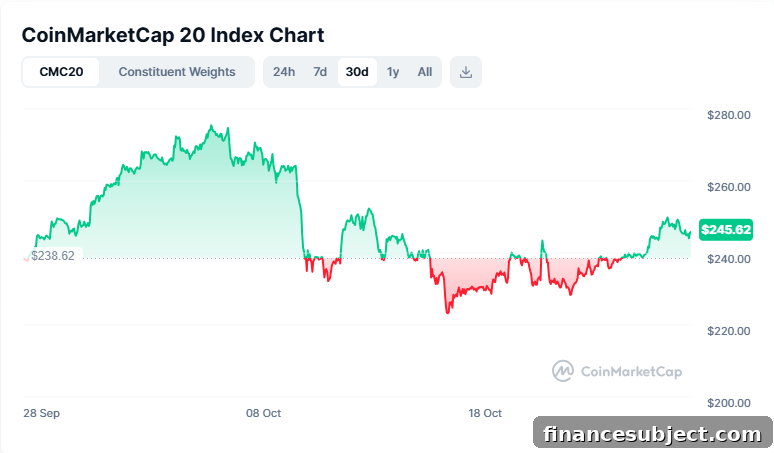
Crypto’s biggest-ever liquidation event—$19.16 billion lost
Between October 10 and 11 the crypto market suffered its largest recorded liquidation event. A confluence of macro headlines—most notably an announcement of proposed tariffs and export controls—sparked panic selling that cascaded through leveraged positions.
A liquidation event occurs when leveraged traders are forced to close positions because price moves rapidly against them. On October 10–11, falling prices triggered a massive round of forced closures that pushed prices down further and set off additional liquidations.
- Roughly $19.16 billion of leveraged positions were liquidated across crypto markets.
- About $16.7 billion of those liquidations were long positions—bets that the market would rise.
- An estimated 1.6 million traders were liquidated across exchanges and platforms.
During the October sell-off, Bitcoin declined by more than 17% (from roughly $126,000 to just above $104,000) while Ethereum dropped over 21% (from about $4,700 to near $3,700). For historical context, the October 2025 event stands as the largest liquidation in the market’s recorded history:
| Ranking | When | Liquidation value | Liquidated traders |
|---|---|---|---|
| 1 | October 2025 | $19.16 billion | 1.63 million |
| 2 | April 2021 | $9.94 billion | 1.03 million |
| 3 | May 2021 | $9.01 billion | 838,000 |
| 4 | February 2021 | $4.1 billion | 427,000 |
| 5 | September 2021 | $3.65 billion | 371,000 |
Should the liquidation scare you?
Whether this liquidation should prompt worry depends largely on your time horizon and risk tolerance.
- Short-term traders: If you are trading with the goal of capturing a quick end-of-year rally, this kind of volatility is a real risk. Short-term strategies can be derailed by fast, deep drawdowns—especially if positions are leveraged or if you are not prepared to hold through sharp swings.
- Long-term investors: For investors with a multi-year horizon who believe in the long-term case for Bitcoin and other major cryptocurrencies, sharp pullbacks can represent buying opportunities. Some market participants continue to express aggressive long-term price targets, but those are speculative and not guaranteed.
In all cases, consider position sizing, diversification, and the potential impact of leverage. Avoid investing funds you cannot afford to lose, and be prepared for extended periods of volatility.
Canadian crypto exchange fined CAD$177 million by FINTRAC
Regulation and platform integrity matter. Canadian crypto exchange Cryptomus was fined CAD$177 million by the Financial Transactions and Reports Analysis Centre of Canada (FINTRAC). FINTRAC’s investigation found numerous failures to properly report transactions and crypto wallets linked to serious criminal activity.
This enforcement action is a reminder that the crypto industry, while more regulated than in the past, still faces persistent risks from illicit activity and weak compliance in some firms. Canadian investors should prioritize platforms that operate within regulatory frameworks and apply robust anti-money‑laundering controls.
In Canada, securities regulators coordinate on crypto oversight through the Canadian Securities Administrators (CSA), which maintains lists of platforms authorized to do business with Canadians as well as platforms that are banned. Reviewing these resources and choosing exchanges that comply with Canadian rules can reduce some counterparty and regulatory risk.
Crypto price swings are common
Cryptocurrencies such as BTC, ETH, XRP, SOL, and BNB remain speculative and highly volatile. Even stablecoins, which are designed to maintain a stable value, can present risks if they are not properly collateralized or managed.
Investing in crypto carries market, technological, and regulatory risks. Before allocating capital, ensure crypto exposure fits your broader financial plan, risk tolerance, and investment timeline. Useful practices include: maintaining diversified allocations, avoiding excessive leverage, using regulated exchanges or custody providers, and keeping informed about scams and security best practices.
Volatility creates both opportunity and danger. Thoughtful risk management, careful platform selection, and a clear investment plan will help Canadian investors navigate the market’s inevitable ups and downs.
Read more about crypto:
- Will bitcoin crash in 2025?
- Bitcoin tops USD$100,000 for the first time
- Price of bitcoin hits new high after major political event, and other crypto headlines
- How to protect your crypto from hacks