
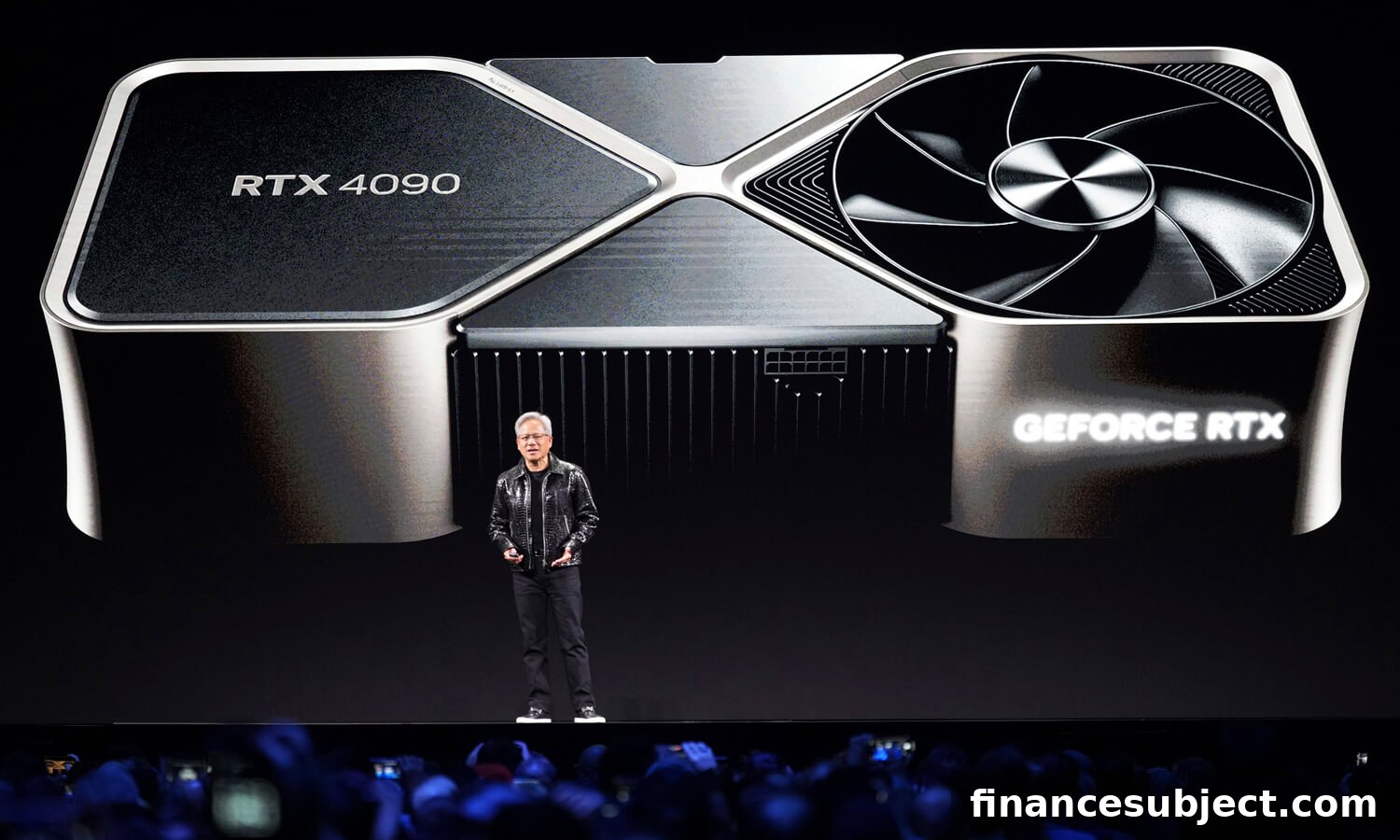
Nvidia reported a sharp rise in fourth-quarter profit and revenue as demand for its Blackwell AI chips—designed to power advanced artificial intelligence systems—continued to accelerate. For the three months ended Jan. 26, the Santa Clara, California-based company posted revenue of US$39.3 billion, an increase of 12% from the previous quarter and 78% from the same period a year earlier. Adjusted earnings were US$0.89 per share, and net income for the quarter reached US$22.06 billion.
How much did Nvidia earn?
Nvidia’s strong results were driven largely by surging demand for Blackwell architecture products. Founder and CEO Jensen Huang highlighted the momentum, saying that “demand for Blackwell is amazing” as new reasoning and longer-thinking AI workloads require more compute. The company said it scaled Blackwell production quickly, generating billions of dollars in sales in its first quarter of full availability.
Analysts had expected adjusted earnings of about US$0.85 per share on revenue near US$38.1 billion, so Nvidia’s numbers topped Wall Street estimates. Management provided a bullish outlook as well, forecasting approximately US$43 billion in revenue for the first quarter of fiscal 2026.
Data center sales, which make up the bulk of Nvidia’s revenue, were the central growth engine in the quarter. Data center revenue totaled US$35.6 billion, up 93% versus the prior year, reflecting widespread adoption of Nvidia GPUs by cloud service providers, enterprises, and large-scale AI developers.
Nvidia’s earnings call: talking points
On the company’s earnings call, Chief Financial Officer Colette Kress said Blackwell sales outperformed expectations. “We delivered US$11 billion of Blackwell architecture revenue in the fourth quarter of fiscal 2025, the fastest product ramp in our company’s history,” Kress said. She noted that large cloud service providers accounted for about half of Nvidia’s data center revenue in the quarter, underscoring how hyperscalers are central customers for the newest AI hardware.
How much is Nvidia worth?
Nvidia has emerged as a defining company of the AI era and is now one of the most valuable corporations on the stock market. At the close before the earnings release, Nvidia’s total market value was roughly US$3.215 trillion, making it the second-largest company in the S&P 500 behind Apple. Two years earlier, Nvidia’s market capitalization had been below US$600 billion, illustrating the speed of its ascent amid the AI boom.
Nvidia in the S&P 500
Nvidia and other AI beneficiaries have been a major driver of the S&P 500’s gains in recent months. Index performance has been heavily influenced by a small group of top-cap technology names, with Nvidia playing an outsized role in overall market returns.
The effect of tariffs
Market watchers have also focused on potential policy risks. Nvidia management said it is monitoring proposed tariffs and export controls closely and will comply with any new rules. Until the specifics of any administration plans are clear, the full impact of tariffs and trade measures on Nvidia’s business remains uncertain.
DeepSeek’s impact on Nvidia
The quarter was Nvidia’s first reporting period since Chinese AI company DeepSeek claimed it had created a large language model that could compete with top U.S. offerings while training more cost-effectively. The DeepSeek announcement briefly wiped out nearly US$595 billion of Nvidia’s market value on a single day as investors weighed whether future AI training demand might shift away from the highest-end GPU usage patterns.
Nvidia responded by praising DeepSeek’s technical contribution as a positive advance that used widely available models and compute consistent with export controls. Jensen Huang said the DeepSeek model—referred to as R1—has “ignited global enthusiasm,” and that many developers are adopting R1-style reasoning and reinforcement learning techniques to scale their models’ performance.
The next wave of AI: It’s coming
Huang told investors the industry is entering a new phase of AI development, pointing to “agentic AI” for enterprise applications, physical AI for robotics, and sovereign AI initiatives as regions build their own ecosystems. He said Nvidia is at the center of much of this development given the company’s hardware and software ecosystem that supports large-scale model training and inference.
Nvidia’s numbers, investors’ response
Investors reacted positively to the earnings beat: Nvidia shares rose in after-hours trading following the report. The company’s results reaffirmed its leadership in supplying AI accelerators for training and inference, even as competitors and alternative software approaches continue to evolve. The market’s strong focus on Nvidia reflects the degree to which AI-driven demand for chips and data center infrastructure can shape both corporate earnings and index-level performance.
Key figures from Nvidia’s recent reporting include the US$39.33 billion in quarterly revenue and US$130.5 billion in revenue for the full fiscal year that ended in January 2025—more than double the prior fiscal year and a dramatic increase over earlier years. Some estimates attribute roughly 22% of the S&P 500’s gain last year to Nvidia alone, highlighting the company’s outsized influence on markets.
The stock has also seen extreme volatility: it rose dramatically through 2024, gaining over 170% for the year, but experienced sharp, single-day declines tied to headline developments such as the DeepSeek announcement. Despite these swings, Nvidia’s rapid product ramps, strong data center demand, and an expanding ecosystem keep it central to conversations about the next phase of AI-driven growth.
By the numbers
- Market value near US$3.215 trillion (pre-earnings close)
- One-day share decline of about 17% after the DeepSeek announcement
- Quarterly revenue: US$39.33 billion, up 78% year-over-year
- Fiscal year revenue: US$130.5 billion, more than double the prior year
- Data center revenue for the quarter: US$35.6 billion, up 93% year-over-year
Additional context
Nvidia is also involved in broader infrastructure initiatives tied to AI deployment, including partnerships focused on data center build-outs and energy generation that support large-scale AI systems. As hardware vendors, cloud providers and software developers iterate on performance and cost, Nvidia’s near-term trajectory will depend on how demand for the latest accelerators balances with innovations that aim to reduce training costs or shift compute patterns.