

Look at almost any housing affordability index in Canada and you’ll notice a common limitation: most of them focus almost entirely on home prices and mortgage costs, and they leave out renters. That omission ignores roughly one-third of Canadians who rent. The Canada Mortgage and Housing Corporation (CMHC) has recognized this gap and released a more comprehensive housing affordability index that includes renters as well as owners, and covers many more regions beyond the usual major metros. The result is a fuller, clearer picture of affordability across the country.
The new CMHC index expands the way we measure affordability by combining information about both the ownership and rental markets. Rather than showing only how much disposable income is needed to buy a home, it also reports what it takes for households to afford rents and essential utility costs. As Joelle Hamilton, Communications & Marketing at CMHC, puts it: “By looking at both the rental and buying markets, we get a more complete view of affordability.”
What’s included in the new CMHC housing affordability index?
Traditional affordability measures typically assess house prices, mortgage rates and vacancy figures to estimate how much of a household’s income would be required to purchase a home. That’s useful for buyers, but it tells an incomplete story for those who rent or who live outside the biggest cities. The CMHC index aims to fix that by explicitly adding rental costs into the calculation and by reporting results for a wider set of regional markets.
CMHC still examines major centres like Vancouver and Toronto, but it also includes data for other important regional markets, giving analysts and the public a broader view of housing pressures. Hamilton notes that “if we focus only on those two cities, we miss what’s happening elsewhere in the country. When you break it down by market and region, the picture can look very different.”
Alongside Vancouver and Toronto, the index presents housing and rental data for several other metropolitan areas, including:
- Calgary
- Edmonton
- Halifax
- Montreal
- Ottawa
Why it matters
Mathieu Laberge, Chief Economist at CMHC, explains that affordability pressures have shifted over time. Two decades ago, problems were mostly concentrated in Vancouver and Toronto. But between 2020 and 2023 those pressures broadened, affecting many other regions. An affordability index that includes both renters and owners and that breaks down results by region makes that change much easier to see.
A conventional index that only tracks homeownership in Vancouver and Toronto can give a misleading impression that affordability challenges are limited to those cities. In fact, conditions have deteriorated in multiple regions, and a narrow focus can hide improvements or differences elsewhere.
Compare a chart that reports only the national homeownership picture with one that displays regional results: the national view can make homeownership seem uniformly unaffordable, whereas the regional view highlights important variation. For example, CMHC’s regional data show that affordability is currently strongest in Edmonton, and that several regions are showing signs of improvement.
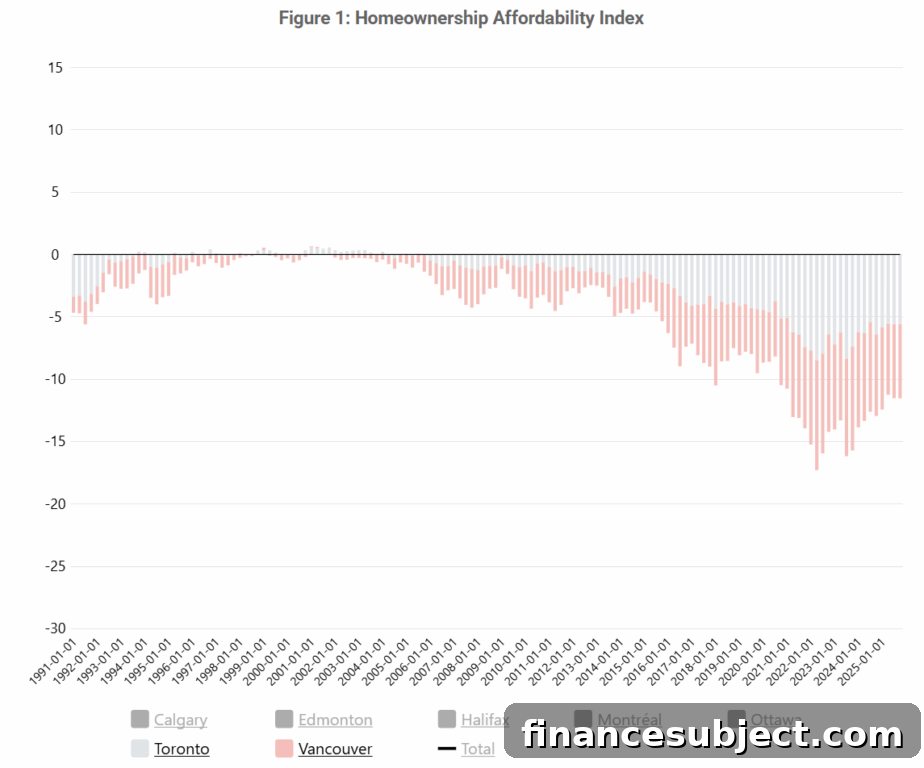
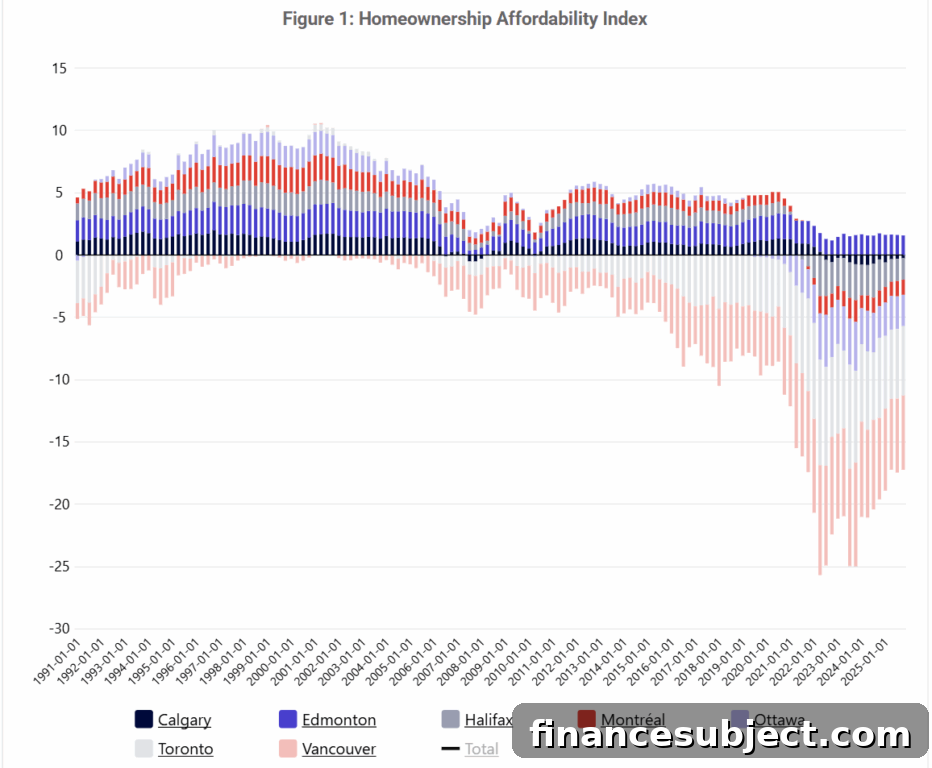
“Since 2023, we’ve seen slight improvements in some regions, particularly in Ottawa, Toronto, Vancouver, and Halifax,” Laberge said. “In Montréal, Calgary, and Edmonton, affordability appears to be stabilizing. That doesn’t mean challenges are gone, but it does suggest momentum may be shifting in some markets.”
Those distinctions may be subtle, but they matter for families deciding where to live and for policymakers planning housing supply. A more comprehensive index helps identify which regions are relatively more affordable and where supply-demand imbalances are largest, guiding better-targeted policy and development decisions.
What does the index tell us about the rental market?
One of the most useful features of the CMHC index is how it reveals variation in rental affordability across regions. If we relied only on data from Vancouver and Toronto, it would be easy to assume that renting is uniformly unaffordable across Canada. The expanded index shows a much more nuanced reality: rental costs and affordability vary significantly from one city to another.
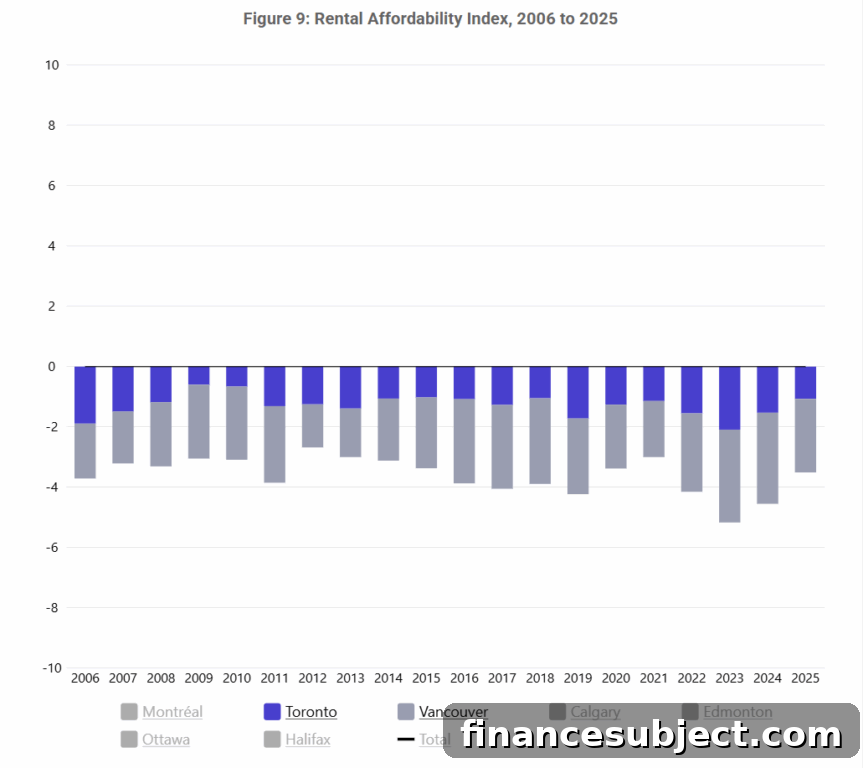
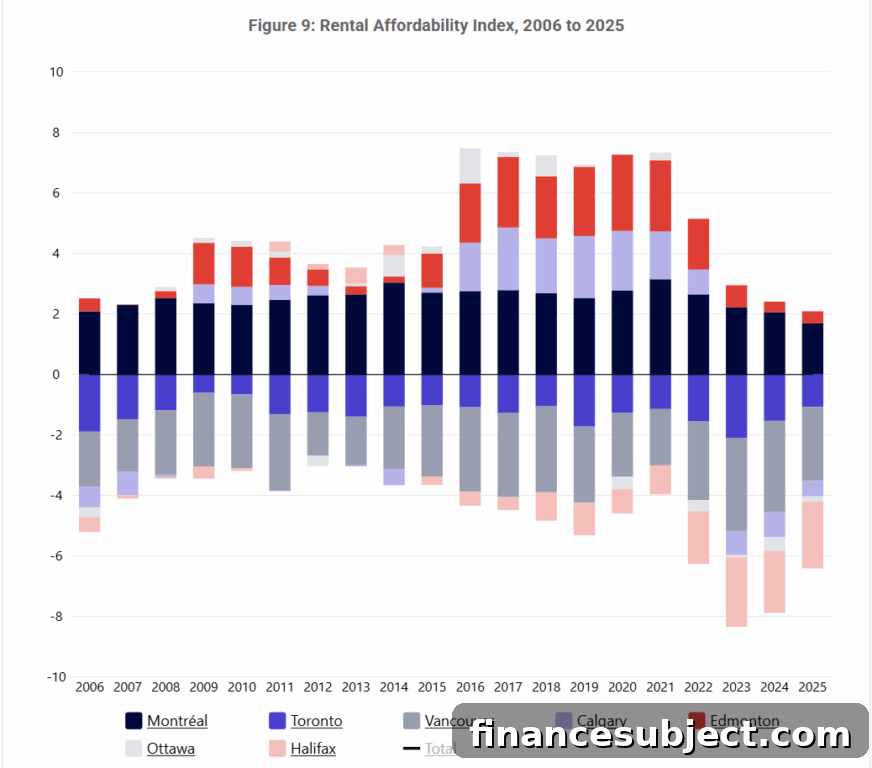
Overall, rental affordability tends to be more stable over time than homeownership affordability, which reacts more sharply to changes in interest rates and housing prices. By presenting both rental and ownership measures side by side, CMHC’s index helps reveal where pressures are most intense and what types of interventions might be most effective.
As Hamilton emphasizes, “By looking at both renting and buying, and by breaking it down by region, we get a clearer understanding of where pressures are strongest. And that helps us identify what kind of housing solutions are needed. Because better data leads to better decisions.”
FAQs
The 30% rent rule is a simple guideline suggesting renters should spend no more than 30% of their gross (before-tax) household income on rent and essential utilities such as electricity, heat, and water. The intention is to leave the remainder of income available for food, transportation, savings and other necessities.
No. Multiple organizations publish housing affordability indexes, including government agencies, provincial bodies, major banks and private firms. What distinguishes the CMHC index is its explicit inclusion of both rental and ownership markets and its broader regional coverage.
Rather than focusing only on home prices, the CMHC index combines data from rental and ownership markets and factors in broader affordability pressures such as household income levels, housing supply and demand, and typical housing-related costs. That produces a more complete indicator of how affordable housing is for different households in different regions.
Resource highlight
You’re 2 minutes away from getting the best mortgage rates.
Answer a few quick questions to get a personalized quote, whether you’re buying, renewing or refinancing.
Powered by ratehub.ca
Newsletter