

Kyle Prevost, editor of Million Dollar Journey and founder of the Canadian Financial Summit, summarizes the week’s top financial headlines and provides context for Canadian investors.
Raising the roof on the U.S. debt ceiling
Markets breathed a collective sigh of relief this week as U.S. lawmakers avoided a default by approving a bill to raise the debt ceiling. The House passed the measure 314 to 117, and the Senate followed late Thursday with a 63-36 vote. Global markets rallied on the news, and U.S. futures rose ahead of Friday trading.
The political reaction was predictably mixed. Representative Nancy Mace called the deal one-sided for progressives, while House Speaker Kevin McCarthy hailed it as a historic achievement. Former President Donald Trump said he would have accepted a default if necessary. The starkly different characterizations from members of the same party highlight how political messaging can diverge even when the outcome is clear: the federal government will continue paying bondholders at least through the next election cycle in 2025.
That continuity matters. Economists warned that a delayed deal would have had severe consequences. The Government Accountability Office has previously estimated that the 2011 debt ceiling showdown increased the government’s borrowing costs by roughly USD$1.3 billion. Treasury officials have stressed that brinkmanship over the debt limit harms businesses and families, raises short-term borrowing costs and risks jeopardizing the country’s credit standing.
Market observers noted a few sectors that could benefit from the agreement and its modest budget adjustments, including tax preparation firms, defense contractors and lenders with exposure to student loans. In short, the immediate relief for global markets was significant: the deal removed a major near-term tail risk and restored confidence that payments to creditors will continue uninterrupted.
It’s the economy, stupid!
Despite widespread talk of a recession—two-thirds of Canadians told a recent poll they believe the country is already in one—actual consumer behavior tells a different story. Statistics Canada reports that household spending rose 5.7% from the previous quarter, with travel spending climbing 6.8% as people resumed vacations and trips.
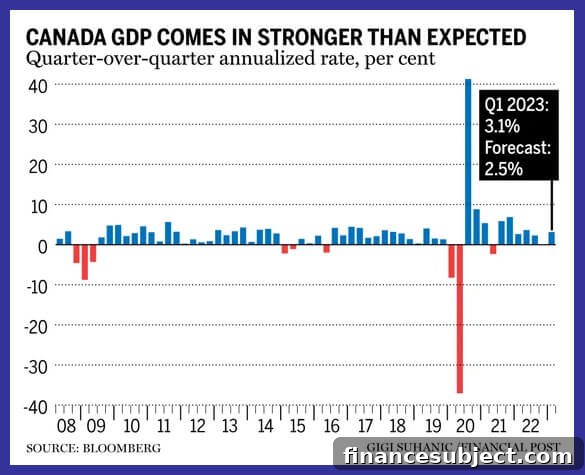
Canada’s economy outperformed expectations in the first quarter. StatCan reported annualized GDP growth of 3.1%, well above the 2.3%–2.5% analysts had forecast and a sharp improvement from the 0.1% decline recorded at the end of 2022. The stronger-than-expected reading has markets pricing in a higher probability of Bank of Canada rate increases: futures now imply a roughly 40% chance of a hike at the next meeting and expect at least one increase by September.
Whether that momentum is sustainable depends on consumers and the labour market. Canada’s jobs picture remains relatively strong, and similar robust U.S. employment data suggest North American demand could persist for several months. Still, maintaining a 3.1% growth pace will be challenging; elevated interest rates or weaker job growth could quickly cool spending.
Looking at future sales in the U.S.
U.S. corporate earnings painted a mixed picture this week. Technology and hardware companies reported largely solid quarters, but the market focused on guidance for future sales—an important signal for investors. Below are some notable results (U.S. dollars):
U.S. earnings highlights this week
- HP (HPQ/NYSE): Earnings per share of $0.80 (versus $0.76 predicted) and revenues of $12.91 billion (versus $13.04 billion predicted).
- Dell (DELL/NYSE): Earnings per share of $1.31 (versus $0.85 predicted) and revenues of $20.92 billion (versus $20.27 billion predicted).
- Dollar General (DG/NYSE): Earnings per share of $2.34 (versus $2.38 predicted) and revenues of $9.34 billion (versus $9.46 billion predicted).
- Lululemon (LULU/NASDAQ): Earnings per share of $2.28 (versus $1.98 predicted) and revenues of $2.0 billion (versus $1.93 billion predicted).
Some results challenged conventional recession narratives. Discount retailers like Dollar General are typically seen as recession-resistant, while premium brands such as Lululemon often suffer when consumers cut back. Yet this week Dollar General shares tumbled after mixed guidance, while Lululemon jumped sharply on an earnings beat despite ongoing inventory challenges. These moves underscore how forward-looking guidance and margin expectations often drive market reactions more than headline revenue or profit numbers.
To put it plainly: if consumers are increasingly willing to buy higher-priced discretionary items, that’s a sign demand is holding up. It’s a simple, if imprecise, lens for understanding whether the economy is weakening—or merely shifting.
Market continues to get Canadian earnings right
On the domestic front, Canadian companies delivered mostly modest results, with banks showing the familiar mix of steady earnings and caution. The following highlights are in Canadian dollars:
Canadian earnings highlights this week
- Laurentian Bank (LB/TSX): Earnings per share of $1.16 (versus $1.11 predicted) and revenues of $257.2 million (versus $255.3 million predicted).
- National Bank (NA/TSX): Earnings per share of $2.38 (versus $2.36 predicted) and revenues of $2.48 billion (versus $2.56 billion predicted).
- CAE (CAE/TSX): Earnings per share of $0.35 (versus $0.34 predicted) and revenues of $1.26 billion (versus $1.20 billion predicted).
Laurentian and National Bank wrapped up reporting season with largely in-line or slightly better-than-expected results. Both institutions noted higher provisions for credit losses—an indication of conservative risk management that can weigh on short-term profits but supports long-term stability. Each bank also announced modest dividend increases, signaling management confidence in ongoing earnings and capital positions.
CAE, the aerospace and defence training specialist, reported solid numbers but saw its shares slip after the company reduced future sales guidance. The reaction is another reminder that the market often penalizes softer outlooks, even when current results are acceptable.
This article or content package is presented by an advertising partner.
It was independently produced by MoneySense and is presented with financial support from the partner.