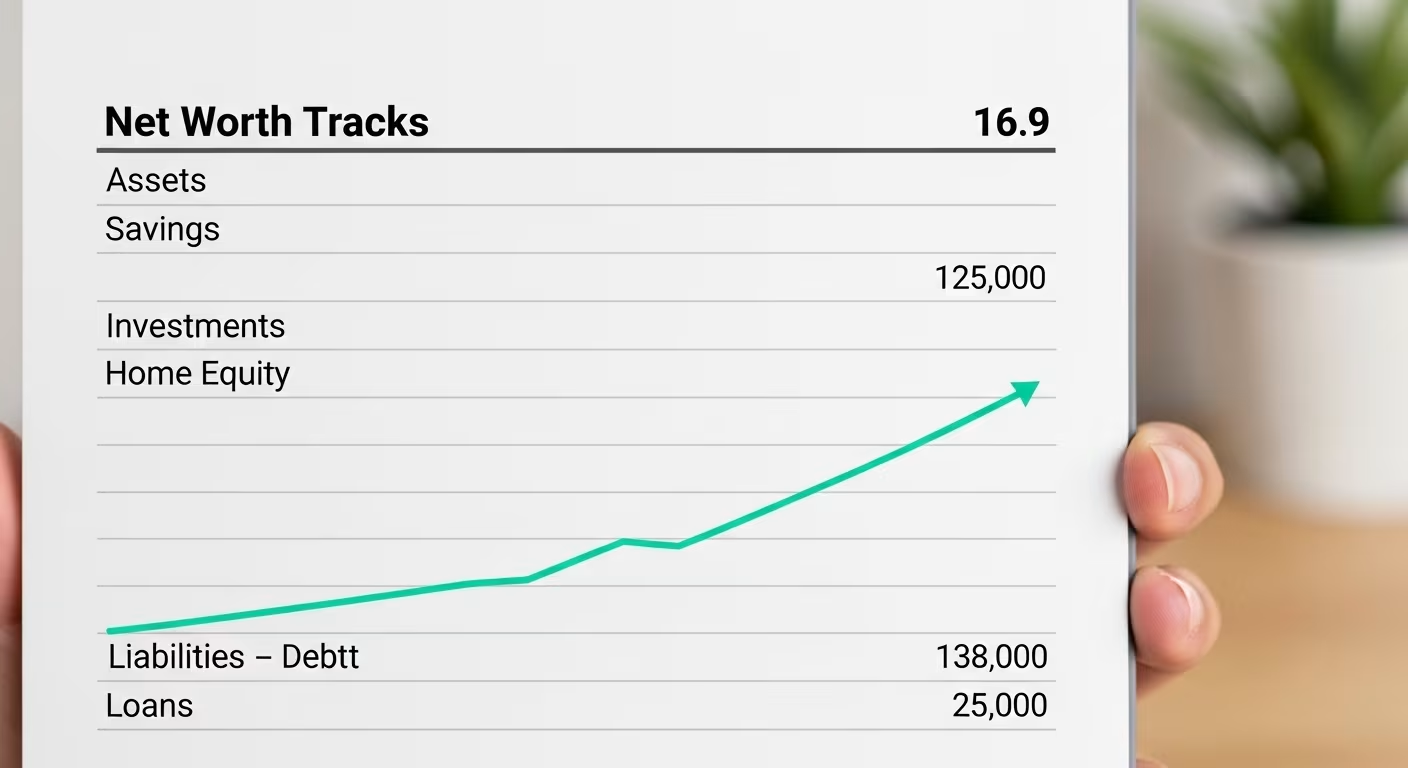
Net worth is the single most important number in personal finance. It tells you exactly where you stand financially—not where you think you stand, not where you want to be, but your actual financial position today. Understanding and tracking net worth transforms how you think about money.
What Is Net Worth?
Net worth is simple math:
Net Worth = Assets − Liabilities
Assets: Everything you own that has value Liabilities: Everything you owe
If you own $200,000 in assets and owe $150,000 in debt, your net worth is $50,000.
Why Net Worth Matters More Than Income
Income tells you how much money flows in. Net worth tells you how much you've kept.
Consider two people:
Person A: Earns $200,000/year, net worth of $50,000 Person B: Earns $60,000/year, net worth of $300,000
Who's in better financial shape? Person B—by a large margin. High income means nothing if it all flows out.
Net worth measures wealth. Income measures cash flow. Building wealth requires growing net worth, not just earning more.
Calculating Your Assets
Liquid Assets
Cash or items easily converted to cash:
| Asset | How to Value |
|---|---|
| Checking accounts | Current balance |
| Savings accounts | Current balance |
| Money market accounts | Current balance |
| Certificates of deposit | Current value |
| Cash on hand | Amount held |
| Series I Bonds | Current value (TreasuryDirect) |
Investment Assets
Wealth-building accounts:
| Asset | How to Value |
|---|---|
| 401(k) | Current balance |
| IRA/Roth IRA | Current balance |
| Brokerage accounts | Current value |
| HSA | Current balance |
| 529 plans | Current balance |
| Stock options (vested) | Current value minus exercise cost |
| Cryptocurrency | Current market value |
Real Estate
Property you own:
| Asset | How to Value |
|---|---|
| Primary residence | Current market value (Zillow, Redfin) |
| Rental properties | Current market value |
| Land | Current market value |
Note: Some financial advisors exclude primary residence from net worth calculations since it's not liquid and you need somewhere to live. Others include it. Decide which approach makes sense for you and be consistent.
Personal Property
Items of significant value:
| Asset | How to Value |
|---|---|
| Vehicles | Kelley Blue Book value |
| Jewelry | Appraised or insurance value |
| Art/collectibles | Appraised value |
| Furniture/electronics | Generally exclude (depreciated, illiquid) |
Most personal property isn't worth including unless it's valuable and could reasonably be sold.
Digital and Alternative Assets
| Asset | How to Value |
|---|---|
| Cryptocurrency (Bitcoin, Ethereum) | Current market value on major exchange |
| Domain names | Estimated sale value (GoDaddy appraisal) |
| Digital businesses (blogs, apps) | Revenue multiple (typically 2-4x annual profit) |
| Intellectual property | Royalty income capitalized, or recent comparable sales |
Crypto valuation note: Cryptocurrency prices fluctuate dramatically. Use the value at your tracking date and accept that next month it could be 20% higher or lower. For net worth purposes, treat crypto like any other volatile investment—include it at current market value, but don’t rely on it for stability.
Other Assets
| Asset | How to Value |
|---|---|
| Business ownership | Estimated value (complex to determine) |
| Cash value life insurance | Current cash value |
| Pension (if vested) | Present value of future payments |
Calculating Your Liabilities
Secured Debt
Debt backed by collateral:
| Liability | Current Balance |
|---|---|
| Mortgage | Outstanding balance |
| Home equity loan/HELOC | Outstanding balance |
| Auto loans | Outstanding balance |
Unsecured Debt
Debt without collateral:
| Liability | Current Balance |
|---|---|
| Credit cards | Outstanding balance |
| Personal loans | Outstanding balance |
| Student loans | Outstanding balance |
| Medical debt | Outstanding balance |
| 401(k) loans | Outstanding balance |
Other Liabilities
| Liability | Current Balance |
|---|---|
| Unpaid taxes | Amount owed |
| Judgments/liens | Amount owed |
| Family loans | Amount owed |
Net Worth Calculation Example
Sarah's Assets:
- Checking account: $5,000
- Savings account: $15,000
- 401(k): $85,000
- Roth IRA: $32,000
- Brokerage account: $12,000
- Home value: $350,000
- Car value: $18,000
Total Assets: $517,000
Sarah's Liabilities:
- Mortgage: $280,000
- Auto loan: $8,000
- Student loans: $22,000
- Credit cards: $3,000
Total Liabilities: $313,000
Sarah's Net Worth: $517,000 − $313,000 = $204,000
What Your Net Worth Means
Positive Net Worth
Assets exceed liabilities. You own more than you owe. This is the goal.
Negative Net Worth
Liabilities exceed assets. You owe more than you own. This is common early in life (student loans, first mortgage) but should trend upward.
Zero Net Worth
Assets equal liabilities. Better than negative, but no wealth accumulation yet.
Net Worth Benchmarks by Age
These are median net worth figures by age group in the United States (2026):
| Age | Median Net Worth | Good | Excellent |
|---|---|---|---|
| 25-34 | ~$40,000 | $75,000+ | $150,000+ |
| 35-44 | ~$135,000 | $250,000+ | $500,000+ |
| 45-54 | ~$250,000 | $500,000+ | $1,000,000+ |
| 55-64 | ~$365,000 | $750,000+ | $1,500,000+ |
| 65-74 | ~$410,000 | $1,000,000+ | $2,000,000+ |
These benchmarks vary significantly by location (cost of living) and circumstances (career, family size, homeownership).
The Wealth Formula
A common benchmark: By retirement, net worth should equal 10-12× annual income.
- Earn $80,000/year → Target $800,000-$960,000 by retirement
- Earn $150,000/year → Target $1,500,000-$1,800,000 by retirement
Tracking Net Worth Over Time
Why Track?
- See progress (or lack thereof) objectively
- Identify what's driving growth or decline
- Spot issues early (debt creeping up, savings stalling)
- Stay motivated with visible progress
How Often to Track
- Monthly: During aggressive saving/debt payoff phases
- Quarterly: For most people in stable situations
- Annually: Minimum frequency to spot trends
Tools for Tracking
Spreadsheet: Create your own or use templates
- Complete control
- No third-party access to data
- Requires manual updates
Personal finance apps:
- Empower (formerly Personal Capital): Free, automatic account linking, best net worth dashboard
- Monarch Money: Replaced Mint (which shut down in early 2024), clean interface, 4.99/month
- YNAB: Includes net worth tracking alongside budget, 4.99/month
- Copilot Money: iOS-focused, AI-powered categorization, .99/month
- Quicken Simplifi: Comprehensive tracking, .99/month
Free alternatives:
- Google Sheets with a net worth template (no account linking, fully private)
- Spreadsheet templates from r/personalfinance (customizable, community-tested)
Simple notes: Even a notes app with dated entries works—consistency matters more than tools
What to Record
Each tracking session, record:
- Date
- Total assets (by category)
- Total liabilities (by category)
- Net worth
- Change from last period
- Inflation-adjusted net worth (optional but valuable)
Adjusting for Inflation
A $500,000 net worth in 2026 isn’t the same as $500,000 in 2016. With cumulative inflation of roughly 35% over the past decade, you need approximately $675,000 today to match the purchasing power of $500,000 from 2016.
When tracking over multiple years, consider calculating your “real” net worth by adjusting for inflation. The Bureau of Labor Statistics CPI Inflation Calculator makes this straightforward. If your net worth grew 5% but inflation was 3%, your real growth was only about 2%.
Improving Your Net Worth
Net worth increases two ways:
- Increase assets
- Decrease liabilities
Strategies to Increase Assets
Invest consistently: Max out retirement accounts (2026 401(k) limit: $24,500). Open a brokerage account for additional investing.
Build emergency savings: Liquid assets provide stability and prevent debt accumulation.
Grow income: Career advancement, side hustles, skill development.
Home appreciation: Build equity through mortgage payments and market appreciation (though appreciation isn't guaranteed).
Compound growth: Time in the market grows investments exponentially.
Strategies to Decrease Liabilities
Aggressive debt payoff: Use avalanche or snowball method for consumer debt.
Avoid new debt: Every new loan is a step backward.
Refinance when beneficial: Lower interest rates accelerate payoff.
Pay extra on mortgage: Even $100/month extra significantly reduces principal over time.
Common Net Worth Mistakes
Overvaluing Assets
Cars: Your car is worth less than you think. Use Kelley Blue Book "private party" value, not dealer retail.
Home: Be conservative. Zillow estimates can be optimistic.
Personal property: Your furniture, clothes, and electronics are worth almost nothing used. Don't include them.
Ignoring Liabilities
Credit cards: Include full current balance, not just minimum payments.
Family loans: Real debt, even if interest-free.
Taxes owed: If you'll owe at tax time, include estimated liability.
Confusing Income and Wealth
High income doesn't guarantee high net worth. Track both separately.
Comparing Inappropriately
Your net worth vs. a 50-year-old's net worth isn't meaningful. Compare to your past self and appropriate benchmarks.
Net Worth and Financial Goals
Using Net Worth for Goal Setting
Retirement: Target 10-12× income by retirement age.
Financial independence: Net worth that generates enough investment income to cover expenses (typically 25× annual expenses).
Major purchases: House down payment represents a net-worth-neutral shift (cash to home equity).
Milestones Worth Celebrating
- First positive net worth (breaking even)
- First $10,000
- First $100,000 (often the hardest)
- First $250,000
- First $500,000
- First $1,000,000
Each milestone represents real wealth accumulation.
Net Worth Is Not Self-Worth
Your net worth doesn't define your value as a person. It's simply a financial measurement—one number among many that matter in life.
People with negative net worth can be:
- Happy
- Successful
- Valuable to their communities
- On the right track
Use net worth as a tool for financial awareness, not a scorecard for life success.
Taking Action Today
Calculate Your Net Worth Right Now
- Open a spreadsheet or document
- List every asset and its current value
- List every liability and its current balance
- Subtract liabilities from assets
- Write down the number
Commit to Tracking
Choose your frequency (monthly, quarterly, or annually) and schedule recurring reminders.
Identify One Improvement
Based on your calculation:
- If heavily weighted to liabilities: Focus on debt payoff
- If light on retirement assets: Increase 401(k) contribution
- If high cash, low investments: Consider investing more
Pro tip: Pick the same date each month (the 1st or the last day) so market fluctuations don’t create misleading comparisons. Consistency in timing matters as much as consistency in tracking.
Share With Your Partner
If you have a partner, calculate net worth together. Financial transparency strengthens relationships and ensures you’re working toward shared goals. Couples who track finances jointly report higher financial satisfaction and lower money-related conflict.
The Net Worth Mindset Shift
Once you start tracking, something shifts. Every purchase gets filtered through a new lens: "Does this increase my net worth, or decrease it?" A new car decreases it (depreciating asset plus loan). Maxing out your 401(k) increases it. Paying off a credit card increases it. This framework doesn’t mean never spending—it means spending consciously.
Knowing your net worth is the foundation of financial awareness. From here, every financial decision can be evaluated: Does this increase my net worth, or decrease it? That simple question transforms how you think about money.
Comments (0)
No comments yet. Be the first to share your thoughts!
Leave a Comment