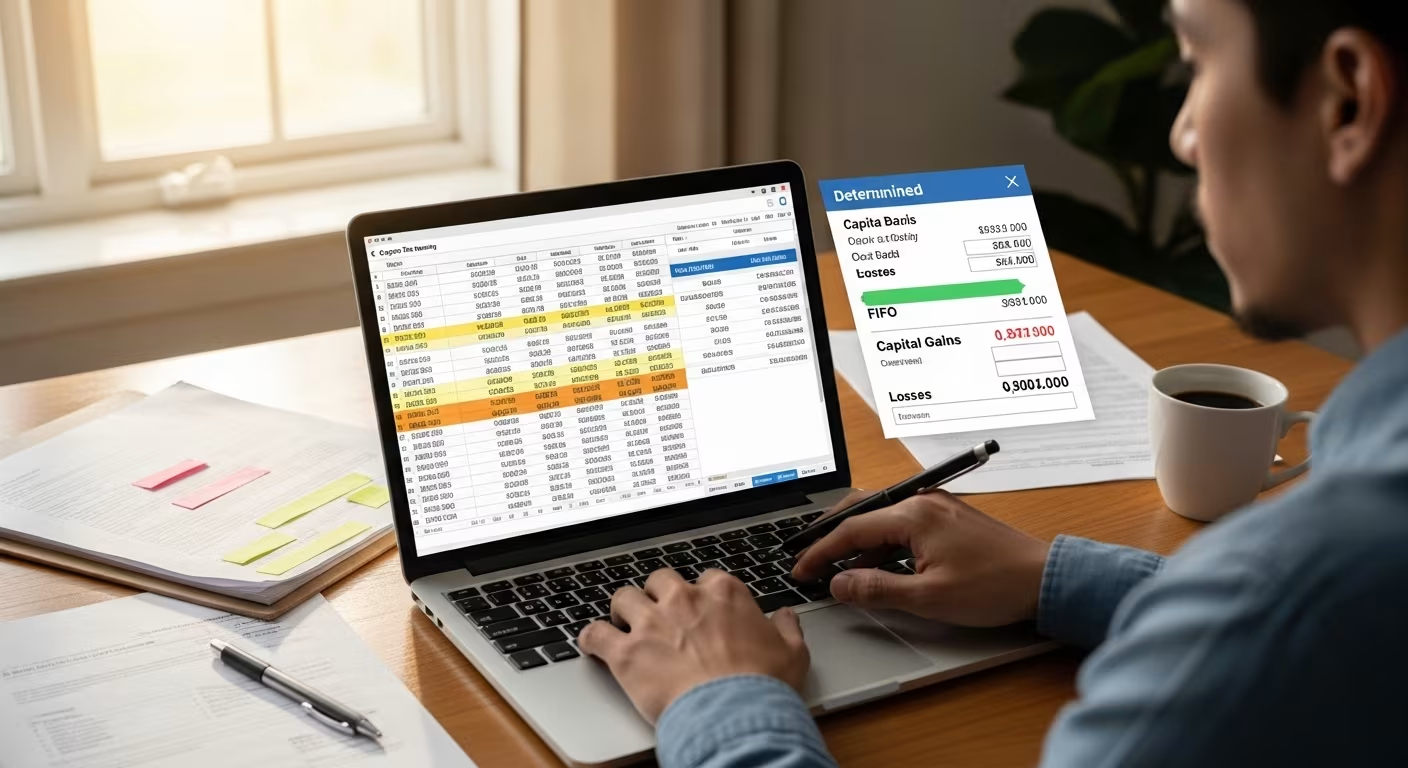
Cryptocurrency is no longer a niche asset—but tax rules remain confusing for many investors. The IRS treats crypto as property, meaning every sale, trade, or use triggers potential tax consequences. Here's everything you need to know to report your cryptocurrency correctly in 2026.
For investing basics and risk checks, SEC Investor.gov investing basics is the official investor education source.
For crypto tax reporting, check the IRS digital assets guidance before relying on any exchange summary.
Crypto Tax Rules (2026): What the IRS Requires
Taxable Events (You OWE Tax) | Event | How It Is Taxed | |-------|----------------| | Selling crypto for USD | Capital gains (short or long-term) | | Trading crypto for crypto (BTC to ETH) | Capital gains on the disposed crypto | | Using crypto to buy goods/services | Capital gains on the crypto spent | | Receiving crypto as income (mining, staking, airdrops) | Ordinary income at fair market value | | Earning crypto from DeFi yields | Ordinary income |
Non-Taxable Events (No Tax) | Event | Why | |-------|-----| | Buying crypto with USD | No gain or loss yet | | Transferring between your own wallets | No change in ownership | | Gifting crypto (under $18,000/year) | Gift tax exclusion | | Donating crypto to charity | Deduction for fair market value (no capital gains tax) |
Crypto Tax Calculation Example
You bought 1 ETH at $2,000 in January 2025. In March 2026, you sell it for $3,500.
- Cost basis: $2,000
- Sale price: $3,500
- Gain: $1,500
- Holding period: 14 months (long-term)
- Tax rate: 15% (long-term capital gains)
- Tax owed: $225
If you sold within 12 months (short-term), at the 22% bracket: $330 tax. Holding 14 months saved $105.
Best Crypto Tax Software (2026)
| Software | Price | Exchanges Supported | Best For |
|---|---|---|---|
| CoinTracker | Free-$199/year | 300+ | General investors |
| Koinly | Free-$279/year | 350+ | International users |
| TaxBit | Free-$175/year | 500+ | High-volume traders |
| CryptoTaxCalculator | $49-$299/year | 400+ | DeFi users |
IRS enforcement: The IRS now receives 1099 forms from major exchanges (Coinbase, Kraken, Gemini). Starting 2026, brokers must report cost basis on form 1099-DA. Not reporting crypto income is increasingly risky.
How the IRS Treats Cryptocurrency
Crypto Is Property, Not Currency
For tax purposes, cryptocurrency is treated as property—similar to stocks or real estate.
What this means:
- Every disposal is a taxable event
- Capital gains/losses rules apply
- You must track cost basis for every transaction
Taxable Events
You owe taxes when you:
- Sell crypto for cash (USD, etc.)
- Trade one crypto for another (BTC → ETH)
- Use crypto to buy goods or services
- Receive crypto as payment for work
- Receive certain airdrops or hard forks
- Earn staking rewards or DeFi yields
Not immediately taxable:
- Buying crypto with fiat currency
- Transferring between your own wallets
- Giving crypto as a gift (may have gift tax implications)
- Donating crypto to charity
Types of Crypto Income
Capital Gains (Most Common)
When you sell or trade crypto at a profit.
Short-term capital gains: Held one year or less → Taxed as ordinary income (10-37%)
Long-term capital gains: Held more than one year → Taxed at preferential rates (0%, 15%, 20%)
Example:
- Bought 1 BTC for $30,000
- Sold for $50,000
- Capital gain: $20,000
Ordinary Income
When you receive crypto for work or as reward.
Taxed as ordinary income:
- Mining income (fair market value when received)
- Staking rewards
- Airdrops (fair market value when received)
- Payment for goods/services
- Referral bonuses
Example:
- Received 0.1 ETH worth $300 as staking reward
- $300 is ordinary income
Calculating Cost Basis
What Is Cost Basis?
The original value of your crypto for tax purposes.
Includes:
- Purchase price
- Transaction fees
- Gas fees for acquisition
Cost Basis Methods
Specific identification: Choose which specific coins you're selling (requires documentation)
FIFO (First In, First Out): Oldest coins sold first (IRS default)
LIFO (Last In, First Out): Newest coins sold first (may result in lower gains)
Example using FIFO:
- Bought 1 BTC at $20,000 (January)
- Bought 1 BTC at $40,000 (June)
- Sold 1 BTC at $50,000 (December)
- FIFO basis: $20,000
- Gain: $30,000
Same example using LIFO:
- LIFO basis: $40,000
- Gain: $10,000
Tracking Challenges
The problem: Multiple purchases, exchanges, wallets, DeFi transactions
Solutions:
- Crypto tax software (CoinTracker, Koinly, TaxBit, CryptoTrader.Tax)
- Detailed spreadsheet tracking
- Exchange-provided records (often incomplete)
Reporting Requirements
Form 8949
Reports each crypto sale:
- Description (e.g., "1 BTC")
- Date acquired
- Date sold
- Proceeds
- Cost basis
- Gain or loss
Schedule D
Summarizes Form 8949:
- Total short-term gains/losses
- Total long-term gains/losses
- Net capital gain or loss
Schedule 1
Reports additional income including:
- Staking rewards
- Mining income
- Airdrops
The Crypto Question
Form 1040 asks: "At any time during [year], did you receive, sell, exchange, or otherwise dispose of any digital asset?"
You must answer "Yes" if you:
- Sold or traded any crypto
- Received crypto as payment
- Received staking/mining rewards
- Received airdrops
Answering "No" when "Yes" is accurate: Potential penalties, including criminal liability for tax evasion
Common Crypto Tax Situations
Trading Between Cryptocurrencies
BTC → ETH is taxable
You're "selling" BTC and "buying" ETH.
Example:
- Trade 1 BTC (basis $30,000, value $50,000) for 20 ETH
- Recognized gain: $20,000
- New ETH basis: $50,000
DeFi Activities
Liquidity pools:
- Adding: May be taxable (swapping for LP tokens)
- Removing: May be taxable (swapping LP tokens back)
- Yield: Ordinary income when received
Staking:
- Rewards: Ordinary income at fair market value when received
- New basis: Value when received
NFTs
Treated as property:
- Sale/trade triggers capital gains/losses
- Creating and selling: Ordinary income
- Royalties: Ordinary income
Mining
Income: Fair market value when coins are received Expenses: May be deductible if treated as business Self-employment tax: May apply if mining is business activity
Airdrops and Forks
Airdrops: Generally ordinary income when received (at fair market value)
Hard forks: Taxable when you receive new coins and have "dominion and control"
Basis: Fair market value at time of receipt
Tax-Saving Strategies
Hold for Long-Term Gains
Short-term vs. long-term rates:
- Short-term: Up to 37%
- Long-term: 0%, 15%, or 20%
Holding over one year can significantly reduce taxes.
Tax-Loss Harvesting
Sell losing positions to offset gains.
No wash sale rule (as of 2026): Can immediately repurchase same crypto
Note: Wash sale rules may eventually apply to crypto—check current regulations
Use the 0% Bracket
2026 single: $0-$48,350 taxable income 2026 married: $0-$96,700 taxable income
Strategy: Realize gains in low-income years at 0% rate
Specific Lot Identification
Choose which coins to sell to minimize gains.
Example: Multiple purchases at different prices—sell highest-basis coins first to minimize gain.
Requirement: Document and identify specific lots at sale time.
Donate to Charity
Donate appreciated crypto:
- Deduct fair market value
- Avoid capital gains tax
- Must have held over one year for full deduction
Gift to Lower-Income Family
Annual gift exclusion: $19,000 (2026)
Recipient takes your basis but may be in lower bracket.
Record Keeping
What to Track
For every transaction:
- Date
- Amount of crypto
- Cost basis (in USD)
- Fair market value at time
- Transaction fees
- Exchange or wallet used
- Purpose of transaction
How Long to Keep Records
Minimum: 3 years from filing date Recommended: 6-7 years If assets still held: Keep records until assets are disposed and time period expires
Tools and Software
Crypto tax software:
- CoinTracker
- Koinly
- TaxBit
- CryptoTrader.Tax
- Accointing
What they do:
- Import transactions from exchanges
- Calculate cost basis
- Generate tax forms
- Track portfolio
Limitation: May not capture all transactions (DeFi, cold wallets, etc.)
Common Mistakes to Avoid
Not Reporting at All
The IRS knows: Exchanges provide 1099 forms, blockchain is public
Penalties: Interest, accuracy penalties, potentially fraud charges
Forgetting Crypto-to-Crypto Trades
Every trade is taxable, not just cash-out transactions
Wrong Cost Basis
Common errors:
- Using zero basis (overpaying taxes)
- Not including fees
- Wrong cost basis method
Missing Income Events
Often forgotten:
- Staking rewards
- Airdrops
- Mining income
- Interest from crypto lending
Not Keeping Records
When records are lost: IRS may assume zero basis (maximum taxes)
IRS Enforcement
Increasing Scrutiny
IRS efforts:
- John Doe summons to exchanges
- 1099 requirements for exchanges
- Crypto question on Form 1040
- Dedicated crypto tax team
Form 1099 Reporting
Exchanges report:
- 1099-MISC for $600+ in income
- Form 1099-B for sales (expanding requirements)
Note: Even without 1099, you must report
Penalties
Accuracy penalty: 20% of underpayment Civil fraud: 75% of underpayment Criminal tax evasion: Up to $250,000 fine and 5 years prison
Taking Action
Throughout the Year
- Track every transaction as it occurs
- Use crypto tax software or detailed spreadsheet
- Note fair market value at acquisition for income events
- Consider tax implications before trading
At Tax Time
- Gather all exchange records
- Import transactions to tax software
- Verify cost basis calculations
- Generate Forms 8949 and Schedule D
- Report ordinary income on Schedule 1
- Answer Form 1040 crypto question accurately
If You're Behind
- Go back and reconstruct records as best as possible
- Consider voluntary disclosure if significant unreported income
- Work with crypto-savvy tax professional
- File amended returns if needed
Cryptocurrency taxation is complex but manageable with proper tracking and understanding. The key is treating every transaction as potentially taxable and maintaining detailed records. As IRS enforcement increases, proper reporting isn't just legal compliance—it's financial protection.
Crypto Tax Strategies for 2026
Hold for Long-Term Capital Gains Just like stocks, holding crypto for over 12 months qualifies for the lower long-term capital gains rate (0%, 15%, or 20% vs.
your ordinary income rate).
Gift Crypto Strategically You can gift up to $18,000 in crypto per person per year without triggering gift tax.
The recipient takes your cost basis—if you bought BTC at $500 and gift it at $50,000, they owe capital gains when they sell.
Donate to Charity Donating appreciated crypto held over 12 months directly to a 501(c)(3) gives you a deduction for the full fair market value and avoids capital gains tax entirely.
On $10,000 of crypto with a $1,000 cost basis, this saves $1,350 in capital gains tax.
Use Specific Identification Most exchanges default to FIFO (first-in, first-out) for cost basis.
Using specific identification lets you choose which lot to sell—selecting high-cost-basis lots minimizes your taxable gain. Check if your tax software and exchange support this method.
Offset Gains With Losses Unlike stocks, crypto is NOT subject to the wash sale rule (as of 2026—this may change).
You can sell crypto at a loss, immediately buy it back, and still claim the tax loss. This is a significant advantage over stock tax-loss harvesting.
Comments (0)
No comments yet. Be the first to share your thoughts!
Leave a Comment