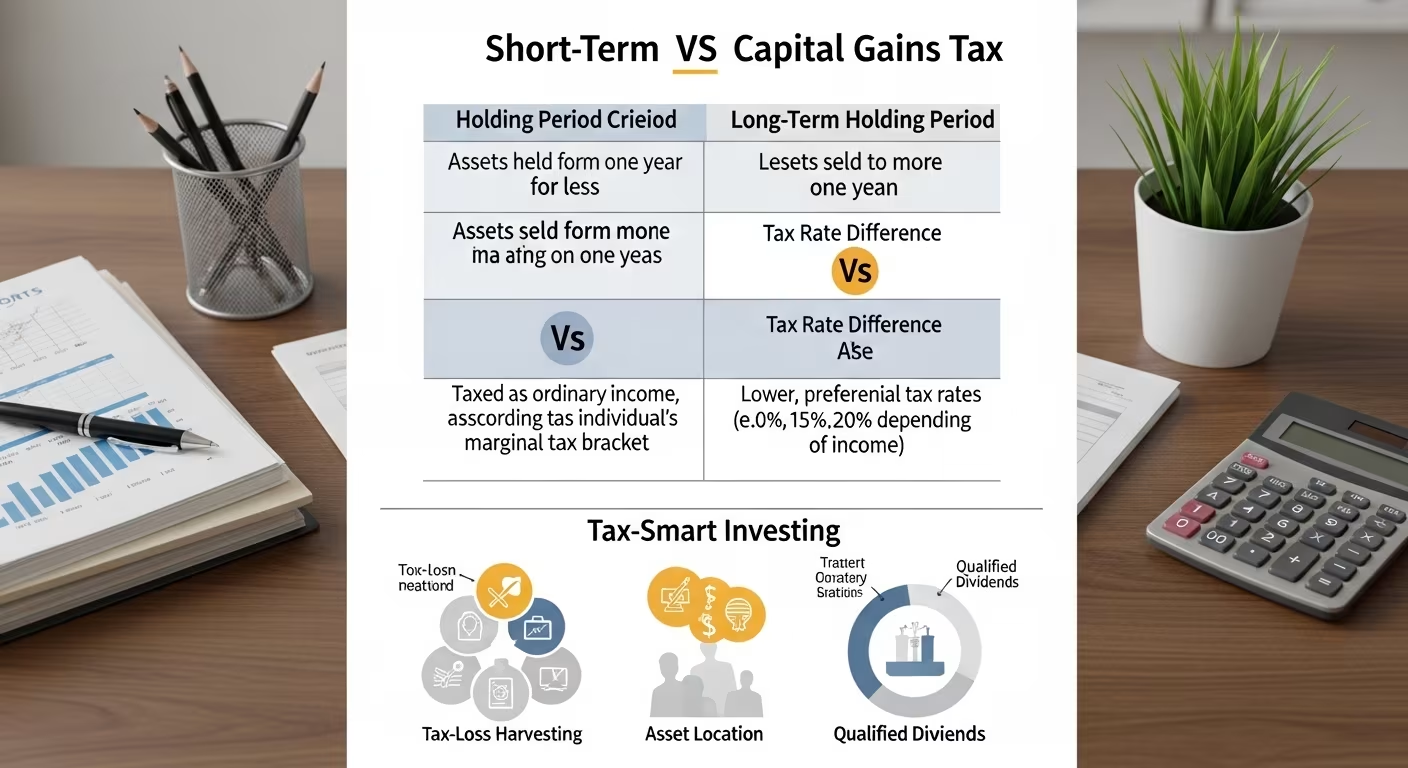
When you sell investments for a profit, you owe capital gains tax. But how much you pay depends significantly on how long you held the investment. Understanding the difference between short-term and long-term capital gains—and how to minimize taxes legally—can save you thousands.
Capital Gains Tax Rates (2026)
Short-Term Capital Gains (Assets Held Less Than 1 Year) Taxed as ordinary income at your marginal tax rate (10-37%).
Long-Term Capital Gains (Assets Held 1+ Years)
| Taxable Income (Single) | Tax Rate |
|---|---|
| $0 - $48,350 | 0% |
| $48,351 - $533,400 | 15% |
| $533,401+ | 20% |
Plus: Net Investment Income Tax (NIIT) of 3.8% on investment income for singles earning over $200,000 and couples over $250,000.
The Difference in Dollars
| Scenario | Short-Term (22% bracket) | Long-Term (15%) | Tax Savings |
|---|---|---|---|
| $5,000 gain | $1,100 tax | $750 tax | $350 saved |
| $10,000 gain | $2,200 tax | $1,500 tax | $700 saved |
| $50,000 gain | $11,000 tax | $7,500 tax | $3,500 saved |
| $100,000 gain | $22,000 tax | $15,000 tax | $7,000 saved |
The lesson: Holding investments for at least 366 days before selling can save you 7-22% on taxes. For a $100,000 gain, that is $7,000-22,000 in tax savings—just for waiting one extra day.
Tax-Loss Harvesting: Offset Your Gains
Sell losing investments to offset capital gains dollar-for-dollar. If you have $10,000 in gains and $7,000 in losses, you only pay tax on $3,000. Plus, you can deduct up to $3,000 in excess losses against ordinary income each year, carrying forward any remaining losses indefinitely.
Watch rule: You cannot buy back the "substantially identical" security within 30 days before or after selling at a loss (wash sale rule). Buy a similar but not identical fund (e.g., sell VTI, buy ITOT).
What Is Capital Gains Tax?
The Basic Concept
Capital gain = Selling price - Purchase price (cost basis)
Example:
- Bought stock for $5,000
- Sold for $8,000
- Capital gain: $3,000
You owe tax on that $3,000 gain.
Types of Capital Assets
Capital gains tax applies to:
- Stocks and bonds
- Mutual funds and ETFs
- Real estate (with exceptions)
- Cryptocurrency
- Collectibles
- Business interests
- Personal property (vehicles, jewelry)
Cost Basis
Your cost basis includes:
- Original purchase price
- Transaction fees (commissions)
- Reinvested dividends (for funds)
- Improvements (for real estate)
Higher basis = lower gain = less tax
Short-Term vs. Long-Term: The Critical Difference
Short-Term Capital Gains
Holding period: One year or less
Tax rate: Your ordinary income tax rate (10%-37%)
Example: 24% tax bracket + $10,000 short-term gain = $2,400 tax
Long-Term Capital Gains
Holding period: More than one year
Tax rate: Special preferential rates (0%, 15%, or 20%)
Example: $10,000 long-term gain at 15% rate = $1,500 tax
2026 Long-Term Capital Gains Rates
| Taxable Income (Single) | Rate |
|---|---|
| $0 - $48,350 | 0% |
| $48,351 - $533,400 | 15% |
| Over $533,400 | 20% |
| Taxable Income (Married Filing Jointly) | Rate |
|---|---|
| $0 - $96,700 | 0% |
| $96,701 - $600,050 | 15% |
| Over $600,050 | 20% |
The Holding Period Impact
$10,000 gain, 24% income tax bracket:
| Holding Period | Tax Rate | Tax Owed | After-Tax Gain |
|---|---|---|---|
| 11 months | 24% (ordinary) | $2,400 | $7,600 |
| 13 months | 15% (LTCG) | $1,500 | $8,500 |
Difference: $900 saved by waiting 2 more months
The Net Investment Income Tax (NIIT)
Additional 3.8% Tax
High earners pay an additional 3.8% surtax on net investment income.
Threshold:
- Single: MAGI over $200,000
- Married filing jointly: MAGI over $250,000
Applies to: Capital gains, dividends, interest, rental income, passive income
Combined Maximum Rates
For highest earners:
- Long-term capital gains: 20% + 3.8% NIIT = 23.8%
- Short-term capital gains: 37% + 3.8% NIIT = 40.8%
How Different Investments Are Taxed
Stocks and ETFs
Short-term: Ordinary income rates Long-term: Preferential LTCG rates (0%, 15%, 20%)
Mutual Fund Distributions
Even if you don't sell, mutual funds may distribute capital gains annually.
Types:
- Short-term capital gain distributions: Taxed as ordinary income
- Long-term capital gain distributions: Taxed at LTCG rates
Tax-efficient alternative: ETFs or tax-managed funds
Real Estate
Primary residence:
- Exclusion: Up to $250,000 gain (single) or $500,000 (married)
- Must have owned and lived in for 2 of last 5 years
Investment property:
- Subject to capital gains tax
- Depreciation recapture taxed at 25%
- 1031 exchange can defer gains
Collectibles
Items: Art, antiques, coins, stamps, precious metals
Tax rate: Maximum 28% (regardless of holding period)
Cryptocurrency
Treated as property:
- Short-term: Ordinary income rates
- Long-term: LTCG rates
Every trade is taxable: Crypto-to-crypto exchanges trigger gains/losses
Tax-Saving Strategies
Hold for Long-Term
Simple but powerful: Wait at least a year and a day before selling appreciated assets.
The math: 15% vs. 22-37% (depending on bracket) = significant savings
Harvest Tax Losses
Tax-loss harvesting: Sell investments at a loss to offset gains
Example:
- $10,000 long-term gain from Stock A
- $4,000 loss from Stock B
- Net taxable gain: $6,000
Excess losses: Up to $3,000 can offset ordinary income; remainder carries forward
Wash sale rule: Can't repurchase "substantially identical" security within 30 days
Use the 0% Bracket
Strategy: In low-income years, realize gains at 0% rate
Examples:
- Year between jobs
- Early retirement before Social Security
- Graduate school year
How: Sell appreciated investments, immediately repurchase at higher basis
Offset Gains with Losses
Netting rules:
- Short-term gains offset by short-term losses
- Long-term gains offset by long-term losses
- Net short-term and net long-term offset each other
Strategy: Harvest losses to match gains realized
Give to Charity
Donate appreciated assets instead of cash:
- Deduct full fair market value
- Avoid paying capital gains tax
- Must have held over one year
Example: $10,000 stock with $3,000 basis
- Sell and donate cash: Pay ~$1,050 LTCG, donate $10,000
- Donate stock directly: No LTCG, deduct $10,000
Step-Up in Basis at Death
What it means: When you die, heirs receive assets at current market value (stepped-up basis)
Impact: All unrealized gains are never taxed
Strategy: Hold highly appreciated assets until death (for estate planning)
Qualified Opportunity Zones
Defer and reduce capital gains by investing in qualified opportunity zone funds
Benefits:
- Defer gain until 2026 (or sale of QOZ investment)
- Exclude 10% of gain if held 5+ years
- Exclude future gains if held 10+ years
Capital Gains and Retirement Accounts
Tax-Advantaged Accounts
Inside 401(k), IRA, Roth IRA: No capital gains tax on trades
Traditional accounts: Pay ordinary income tax on all withdrawals Roth accounts: Pay nothing on qualified withdrawals
Strategy Implications
Hold high-growth investments in tax-advantaged accounts when possible Hold tax-efficient investments (index funds, stocks you'll hold long-term) in taxable
Reporting Capital Gains
Form 8949
Reports each sale:
- Description of property
- Date acquired
- Date sold
- Proceeds
- Cost basis
- Gain or loss
Schedule D
Summarizes Form 8949:
- Total short-term gains/losses
- Total long-term gains/losses
- Net capital gain or loss
Cost Basis Reporting
Since 2011, brokerages report cost basis to IRS (for covered securities)
Still verify: Ensure reported basis is correct, especially for older holdings
Common Situations
Inherited Investments
Basis: Stepped up to value at date of death Holding period: Automatically long-term
Example:
- Parent bought stock at $10
- Worth $100 at death
- Your basis: $100 (no tax on $90 gain)
Gifted Investments
Basis: Donor's original basis (carryover) Holding period: Includes donor's holding period
Exception: If fair market value is less than donor's basis, special rules apply
Divorce Transfers
Between spouses: Generally tax-free Basis: Carries over from spouse
Home Sale
Exclusion: $250,000 (single), $500,000 (married) Requirements: Owned and lived in for 2 of last 5 years
Planning Throughout the Year
January-November
- Track realized gains and losses
- Identify tax-loss harvesting opportunities
- Consider holding period before selling
December
- Calculate year-to-date gains/losses
- Harvest losses if beneficial
- Realize gains at 0% rate if applicable
- Review mutual fund expected distributions
At Tax Time
- Gather all 1099-B forms
- Verify cost basis accuracy
- Complete Form 8949 and Schedule D
- Consider impact on other taxes (Medicare premiums, etc.)
Taking Action
For Current Investments
- Review holding periods before selling
- Calculate unrealized gains/losses
- Identify tax-loss harvesting opportunities
- Consider which accounts hold which investments
For New Investments
- Buy in tax-appropriate accounts
- Track cost basis from the start
- Plan for long-term holding when possible
Annually
- Review portfolio for harvesting opportunities
- Check mutual fund expected distributions
- Rebalance in tax-efficient manner
- Consider Roth conversions in low-income years
Understanding capital gains tax is essential for investment success. The difference between short-term and long-term rates is substantial—often 10-20 percentage points. By holding investments long-term, harvesting losses strategically, and using tax-advantaged accounts wisely, you can keep more of your investment gains where they belong: in your pocket.
Strategies to Minimize Capital Gains Tax
1. Hold for the Long Term The simplest strategy: hold investments for at least 366 days to qualify for long-term rates.
The difference between 22% (short-term, income bracket) and 15% (long-term) on $50,000 in gains saves $3,500.
2. Use Tax-Loss Harvesting Sell losing investments to offset winning investments.
$20,000 in gains offset by $15,000 in losses means you only pay tax on $5,000. Plus $3,000 of excess losses can offset ordinary income.
3. Donate Appreciated Stock to Charity Instead of selling stock and donating cash, donate the stock directly.
You get a full fair market value deduction AND avoid paying capital gains tax entirely. On $10,000 of appreciated stock with a $3,000 cost basis, this saves $1,050 in capital gains tax plus provides a $2,200 income tax deduction (22% bracket).
4. Use the 0% Capital Gains Bracket In 2026, singles with taxable income under $48,350 pay 0% long-term capital gains tax.
Retirees and gap-year workers can strategically sell investments in low-income years to realize gains tax-free.
5. Step-Up in Basis at Death Inherited investments receive a "step-up" in cost basis to the fair market value at the date of death.
If your parent bought stock at $10 and it is worth $100 when they die, your cost basis is $100—not $10. Selling immediately triggers zero capital gains.
Comments (0)
No comments yet. Be the first to share your thoughts!
Leave a Comment