

In this series
- An intro to couch potato portfolios
- How to build a couch potato portfolio
- Building an advanced couch potato portfolio
A couch-potato portfolio can be assembled in three straightforward ways: using index mutual funds, index exchange-traded funds (ETFs), or one-ticket asset-allocation ETFs. Each approach has trade-offs in cost, simplicity and control. Below we outline representative sample portfolios to illustrate the options—these examples are educational and not investment advice. If you’re new to this approach, review the core principles behind how to build a couch-potato portfolio and the overall couch-potato investing overview before making decisions with your money.
Option 1: Build a mutual fund portfolio
Many Canadian banks and large providers offer affordable index mutual funds you can use to construct a diversified portfolio. If you hold accounts at the provider, you may also have access to guidance or basic advice as part of the relationship.
Your mutual fund options
TD’s e-Series index funds are the most widely known example, but other major institutions such as Scotiabank, RBC and CIBC offer comparable index mutual funds. These products let you combine domestic and global equity exposure with fixed income to match your risk tolerance.
For example, a typical mid-career investor with moderate risk tolerance might hold a mix that balances growth and income. More conservative investors often increase fixed-income allocations up to 80%, while growth-oriented investors may reduce bonds to 20% or less.
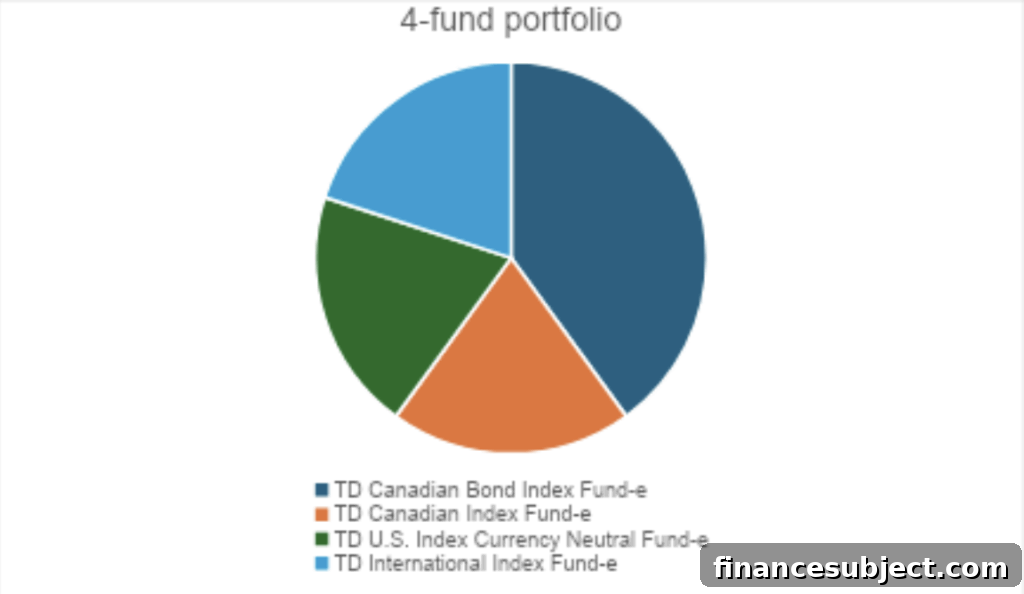
Tangerine (the online banking arm of Scotiabank) offers single mutual fund solutions that simplify portfolio construction, similar in purpose to asset-allocation ETFs but structured as mutual funds. Their offerings typically include balanced and growth-oriented portfolios—Core Balanced (roughly 60% stocks/40% bonds), income-focused, growth-focused and all-equity options—so you can pick one that matches your risk profile.
Mutual fund fees
Index mutual funds charge management expense ratios (MERs) that are generally lower than actively managed funds but higher than comparable ETFs. TD’s e-Series funds typically have MERs in the 0.25%–0.5% range, while Tangerine’s all-in-one portfolios are over 1%.
Mutual fund pros and cons
| Pros | Cons |
|---|---|
| No brokerage commissions to buy or sell fund units | Higher ongoing management costs than equivalent ETFs |
| Familiar structure for investors used to mutual funds | |
| Optional advice or guidance available from the provider |
Rankings
Compare the best TFSA rates in Canada
Option 2: Build an ETF portfolio
Core ETF portfolios can be simple—two to four ETFs can cover global equities, domestic equities, U.S. exposure and domestic fixed income. ETFs are typically the most cost-efficient method for building a diversified, low-maintenance portfolio, but they require more initial setup and occasional rebalancing.
All sample ETF portfolios below assume moderate risk and return expectations. You can shift toward more conservative or more growth-oriented allocations by adjusting the weightings between equities and fixed income. Asset-allocation ETF options are discussed in the next section for investors who prefer a one-ticket solution.
Your ETF options
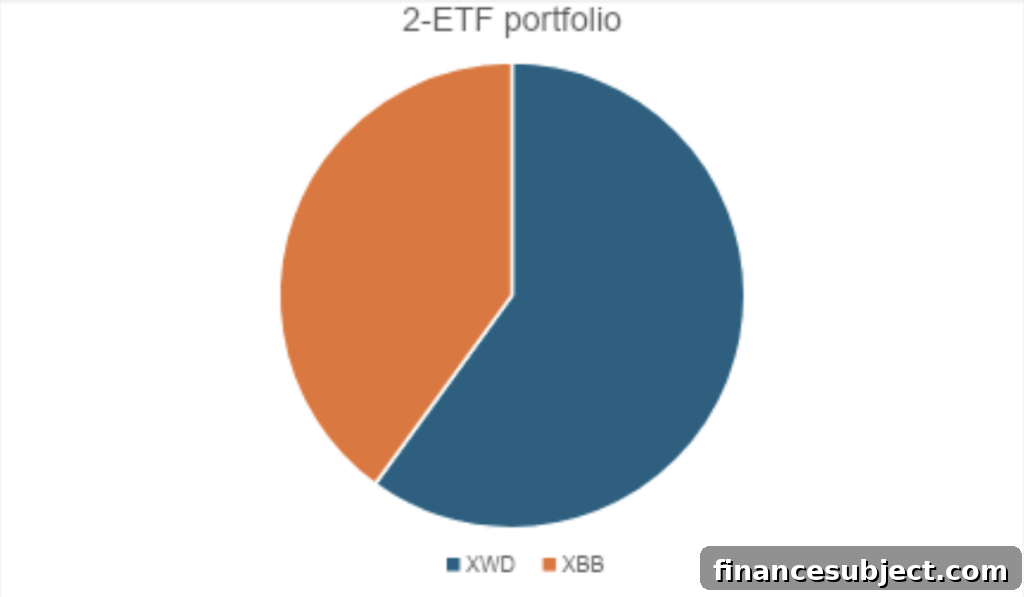
A straightforward ETF approach is to pair a broad Canadian bond ETF—such as iShares Core Canadian Universe Bond ETF (XBB) or Vanguard Canadian Aggregate Bond ETF (VAB)—with a global equity ETF that covers multiple geographies like iShares MSCI World Index ETF (XWD). Using a global equity fund will typically increase U.S. exposure and reduce the relative weight of Canadian equities, and global funds often carry slightly higher MERs (around 0.2%).
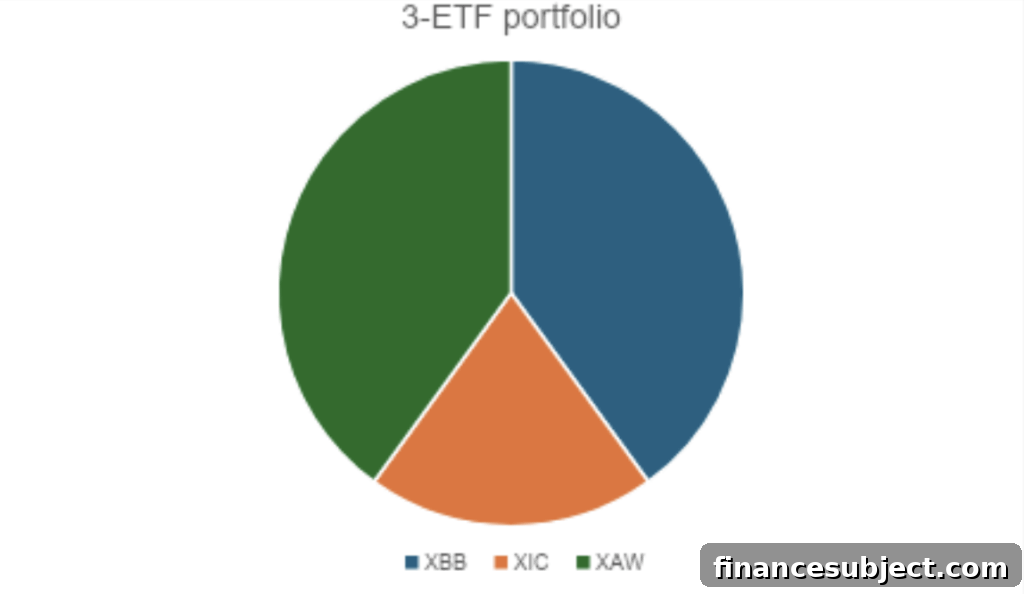
There are many comparable ETFs from providers such as BMO, Vanguard, TD and Global X. If you prefer to retain a higher Canadian equity allocation, an alternative three-ETF mix would include a Canadian equity ETF (e.g., iShares Core S&P/TSX Capped Composite Index ETF, XIC), a global ex-Canada equity ETF (e.g., iShares Core MSCI All Cap World ex-Canada Index ETF, XAW), and a bond ETF.
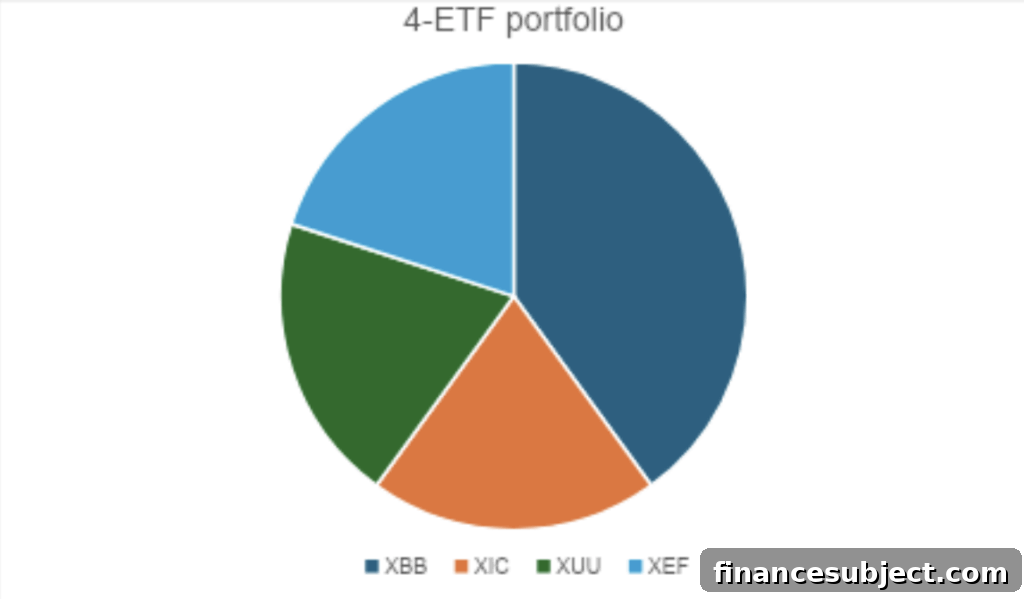
Another approach divides equities into U.S., Canadian and international slices. That increases customization and may reduce costs for certain exposures, but it requires more attention to rebalancing and portfolio upkeep.
For U.S. exposure, funds such as iShares Core S&P US Total Market Index ETF (XUU) are common choices; for international developed markets, an ETF like iShares Core MSCI EAFE IMI Index ETF (XEF) can be used. Many providers offer equivalent options—research current fund details and fees before choosing.
ETF fees
Index ETFs are typically the lowest-cost way to implement a passive portfolio, assuming you avoid frequent trading that incurs brokerage commissions. A well-constructed ETF portfolio will often have a blended MER around 0.1% per year (a bit higher for international equity exposures), which means fees have minimal impact on long-term returns.
ETF pros and cons
| Pros | Cons |
|---|---|
| Highly cost-effective and tax-efficient in many account types | Requires more hands-on setup and occasional rebalancing compared with one-ticket funds |
| Flexible customization of asset allocation to match time horizon and risk tolerance |
Rankings
The best ETFs in Canada
Option 3: Buy an asset-allocation ETF
Asset-allocation ETFs—often called one-ticket, all-in-one or multi-asset ETFs—hold a diversified mix of equities and fixed income inside a single fund. They typically achieve this by investing in the fund company’s own index ETFs. These products are ideal for investors who prefer minimal maintenance: buy one ETF, enable dividend reinvestment (DRIP) if you wish, and the fund will maintain its target allocation through automatic rebalancing.
Your asset-allocation ETF options
Major providers offer similar multi-asset ETFs; the primary decision is the level of equity versus bonds you want based on your time horizon and risk tolerance. Conservative multi-asset funds generally hold about 80% bonds and 20% stocks; balanced options typically range from 40%–60% bonds to 40%–60% stocks; growth or all-equity versions may be 80%–100% stocks and suit younger investors with longer horizons.
If your time horizon is very short (one or two years) and preservation is critical, a multi-asset ETF may not be appropriate—you might prefer cash equivalents such as high-interest savings or money-market funds instead.
For specific fund suggestions, review current lists of best all-in-one ETFs from reputable sources to compare fees, holdings and historical performance.
| Time horizon | 1–2 years | 3–5 years | 5–7 years | 7–10 years | 10+ years |
|---|---|---|---|---|---|
| Risk level | No risk | Low | Low–medium | Medium | Medium–high |
| Potential decline | None | 5%–15% | 10%–35% | 20%–45% | 25%–55% |
| Stock-to-bond ratio | None | 70%–80% bonds, 20%–30% stocks | 40%–60% bonds, 40%–60% stocks | 20%–30% bonds, 70%–80% stocks | 0%–10% bonds, 90%–100% stocks |
| Portfolios | Cash and GICs | iShares XINC | iShares XCNS | iShares XGRO | iShares XEQT |
| Vanguard VCIP | iShares XBAL | Vanguard VGRO | Vanguard VEQT | ||
| TD TOCC | Vanguard VCNS | BMO ZGRO | Global X HGRO | ||
| Vanguard VBAL | Global X HBAL | TD TOCA | |||
| BMO ZCON | |||||
| Global X HCON | |||||
| TD TOCM |
Asset-allocation ETF fees
Asset-allocation ETFs typically charge MERs in the 0.17%–0.24% range with the largest providers. You’ll also pay any applicable brokerage fees when buying or selling, though many brokers now offer commission-free ETF trades.
Asset-allocation ETF pros and cons
| Pros | Cons |
|---|---|
| Minimal monitoring and rebalancing—fund automatically maintains its target allocation | Allocation and geographic exposure may not match your personal preference (some provider funds overweight Canadian equities relative to Canada’s share of global market cap) |
| Simple to use—one fund does the work of several | Slightly higher MERs than holding the cheapest individual equity and bond ETFs separately |
Newsletter