

Welcome to the Canadian Crypto Observer. Financial journalist and author Aditya Nain provides concise market analysis to help Canadian investors understand developments in the cryptocurrency space.
The year 2025 marked an important turning point for bitcoin (BTC) and the broader cryptocurrency market. In the United States, the passage of the GENIUS Act formalized rules for U.S. dollar stablecoins and reinforced crypto’s status as a mainstream asset class. At the same time, exchange-traded funds (ETFs) focused on cryptocurrencies expanded in Canada, the U.S. and other jurisdictions, making it easier for investors to gain exposure to BTC, ethereum (ETH), Solana (SOL) and other tokens without navigating wallets, exchanges or custody concerns. For many investors, buying a crypto ETF has become as straightforward as purchasing an S&P 500 or S&P/TSX index ETF.
How did bitcoin perform as an investment in 2025? Although BTC finished the year down only modestly—about 7.32% from the opening to the close of 2025—the year was marked by significant intra-year volatility. The table below shows BTC’s performance by quarter for 2025.
| Closing price on the first day of the quarter (A) | Closing price on the last day of the quarter (B) | % change from (A) to (B) | |
|---|---|---|---|
| Q1 (Jan–Mar) | $94,419 | $82,548 | (12.57%) |
| Q2 (Apr–Jun) | $85,169 | $107,135 | 25.79% |
| Q3 (Jul–Sep) | $105,698 | $114,056 | 7.90% |
| Q4 (Oct–Dec) | $118,649 | $87,508 | (26.34%) |
| Closing price on the first day of the year (C) | Closing price on the last day of the year (D) | % change from (C) to (D) | |
|---|---|---|---|
| Entire year (Jan–Dec) | $94,419 | $87,508 | (7.32%) |
What the Venezuela crisis means for BTC
Early 2026 brought a dramatic geopolitical event: U.S. special forces carried out an operation in Venezuela, detaining the country’s leader, Nicolás Maduro, and his wife, Cilia Flores, and transporting them to New York to face charges. Geopolitical shocks like this can change investor behavior, and bitcoin has reacted accordingly.
Bitcoin behaves in two distinct ways in markets. At times it acts like a safe-haven asset, similar to gold, appreciating when geopolitical risk rises. At other times it behaves more like a high-growth technology or risk asset—rallying when liquidity is ample and investor sentiment is optimistic. In the weeks after the Venezuela operation, BTC traded more like a safe-haven asset, rising on increased geopolitical risk.
Also read
The best crypto platforms and apps
We’ve ranked the best crypto exchanges in Canada.
From the start of 2026 through mid-January, bitcoin gained more than 8% while gold rose roughly 5%. That relative performance reflects investor demand for assets that can provide a degree of independence from U.S. policy influence. Both gold and bitcoin are globally traded stores of value that many investors consider “hard” assets—less prone to direct manipulation or excessive inflation by any single government.
That said, a geopolitical risk premium does not guarantee a sustained rally. Bitcoin’s longer-term direction in 2026 will depend on macroeconomic conditions, including inflation trends and central bank policy.
BTC’s path in 2026 will hinge on inflation and interest rates
Bitcoin often benefits from two different forces: safe-haven demand during geopolitical stress, and risk-on flows when interest rates are low and liquidity is plentiful. For a sustained bitcoin advance in 2026, inflation—particularly in the U.S., the world’s largest capital market—would likely need to remain subdued and interest rates would need to stay relatively low.
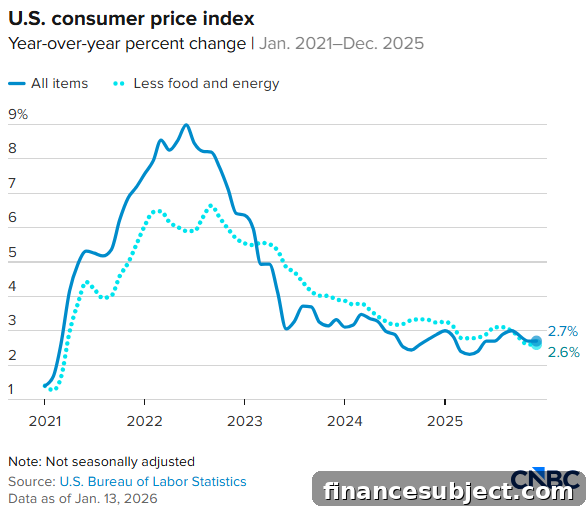
Current U.S. inflation data are encouraging. The headline U.S. consumer price index (CPI) for December 2025 printed at 2.7% year-over-year, roughly in the Federal Reserve’s comfort zone. If inflation remains near that level, the Fed may be less inclined to raise rates aggressively, which would be supportive for risk assets including bitcoin.
The chart below illustrates CPI from 2021 through the latest December 2025 print. CPI has remained relatively contained—generally within a 2%–3% range—helped by softer energy prices and productivity gains tied in part to increased use of artificial intelligence (AI).
Source: cnbc.com as of January 13, 2026
Looking ahead, bitcoin’s trajectory will be influenced by oil prices, continued corporate adoption of AI and the resulting effects on inflation and monetary policy. Those variables will help determine whether BTC behaves more like a safe haven or more like a levered growth asset in 2026.
Crypto price swings are part of the landscape
Cryptocurrencies—including BTC, ETH, XRP, SOL, BNB and others—are speculative and highly volatile. Prices can move dramatically in short periods, and that volatility is a core risk for investors. Even stablecoins, which are marketed for stability, can carry risks if they are not fully backed by transparent, high-quality assets.
Investing in bitcoin and other cryptocurrencies entails market, technological and regulatory risks. Crypto investments should only be considered if they fit your overall financial plan, time horizon and risk tolerance. Remain vigilant about security and fraud: scams and hacks remain a persistent threat in the crypto ecosystem.
Newsletter
Get free MoneySense financial tips, news & advice in your inbox.
Read more about crypto:
- Will bitcoin crash in 2025?
- Bitcoin tops USD$100,000 for the first time
- Price of bitcoin hits new high after Trump victory, and more crypto news
- How to protect your crypto from hacks