

Despite a growing body of evidence that most investors are best served by low-cost, broadly diversified index funds, some prefer a more hands-on approach to their portfolios. That can mean picking individual stocks or making tactical bets on specific markets—such as favouring Canadian equities or overweighting U.S. stocks.
Sitting between these extremes is sector investing. While definitions vary, sector investing generally means deliberately overweighting or underweighting particular slices of the market. Instead of owning the entire market, you make targeted bets on areas such as financials, energy or technology based on your outlook.
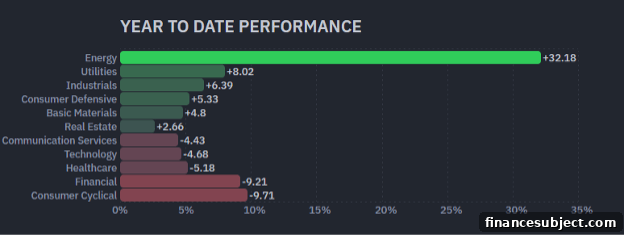
Sector rotation has been prominent over the last six months. According to Finviz data as of March 19, the U.S. energy sector rose sharply year to date, while some mega-cap-heavy areas tied to the Magnificent Seven lagged: communication services, technology and consumer cyclical sectors posted negative returns over that period.
Source: Finviz
Macro forces help explain that shift. Rising geopolitical tensions have pushed energy prices higher, benefitting oil and gas producers, while investor enthusiasm around artificial intelligence has cooled, prompting a reassessment of valuations and near-term earnings expectations for some large-cap technology names.
The difficulty for Canadian investors is that while sector investing as a strategy has evolved, the Canadian sector ETF landscape has not always kept pace—particularly on fees and construction methodology.
In the U.S., investors can choose from many low-cost sector ETFs—most notably the Select Sector SPDR lineup from State Street, which offers management expense ratios (MERs) near 0.08%. Some of these U.S. sector ETFs are available to Canadian investors in Canadian-dollar and currency-hedged variants through partnerships that offer competitive expense ratios.
By contrast, comparable Canadian-focused sector ETFs tend to be more expensive. The iShares suite of Canadian sector ETFs, for example, tracks S&P/TSX sector indices but often carries MERs nearer to 0.6%—a meaningful premium for many investors.
More importantly, the construction of many Canadian sector ETFs can introduce unintended concentration risk. That risk arises from the underlying index methodology—frequently S&P Global’s capped sector indices—rather than from the ETF provider itself. Understanding this structural quirk is essential before using sector funds to express a sector view.
When “sector exposure” becomes a stock bet
Sector investing inherently means overweighting a portion of the economy beyond its natural market-cap weight. That is the point of the strategy. The danger comes when that sector exposure is dominated by a tiny number of companies, turning a sector bet into effectively a concentrated stock bet.
Tools
MoneySense’s ETF Screener Tool
Many Canadian sector ETFs, particularly in the iShares lineup, track S&P/TSX capped sector indices that apply a 25% cap to any single holding at each rebalance. Caps exist to prevent extreme concentration—recall how Nortel once dominated the TSE 300—yet a 25% limit at the sector level is often too generous to meaningfully reduce concentration risk.
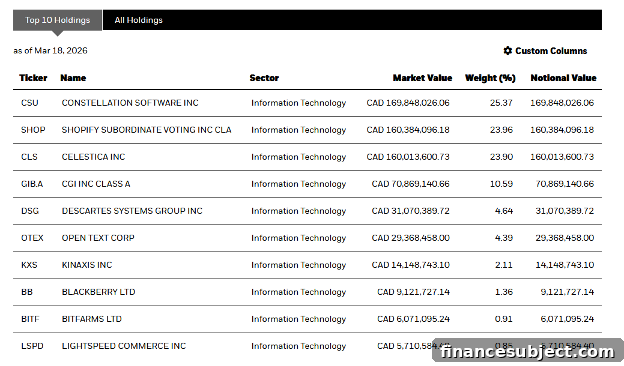
Take the Canadian technology sector. The iShares S&P/TSX Capped Information Technology Index ETF (XIT) tracks roughly 20 companies, but about 75% of its weight can reside in three names: Constellation Software, Shopify and Celestica. When three companies drive most of the portfolio’s performance, the purported sector exposure looks less like a diversified slice of the economy and more like a handful of concentrated stock bets.
Source: iShares Canada
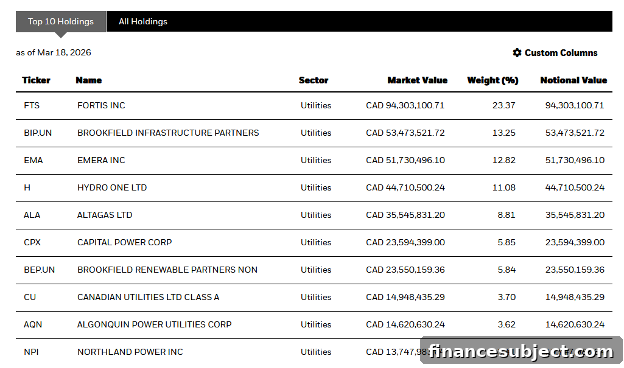
Utilities exhibit a similar pattern. The iShares S&P/TSX Capped Utilities Index ETF (XUT) is heavily concentrated in Fortis, Brookfield Infrastructure Partners, Emera and Hydro One—four companies that combine for roughly 60% of the ETF’s weight. Again, a narrow group of names dominates risk and return.
Source: iShares Canada
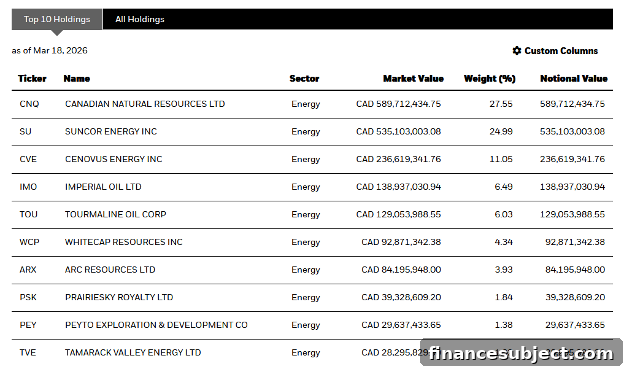
Even in energy, concentration can be extreme: the iShares S&P/TSX Capped Energy Index ETF (XEG) has seen Canadian Natural Resources exceed the cap between rebalances while Suncor sits at the 25% limit, meaning those two names can make up more than half of the ETF’s exposure.
Source: iShares Canada
If just two or three companies determine most of an ETF’s outcome, you are no longer making a sector-wide thesis but rather a concentrated wager on a few names—while still paying ETF fees. That undermines some of the primary benefits investors seek from ETFs: diversification and cost efficiency.
What should Canadian sector investors do?
Investors should question whether legacy Canadian sector ETFs remain the best option. Some funds, like XEG (launched in March 2001), have accumulated assets largely due to brand recognition, but their fee levels and concentration profiles can be hard to justify today.
One practical approach is to buy the top holdings directly. If a sector ETF effectively mirrors a small number of dominant names, replicating that exposure by assembling a basket of the top 10 holdings—using zero-commission brokerages—can be cost-effective. You can equal-weight those positions or tilt toward higher-conviction names. The trade-off is that this method is more active and introduces tracking error.
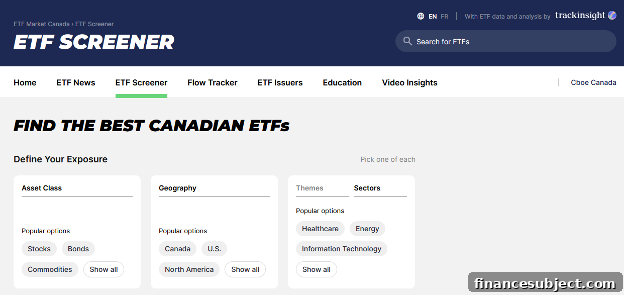
A second approach is to be selective with ETFs. Use tools like Cboe Canada’s ETF screener to filter by asset class, geography and sector, and then sort by key metrics such as expense ratio. That exercise often reveals lower-cost and better-constructed alternatives.
Source: Cboe Canada
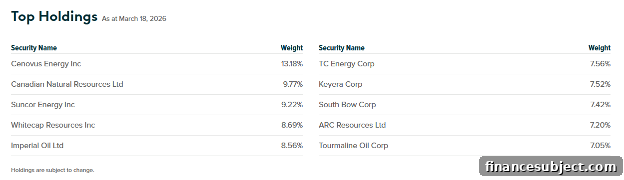
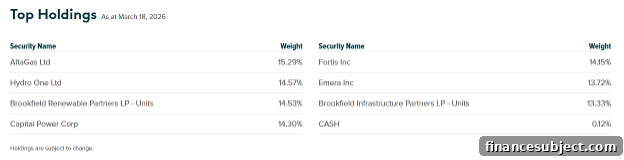
For example, in energy you can find lower-fee equal-weighted options, such as the Global X Equal Weight Canadian Oil & Gas Index ETF (NRGY), which spreads exposure more evenly across constituents. The same logic applies to utilities, where equal-weighted ETFs like the Global X Equal Weight Canadian Utilities Index ETF (UTIL) can offer a more balanced allocation and lower expenses.
Source: Global X Canada
Source: Global X Canada
In short, sector investing in Canada requires careful scrutiny. It is not enough to hold a view on a sector—you must understand how that exposure is constructed. Otherwise you may think you are making a broad sector bet when you are actually paying a premium to hold a small number of stocks.
Newsletter
Get free MoneySense financial tips, news & advice in your inbox.
Read more about investing with ETFs:
- How to spot and avoid illiquid ETFs
- Why Vanguard’s ETF aimed at retirees is currently cautious
- How often should you rebalance?
- Best robo-advisors in Canada for 2026