

Canadians faced a sharp cost-of-living squeeze in 2023. Although inflation eased to 2.8% in June, the steep price rises of 2022 and early 2023 left essentials such as groceries much more expensive for many households. At the same time, the Bank of Canada’s efforts to curb inflation pushed borrowing costs to levels not seen in two decades, creating extra pressure for homeowners with mortgages.
Headlines have highlighted families stretched thin by higher mortgage payments: some homeowners have been forced to sell, while others report monthly mortgage bills that are thousands of dollars higher than they were two years earlier. Yet overall consumer spending did not fall as sharply as the Bank anticipated when it raised rates, and the housing market has remained relatively stable given today’s mortgage rates. To understand why the experience of mortgage pain varies so widely, we need to look at broader averages and the differences between fixed and variable-rate mortgages.
How average mortgage payments have changed since rate hikes began
By the first quarter of 2023 the average monthly payment on new mortgages in Canada reached $1,984, up 40% from $1,415 in 2019, according to the Canada Mortgage and Housing Corporation (CMHC). For existing mortgages, the average monthly payment in that same period was $1,551, up 20% from $1,277 in 2019.
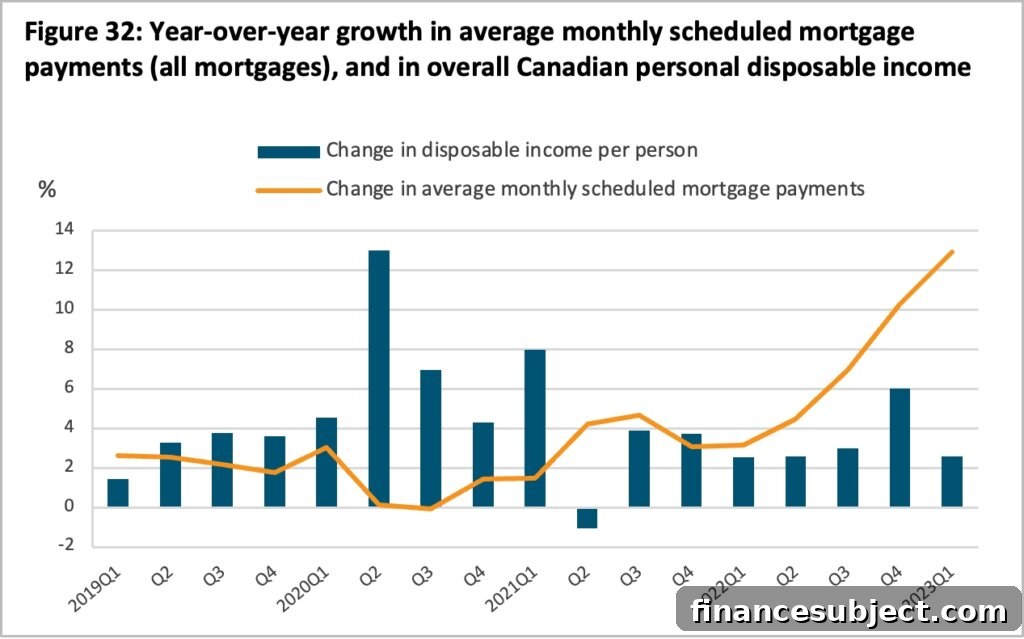
The pace of increase accelerated sharply in 2023. While mortgage payments grew from 1% to 5% annually at times since 2019, the annual growth rate rose to nearly 13% in the first quarter of 2023, the fastest increase in at least five years.
How mortgage payments have changed across Canada
The impact of rising rates has not been uniform across the country. The largest increases in typical mortgage payments occurred after early 2022, when the Bank of Canada began raising its policy rate. The table below shows average monthly mortgage payments for large, medium and small census metropolitan areas (CMAs) for the first quarter of 2021, 2022 and 2023. These figures are based on CMHC calculations using Equifax data.
| Census metropolitan area | Q1 2021 | Q1 2022 | Q1 2023 |
|---|---|---|---|
| Canada (average) | $1,339 | $1,382 | $1,561 |
| Large CMAs (average) | $1,555 | $1,605 | $1,826 |
| Montreal | $1,153 | $1,191 | $1,321 |
| Ottawa–Gatineau | $1,281 | $1,324 | $1,474 |
| Toronto | $1,790 | $1,863 | $2,176 |
| Calgary | $1,487 | $1,487 | $1,615 |
| Edmonton | $1,430 | $1,426 | $1,509 |
| Vancouver | $1,912 | $1,979 | $2,281 |
| Medium CMAs (average) | $1,242 | $1,282 | $1,442 |
| Halifax | $1,144 | $1,171 | $1,294 |
| Quebec City | $904 | $918 | $988 |
| Oshawa | $1,536 | $1,613 | $1,889 |
| Hamilton | $1,494 | $1,564 | $1,809 |
| St. Catharines–Niagara | $1,184 | $1,242 | $1,402 |
| Kitchener–Cambridge–Waterloo | $1,390 | $1,468 | $1,710 |
| London | $1,191 | $1,258 | $1,452 |
| Windsor | $1,065 | $1,109 | $1,255 |
| Winnipeg | $1,105 | $1,116 | $1,203 |
| Regina | $1,285 | $1,283 | $1,364 |
| Saskatoon | $1,276 | $1,275 | $1,357 |
| Victoria | $1,676 | $1,708 | $1,955 |
| Small CMAs (average) | $1,120 | $1,159 | $1,301 |
| St. John’s | $1,203 | $1,193 | $1,277 |
| Charlottetown | $1,010 | $1,046 | $1,133 |
| Moncton | $877 | $889 | $977 |
| Saint John | $915 | $915 | $979 |
| Saguenay | $740 | $748 | $799 |
| Sherbrooke | $854 | $876 | $952 |
| Trois-Rivières | $713 | $721 | $780 |
| Kingston | $1,251 | $1,306 | $1,434 |
| Peterborough | $1,244 | $1,302 | $1,460 |
| Brantford | $1,260 | $1,327 | $1,517 |
| Guelph | $1,438 | $1,500 | $1,724 |
| Barrie | $1,441 | $1,515 | $1,752 |
| Greater Sudbury | $1,128 | $1,166 | $1,282 |
| Thunder Bay | $1,084 | $1,105 | $1,187 |
| Kelowna | $1,546 | $1,613 | $1,821 |
| Abbotsford–Mission | $1,597 | $1,687 | $2,019 |
| Other cities | $1,111 | $1,150 | $1,295 |
Between Q1 2021 and Q1 2022 many average monthly payments rose only slightly—Canada-wide the increase was $43 per month. But between Q1 2022 and Q1 2023 the change was far larger: average monthly payments climbed $179 across Canada and rose by more than $200 in large CMAs. That abrupt change reflects the period when the Bank of Canada moved aggressively to slow inflation.
Why are some Canadians struggling more than others?
The averages above include both fixed-rate and variable-rate mortgages and are useful for understanding general trends. However, they don’t fully explain why some homeowners have seen their payments double. To see that, we must examine how fixed and variable rates reacted differently as the Bank of Canada raised its benchmark rate.
CMHC data show the average new mortgage loan was about $319,140 in Q1 2021. Using that figure as an example, it’s clear how borrowers with different mortgage products experienced diverging outcomes. A five-year fixed-rate borrower who locked in a low rate in March 2021 would keep the same monthly payment until their term expires—on average about $1,289 per month for that example mortgage—so they have not felt immediate payment increases.
Variable-rate borrowers experienced rate increases tied to every rise in the Bank’s policy rate. Many variable-rate lenders offer fixed monthly payments even while the interest portion rises; in that case the payment stays the same but more of it goes to interest, lengthening the amortization and increasing the total interest paid over time. A sub-group of variable mortgages—so-called floating-rate mortgages where payments move directly with the Bank’s rate—saw payments jump sharply. For example, borrowers with such a mortgage obtained in March 2021 could be paying roughly $800 more per month than when they first took out the loan. As of late 2022 about one-quarter of variable-rate mortgages behaved this way.
When will Canadians find relief with mortgage rates?
So far only a minority of borrowers have experienced the full effect of higher interest rates. Many homeowners will feel the sharpest increases when mortgages come up for renewal. The Bank of Canada projects that most borrowers will renew before 2026, and some households could see monthly payments jump by 20% to 40% at renewal.
Meaningful relief for borrowers will depend on inflation returning to more typical levels so the Bank of Canada can begin cutting its benchmark rate. Until then, homeowners should review their mortgage terms, consider the mix of fixed and variable exposure, and plan for renewals that could materially raise monthly costs.
Related mortgage topics
- Should you accelerate mortgage payments or invest?
- Renting vs. buying: financial trade-offs to consider
- How much income is needed to afford a home in Toronto and the GTA
- Mortgage penalty and renewal calculations