

Market-Neutral ETFs: Do They Deliver Diversification?
In August 2025 I wrote about a growing concept among financial advisors: the 40-30-30 portfolio. That allocation gained traction after the 2022 bear market, when rising inflation and aggressive rate hikes caused both stocks and bonds to fall at the same time. The episode challenged the traditional balanced portfolio and pushed advisors to consider alternatives.
The basic idea is to reduce exposure to conventional stocks and bonds and increase the share allocated to alternatives. These alternatives can include hard assets or digital stores of value like gold and cryptocurrencies, private market investments such as private equity, private credit and real estate, and a third, less-discussed category: hedge fund–style or market-neutral strategies that aim for returns uncorrelated with traditional assets.
Since early 2019 regulatory changes in Canada have broadened access to liquid alternatives in both mutual fund and ETF form. Today investors have a small but growing selection of market-neutral ETFs to consider. Using the Cboe Canada ETF screener, you can find several market-neutral ETFs, with assets ranging from a few million dollars for smaller products to over $500 million for larger funds.
Many of these funds launched shortly after the regulatory shifts, so we now have multiple years of performance data that include major stress events such as the March 2020 COVID-19 crash and the 2022 bear market. The central question is: have these strategies actually delivered on their promise of diversification?
What is a market-neutral strategy?
Market-neutral strategies fall under alternative investing: they go beyond buy-and-hold stocks or bonds and aim to generate returns irrespective of market direction. Broad market forces—interest rates, economic growth, credit conditions and sentiment—can move entire baskets of stocks together, so even fundamentally sound companies may decline during a market sell-off.
Market-neutral managers attempt to minimize that exposure. By balancing long and short positions, they try to neutralize market-wide movements and capture returns from relative performance between positions. For example, a manager bullish on U.S. energy stocks might go long selected energy companies while shorting a broad market index to hedge overall market risk. The objective is a portfolio with a beta near zero so returns come mainly from the manager’s stock-selection skill rather than from market direction.
A closer look at market-neutral ETFs
These ETFs are active strategies, not rules-based index products. Portfolio managers decide what to buy and short, often supported by proprietary quantitative models that aren’t fully disclosed, which can make the strategies feel like a “black box.” Nevertheless, providers typically explain their general approach.
Picton’s market-neutral ETF (PFMN), the largest Canadian offering, runs roughly 100% long equity exposure and 100% short equity exposure to offset market movements and keep overall market sensitivity low. The fund reports transparency around its long and short exposures, including sector and regional differences.
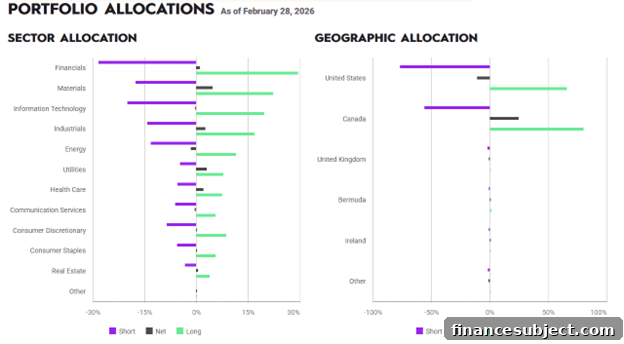
Source: Picton Investments
Desjardins’ Alt Long/Short Equity Market Neutral (DANC) follows a comparable long/short approach intended to neutralize market exposure, while AGF’s U.S. Market Neutral Anti-Beta CAD-Hedged ETF (QBTL) targets a negative beta. QBTL goes long low-beta U.S. stocks and shorts high-beta stocks on a dollar-neutral basis, which can make it behave defensively relative to the broader market.
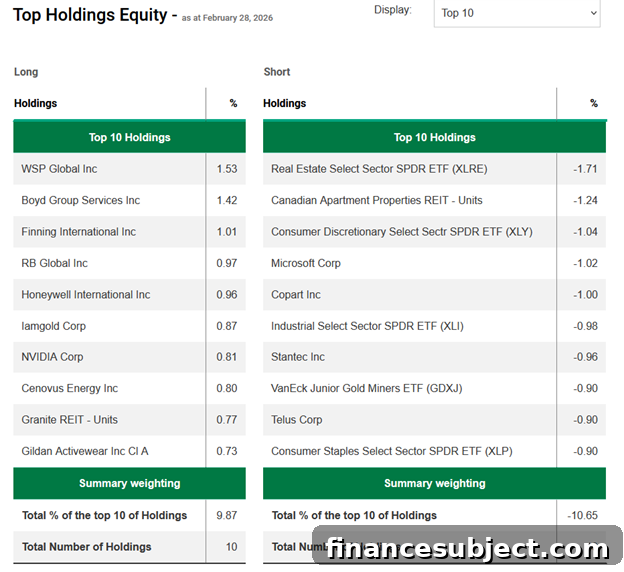
Source: Desjardins
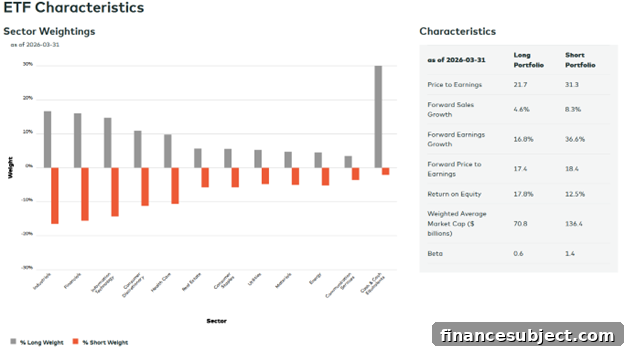
Source: AGF Investments
Fees are a key consideration. Market-neutral ETFs typically carry higher and more complex costs than plain-index ETFs. Desjardins’ DANC lists a management expense ratio around 1.17%. AGF’s QBTL shows a base management fee of 0.55% but also reports an additional trading expense ratio of roughly 2.2%, which increases total cost materially. PFMN charges a 0.95% base fee plus a 20% performance fee above a 2% hurdle, subject to a high-water mark; this makes its total cost variable. PFMN’s trailing total management expense ratio was reported at 4.27% as of June 2025. These costs are substantially higher than those for bond or cash-like ETFs used to reduce portfolio risk.
Do market-neutral ETFs actually work?
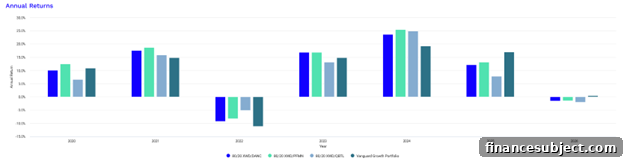
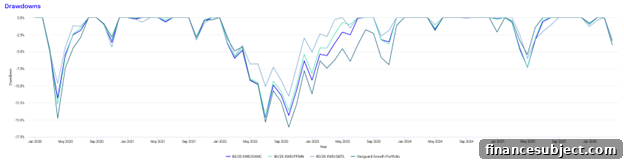
To test whether these ETFs deliver, I ran a back-test using PortfolioVisualizer.com. As a baseline I used the Vanguard Growth ETF Portfolio (VGRO), a low-cost, diversified mix of roughly 80% equities and 20% bonds. I then built three comparable portfolios that held 80% in the iShares MSCI World Index ETF (XWD) and 20% in a single market-neutral ETF: DANC, PFMN, or QBTL. The back-test period ran from January 2020 through March 2026 with annual rebalancing. All results are net of fees; the ETFs’ higher costs were included in the performance figures.
| Portfolio performance statistics | ||||
| Metric | 80/20 XWD/DANC | 80/20 XWD/PFMN | 80/20 XWD/QBTL | Vanguard Growth Portfolio (VGRO) |
| Start balance | $10,000 | $10,000 | $10,000 | $10,000 |
| End balance | $18,734 | $20,055 | $17,517 | $18,187 |
| Annualized return (CAGR) | 10.57% | 11.78% | 9.38% | 10.04% |
| Standard deviation | 10.28% | 10.63% | 8.72% | 11.36% |
| Best year | 23.64% | 25.48% | 24.91% | 19.30% |
| Worst year | -9.18% | -8.18% | -5.08% | -11.19% |
| Maximum drawdown | -14.65% | -14.51% | -11.54% | -16.08% |
| Sharpe ratio | 0.80 | 0.88 | 0.81 | 0.69 |
Source: Portfolio Visualizer
The results show that portfolios with DANC and PFMN outperformed VGRO on raw annualized return during this period, while QBTL lagged in total return—consistent with its negative-beta design. All three market-neutral combinations improved risk-adjusted performance: each posted a higher Sharpe ratio and lower volatility than the VGRO baseline. They also exhibited stronger best-year returns and milder worst-year declines, with reduced maximum drawdowns across the board. QBTL stood out for downside protection, aligning with its defensive orientation.
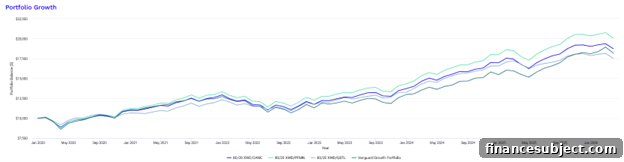
In short, over a period that included the COVID crash and the 2022 drawdown—times when both stocks and bonds struggled—these market-neutral ETFs generally held up well and provided meaningful diversification when it mattered most.
So, are market-neutral ETFs worth it?
Historically, these ETFs have offered real diversification benefits, but they come at a price. Higher fees are a persistent long-term headwind. Past performance in a volatile and stressed market environment does not guarantee similar results in future regimes, and there is a risk of “fighting the last battle”: strategies that excelled during recent stress periods may not perform the same way when market conditions change.
Other risks include style drift and model risk—active or quantitative strategies can evolve, and a model that worked in one regime may fail in another. Key-person risk also matters: strategies heavily dependent on specific teams or managers can be vulnerable if personnel change.
For investors who value simplicity, low fees and transparency, index-based portfolios remain compelling. That said, some market-neutral ETFs serve a purpose and can improve outcomes under certain conditions. The prudent approach is to understand how a fund works, how much it costs in total, what role it is expected to play in a portfolio, and whether the trade-offs align with your objectives and time horizon. For some investors, the added diversification is worth the complexity and fees; for others, including myself, the benefits may not justify the cost.
If you consider adding a market-neutral ETF to your allocation, treat it like any other active tool: know the strategy, understand the fee structure (including performance fees or hidden trading costs), monitor performance across market regimes, and consider how it complements your broader portfolio.
Market-neutral ETFs are not a universal solution, but they are a legitimate option for investors seeking alternative sources of return and improved downside protection—provided those investors accept higher costs and the inherent uncertainties of active strategies.