

Welcome to the Canadian Crypto Observer. Financial journalist and author Aditya Nain provides timely analysis of market-moving headlines to help Canadian investors make sense of the cryptocurrency landscape.
If you follow the crypto market, you likely noticed a sharp fall in prices recently. In October and November, Bitcoin (BTC) plunged from a peak near $124,000 to a low around $80,000 (all figures in US dollars unless noted). That roughly 35% decline unfolded in weeks and was driven in large part by lower expectations for future interest-rate cuts from the U.S. Federal Reserve.
Since then, BTC has staged a modest recovery and is trading near $87,000 at the time of writing. Before declaring cryptocurrencies dead or assuming further declines are inevitable, it helps to put this move in perspective by reviewing Bitcoin’s longer-term performance and comparing it with other mainstream assets over the past five years.
The crypto crash in perspective
Bitcoin entered a strong cyclical bull market beginning in November 2022, when it rose from a low of about $16,400. From that trough to the recent high around $124,000, BTC delivered approximately a 646% gain over the nearly three-year stretch from November 2022 to October 2025.
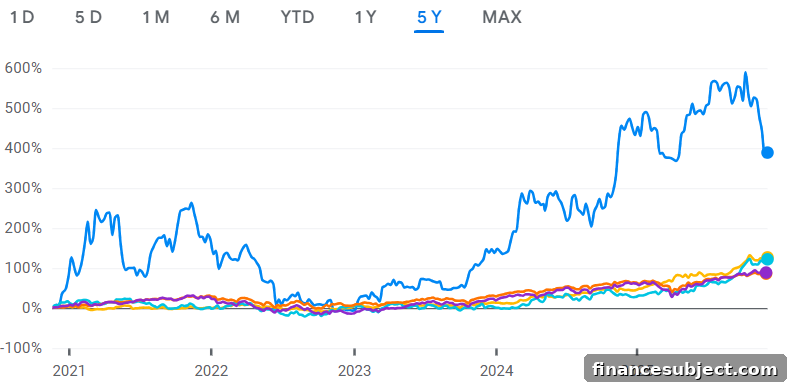
Source: Google Finance as of Nov. 26, 2025
Of course, few investors buy at exact lows and sell at exact highs. The table below shows Bitcoin’s returns for several commonly referenced time periods over the past five years, which offers a more realistic view of investor outcomes.
| Time period | BTC absolute return (%) | Annualized return / CAGR |
|---|---|---|
| 6 months | -21% | Not applicable |
| Year to date | -7% | Not applicable |
| 1 year | -8% | -8% |
| 3 year | 427% | 62.23% |
| 5 year | 389% | 37.34% |
Source: Data gathered from Google Finance as of Nov. 26, 2025
Viewed this way, Bitcoin’s performance over three and five years remains strong. A five-year compounded annual growth rate (CAGR) above 35% is a result most long-term investors would welcome, assuming they were able to tolerate the interim volatility.
Also read
The best crypto platforms and apps
We’ve ranked the best crypto exchanges in Canada.
How does BTC’s return compare to stocks, gold and silver?
Bitcoin’s multi-year returns look impressive on their own, but how do they stack up against conventional assets that investors commonly consider?
| BTC | Gold (GLD) | Silver (SLV) | S&P 500 (.INX) | Nasdaq Composite (.IXIC) | S&P/TSX Composite (OSPTX) | |
|---|---|---|---|---|---|---|
| 5 year return | 389% | 126% | 121% | 86% | 88% | 77% |
| 5 year CAGR | 37.34% | 17.11% | 17.26% | 13.21% | 13.22% | 12.18% |
Source: Google Finance as of Nov. 26, 2025
Even after the recent six-week selloff, Bitcoin remains the top performer among the assets listed. It has outpaced commodities such as gold and silver and beaten major equity benchmarks over the five-year window.
The accompanying five-year percentage chart shows Bitcoin well above the other assets, which are clustered closer together. That visual highlights how exceptional BTC’s run has been, even when accounting for interim declines.
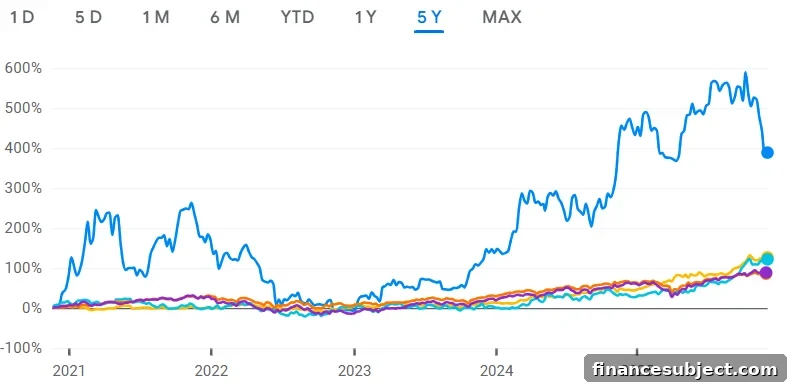
Source: Google Finance as of Nov. 26,2025
Will the recent decline continue, or have we already seen the bottom? No one can predict the short-term path with certainty. If the market is entering a cyclic bear phase rather than experiencing a 35% correction inside a larger bull market, a revisit of prior highs in the $60,000 to $70,000 range (levels seen in 2021) would be consistent with past Bitcoin bear cycles.
Is BTC’s recent fall unusual and worrying?
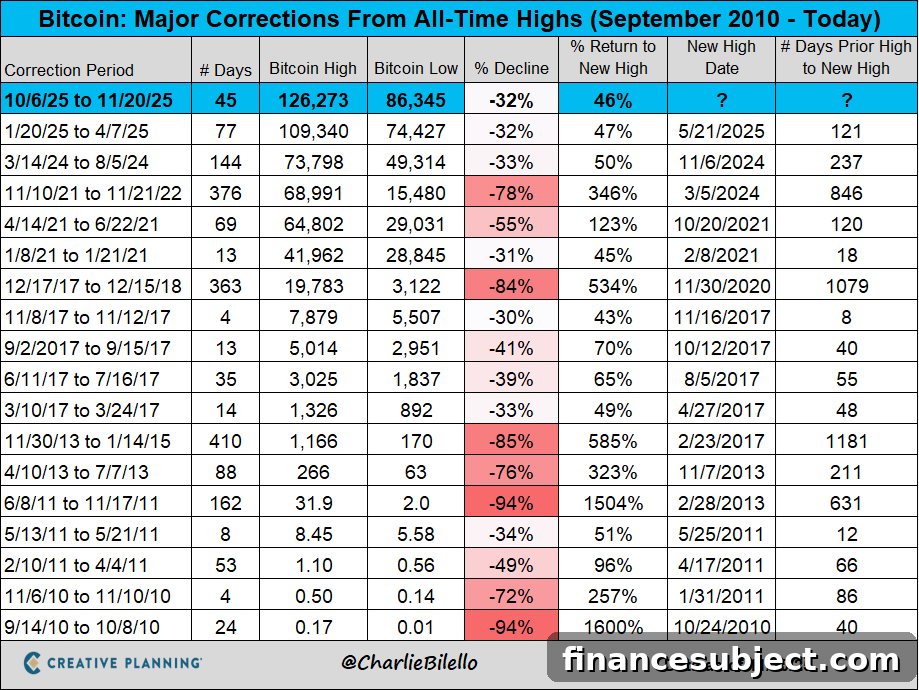
Bitcoin has a history of deep drawdowns, so the October–November selloff is not unprecedented. Since 2010, BTC has experienced declines of 30% or more from peak values on numerous occasions—eighteen such instances by the measure cited below.
These intermittent crashes have been part of Bitcoin’s history, and on many occasions the asset has recovered and established new all-time highs. The time required to recover has varied widely—from just over a week to several years—depending on where the market was in its broader cycle.
Could Canada see stablecoin regulation soon?
Following developments in the United States, Canada is considering regulation for stablecoins—potentially as early as 2026. Clear rules for stablecoins would likely strengthen parts of the crypto ecosystem by reducing uncertainty around the coins that act as the market’s cash equivalents.
In 2025, the U.S. GENIUS Act that created a regulatory framework for U.S. dollar–pegged stablecoins (such as Tether/USDT and USDC) helped boost crypto market sentiment. Stablecoins make it easy for crypto investors to lock in gains while staying within the crypto ecosystem, and because they represent a large portion of crypto market volume, regulation can have a meaningful market impact.
Stablecoins are effectively the cash used in many crypto markets. Interest has grown in stablecoins denominated in other currencies—such as the Canadian dollar—but unregulated stablecoins carry significant risks. According to the Federal Budget released in November 2025, Canadian lawmakers plan to advance stablecoin legislation, with the Bank of Canada expected to play a key oversight role.
Crypto price swings are common
Cryptocurrencies—including Bitcoin (BTC), Ethereum (ETH), XRP, Solana (SOL), and BNB—are inherently speculative and highly volatile. Even so-called stablecoins can pose risk if they lack adequate backing with real-world assets.
Investing in cryptocurrencies exposes investors to market, technological, and regulatory risks. Crypto may suit some portfolios but not others. Only invest if digital assets fit your financial objectives, time horizon, and tolerance for risk, and remain vigilant against scams and security threats.
Newsletter
Get free MoneySense financial tips, news & advice in your inbox.
Read more about crypto:
- Will bitcoin crash in 2025?
- Bitcoin tops USD$100,000 for the first time
- Price of bitcoin hits new high after Trump victory, and more crypto news
- How to protect your crypto from hacks