

North American markets feel like a new “Roaring Twenties,” but this time the rally is concentrated in speculative bets on artificial intelligence and quantum computing. Many firms related to these technologies trade at very high revenue multiples—or have no earnings at all—while more traditional asset classes have lagged.
The chart below compares total returns (price changes plus reinvested dividends) across major Canadian and U.S. equity benchmarks since 2016.
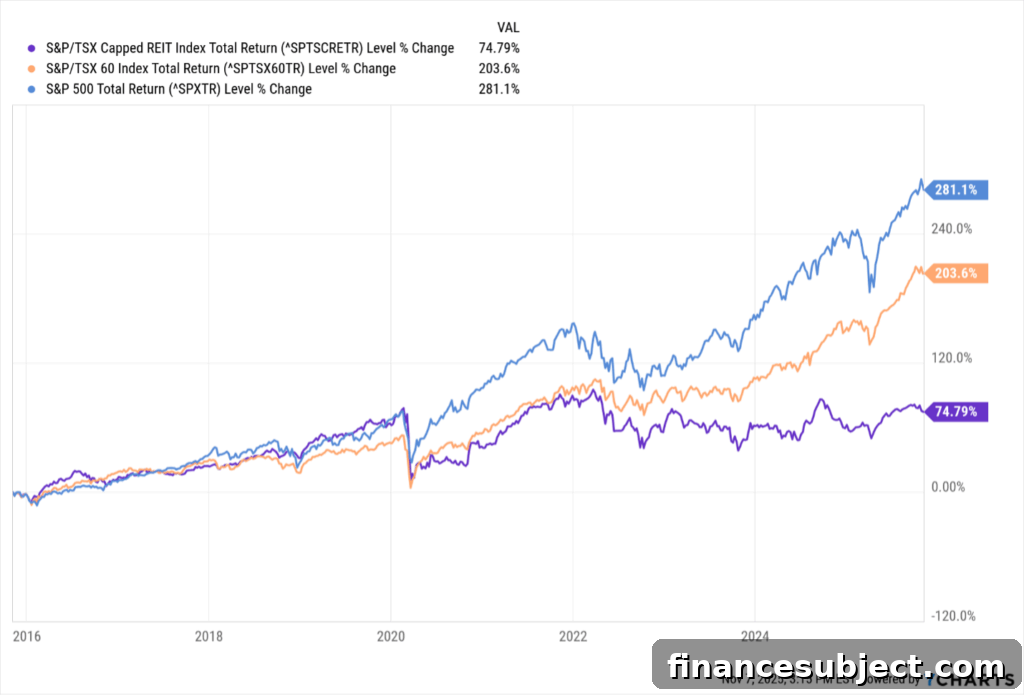
While the S&P 500 and the S&P/TSX 60 have climbed sharply, Canadian real estate investment trusts (REITs) have lagged behind. Even with distributions reinvested, the S&P/TSX Capped REIT Index remains below its pre-COVID highs and shows little sign of a sustained recovery.
That divergence is notable. Canadian REITs may be one of the few asset classes that are not bid up today, and they could offer genuine recovery potential if interest rates fall. Many Canadians view real estate as a path to wealth after decades of rising home prices, yet REITs—particularly when held via an exchange-traded fund (ETF)—deliver similar exposure with the added benefits of diversification and liquidity that direct property ownership often lacks.
The ABCs of Canadian REIT investing
REITs operate differently from typical operating companies, so they require different metrics and a tailored analysis. They are pass-through vehicles that avoid corporate income tax by distributing most of their taxable income to unitholders. Rather than selling products or services, REITs generate revenue primarily from rent and distribute that income to investors as regular distributions—often monthly and typically higher than average stock dividends.
Canadian REITs cover several property types:
- Office: properties leased to businesses and professional firms
- Retail: shopping centres and standalone stores
- Residential: apartment complexes and multi-family housing
- Industrial: warehouses, logistics hubs, and distribution centres
- Diversified: a mix of the categories above
You can’t rely on conventional ratios like EPS or P/E for REITs because significant non-cash charges such as depreciation reduce reported earnings even when cash flow is solid. The key metric for REITs is funds from operations (FFO), which adjusts net income by adding back depreciation and amortization and removing gains or losses from property sales. FFO provides a clearer view of a REIT’s cash-generating capacity.
From FFO, investors calculate price-to-FFO, the REIT equivalent of a P/E ratio. Comparing price-to-FFO against a REIT’s historical average and against peers in the same subsector (for example, residential vs. residential) gives a more accurate sense of valuation.
FFO also helps assess the sustainability of distributions. REIT payout ratios are typically measured as a percentage of FFO rather than net income; a lower payout ratio indicates more cushion for maintaining payments through downturns. Supporting FFO is the occupancy rate, reported quarterly, which shows how much of a REIT’s portfolio is leased. As of late 2025, residential REITs tend to have the strongest occupancy, while office REITs face pressure from remote work. Generally, higher occupancy—around 95% or above—is preferable.
Another useful measure is net asset value (NAV) per unit, which estimates the fair value of a REIT’s underlying properties after liabilities. NAV compares the appraised property value minus debt to outstanding units; the market price can trade at a premium or discount to NAV, and while convergence is not guaranteed, NAV is a helpful valuation reality check.
These figures appear in REIT quarterly reports and audited filings; some data providers aggregate them for easier comparison.
For most investors, REIT ETFs are often preferable to selecting individual REITs. Properly valuing individual REITs requires understanding specialized metrics. REITs may be internally diversified, but many focus on one property type or region. An ETF spreads exposure across sectors and issuers, lowering idiosyncratic risk and simplifying portfolio management.
In Canada, REIT ETFs fall into two broad categories: passive index trackers and actively managed funds. Each approach has pros and cons, which I cover below.
Passive index REIT ETFs
The passive market is dominated by large issuers—Vanguard, iShares Canada, and BMO Global Asset Management—each offering trade-offs between concentration, methodology, yield, and fees.
The largest by assets is the iShares S&P/TSX Capped REIT Index ETF (XRE), tracking the S&P/TSX Capped REIT Index since 2002. It pays a 3.56% trailing yield monthly, but the index holds just 16 names and is market-cap weighted, so a few large REITs like CAPREIT and RioCan account for roughly 23% of the fund—concentration that many investors may find undesirable. Its MER is 0.6%.
The Vanguard FTSE Canadian Capped REIT Index ETF (VRE) is cheaper at a 0.39% MER, but yields only about 2.44%. Its benchmark includes real estate operating companies that don’t own properties and therefore generate lower distributions—diluting the income focus many investors seek from REIT exposure.
My preferred passive choice is the BMO Equal Weight REITs Index ETF (ZRE), which tracks an equal-weight index of 20 REITs. Equal weighting naturally rebalances by trimming winners and adding to laggards, helping reduce concentration risk. ZRE yields about 4.96% and has an MER of 0.61%, a reasonable trade-off for the diversification and more balanced exposure it offers.
Actively managed REIT ETFs
Active REIT ETFs can justify higher costs by using flexibility that passive trackers lack—such as the ability to allocate outside the narrow Canadian REIT universe or to favour specific securities based on manager insight.
The Middlefield Real Estate Dividend ETF (MREL) takes a bottom-up, active approach and includes roughly 18% in mostly U.S. names, offering broader opportunity than a pure Canadian REIT index. Its management fee is 0.75%, and the full MER rises to 1.21%, but it pays a higher yield—about 7.16% monthly.
The CI Canadian REIT ETF (RIT) is a lower-cost active option with a 0.87% MER and the flexibility to allocate up to 30% outside its benchmark. With a long track record dating back to 2004, RIT currently yields roughly 4.86%.
Active funds can be opaque about individual security selection, so investors should read quarterly commentaries to understand recent trades, performance drivers, and management’s outlook.
Active versus passive Canadian REIT ETFs
So far, the higher fees of active management have often been rewarded: RIT and MREL have outperformed passive funds like VRE and XRE, though not the equal-weighted ZRE. The ability to move beyond a narrow domestic REIT universe into U.S. REITs or non-REIT real estate names has been an important advantage for active managers seeking better returns.
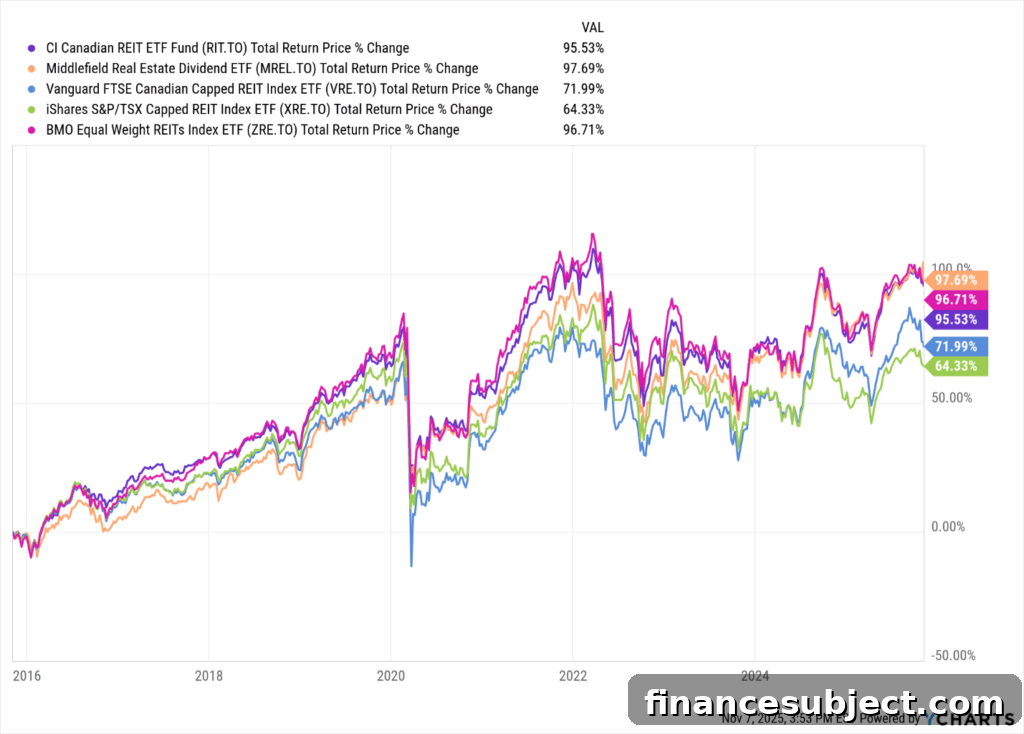
Despite active funds’ outperformance, ZRE’s disciplined equal-weight approach, lower structural constraints, and moderate fees make it a compelling choice for many investors. In a small, concentrated market like Canadian REITs, equal weighting can balance cost, diversification, and consistent performance.
A third option: build your own REIT basket
Another approach is to assemble your own REIT portfolio. With commission-free trading platforms widely available, building a small basket of Canadian REITs is more accessible and cost-effective than in the past. If you choose this path, follow a few simple rules:
- Limit your REIT allocation to a sensible portion of your total portfolio and avoid overlap with existing Canadian equity ETFs.
- Prioritize quality: look for consistent FFO growth, solid distribution coverage, high occupancy rates, and manageable leverage.
- Diversify across property types—residential, industrial, office, and retail—to reduce single-sector risk.
- Hold REITs in registered accounts where possible, because most distributions are taxed as ordinary income rather than eligible dividends, which can reduce after-tax returns for higher-income investors.
Newsletter
Get free MoneySense financial tips, news & advice in your inbox.
Read more about investing strategy:
- The MoneySense ETF Screener
- Covered call ETFs have high yields but come with a trade-off
- Beyond bullion: Smarter ways for Canadians to invest in gold
- How to read your investment statements