

Although Canadian banks are already prominent within major Canadian indices, many investors look for additional direct exposure to the sector. Canadian banks tend to deliver steady earnings, durable dividend growth and attractive current yields. Their earnings aren’t typically exposed to international trade frictions or supply-chain disruptions, and a stable regulatory framework has helped them defend profitable market positions for decades. When held in taxable accounts, payouts from these banks often qualify for the Canadian dividend tax credit, improving after-tax yield for many investors.
That said, banks differ from many other TSX stocks. Common valuation measures such as price-to-earnings ratios can be misleading because bank earnings are shaped by regulation, capital requirements, interest-rate spreads and credit risk—factors that earnings multiples alone don’t capture well.
Investors in Canadian banks therefore need to consider balance-sheet strength and risk-management metrics. Measures like loan-loss provisions reveal how conservatively a bank is provisioned for potential defaults, while cost-to-income ratios indicate operating efficiency relative to net interest revenue. Those metrics provide more useful context for banking exposures than simple multiples.
If researching individual banks and balance-sheet metrics feels daunting, a practical alternative is to buy an exchange-traded fund (ETF) that holds all six major Canadian banks. That moves the decision from picking a single outperformer to making a sector bet: that Canada’s banks will expand their customer bases, grow into new lending and wealth-management verticals, and continue benefiting from long-term tailwinds such as population growth and housing demand.

Get up to 3.00% interest on your savings without any fees.

Lock in your deposit and earn a guaranteed interest rate of 3.50%.

Open a High Interest Savings Account and earn 4.60% interest for five months on eligible deposits up to $100,000.
MoneySense is an established personal finance magazine that has helped Canadians with money decisions since 1999. Our editorial team of trained journalists works with financial experts and compares products from major institutions, including banks and credit unions. We strive to present clear, independent analysis to help readers choose the best financial products for their needs.
Using an ETF that holds all six large Canadian banks shifts the focus from selecting a single winner to taking a diversified position across the sector. That approach reduces single-name risk and allows investors to benefit from the broader growth of the industry, including expansion into digital banking, wealth management and business lending.
The competitive landscape for bank ETFs in Canada is broad. Funds use different weighting schemes and strategies, which create varying trade-offs between risk, return and fees. Below is a practical guide to the main types of Canadian bank ETFs, what each seeks to achieve, and the investor profiles that might suit them.
Equal-weighted Canadian bank ETFs
The most straightforward and widely held bank ETFs are equal-weighted funds. Examples include Global X Equal Weight Canadian Banks Index ETF (HBNK), BMO Equal Weight Banks Index ETF (ZEB) and Hamilton Canadian Bank Equal-Weight Index ETF (HEB). These ETFs track an equal-weight index that assigns roughly the same weight—about 16.67%—to each of the six major Canadian banks and rebalances periodically to maintain equal exposure.
Equal weighting avoids the concentration that market-cap-weighted indices produce in a sector dominated by a few very large banks. By trimming strong performers and adding to laggards at rebalance points, equal-weighted indices often create a disciplined buy-low-sell-high dynamic.
All three funds pay monthly distributions, which can appeal to income-focused investors who prefer regular cash flow rather than the quarterly payouts typical of the underlying bank stocks. As of May 14, the cited distribution yields were:
- HBNK: 4.12%
- ZEB: 3.89%
- HEB: 4.34%
Most of the income these ETFs generate is eligible Canadian dividends for tax purposes, with occasional return of capital. Fee structures vary: ZEB carries a 0.28% MER, HEB has indicated a waived fee through January 31, 2026 and reported a recent MER around 0.25%, and HBNK reports a particularly low stated fee (0.04% MER and 0.01% TER). Historically, their returns have been broadly similar.
ZEB, HBNK and HEB historical cumulative total returns
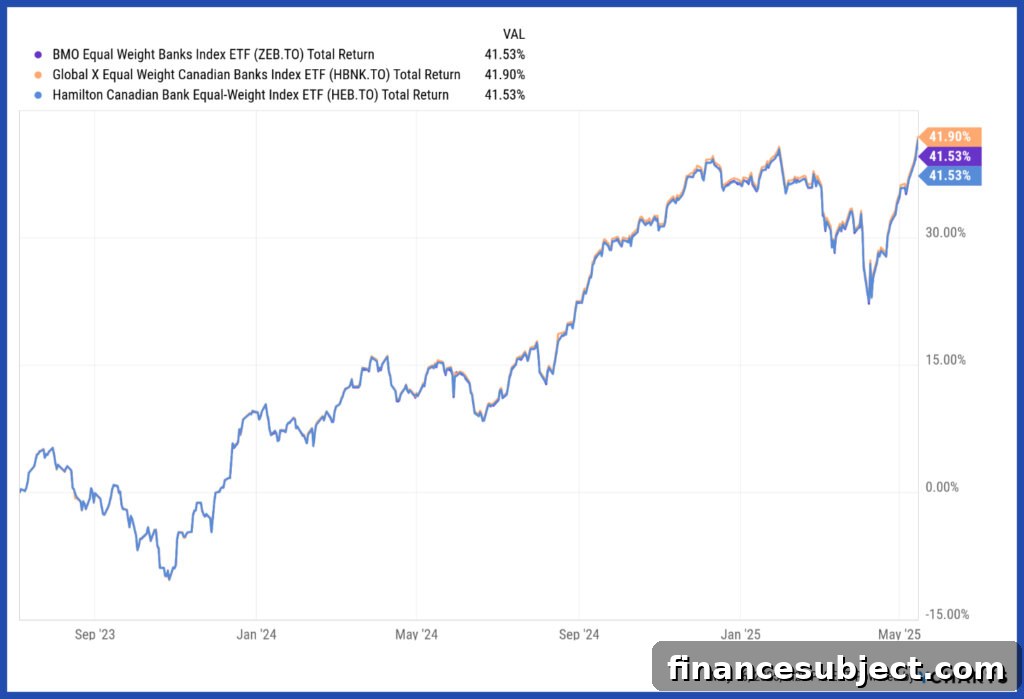
Use case: Equal-weight bank ETFs suit investors seeking straightforward, diversified exposure to Canadian banks without trying to pick a single outperformer. They are convenient for those who value monthly distributions and a simple, low-maintenance strategy.
Fundamental-weighted Canadian bank ETFs
Fundamental-weighted ETFs allocate holdings based on business metrics rather than market price, aiming to reflect economic importance more directly. Different funds use distinct fundamental approaches, so the outcome depends on the specific rules each provider applies.
For instance, the TD Canadian Bank Dividend Index ETF (TBNK) emphasizes dividend-growth characteristics by ranking banks according to their dividend growth histories. The RBC Canadian Bank Yield Index ETF (RBNK) weights banks by indicated dividend yield, tilting exposure toward higher-yielding names. The Hamilton Canadian Bank Mean Reversion Index ETF (HCA) follows a mean-reversion methodology, typically allocating 80% to recent underperformers and 20% to recent outperformers in the expectation that laggards might rebound.
These more customized strategies usually carry higher fees. TBNK charges a 0.28% MER, RBNK a 0.32% MER, and HCA about 0.45% MER. To date, those fee premiums have not produced consistent, large outperformance: between May 2023 and May 2025, total returns for these funds clustered within roughly a one-percentage-point range relative to a simpler equal-weighted product such as ZEB.
HCA, TBNK, RBNK and ZEB historical cumulative total returns
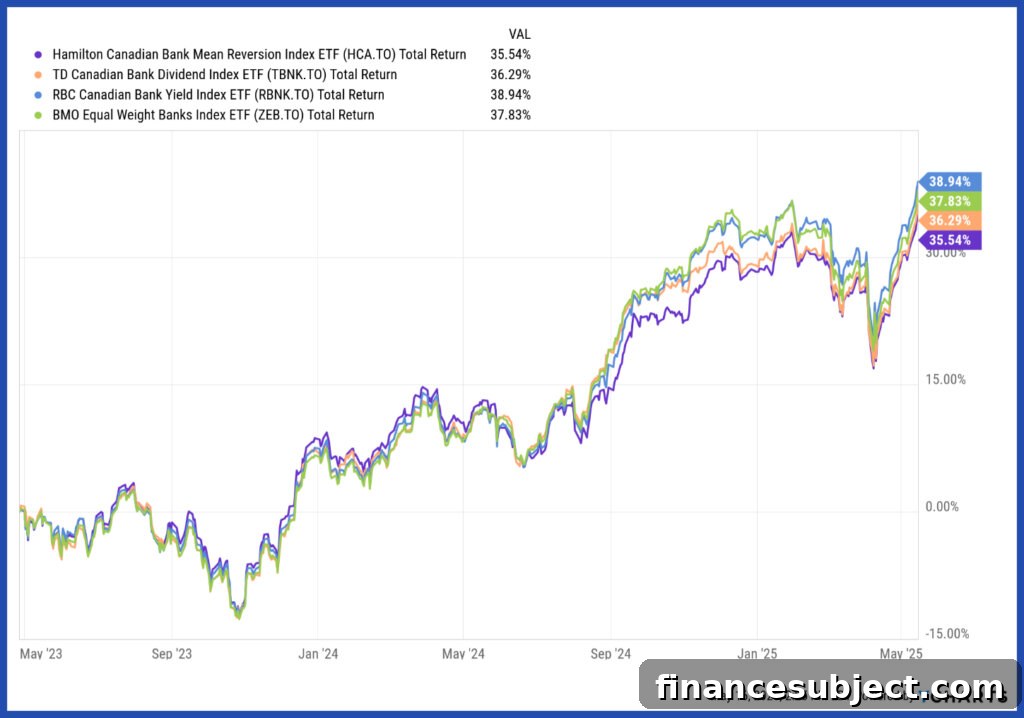
Use case: Fundamental-weighted bank ETFs may appeal to investors who want a more tailored exposure—targeting dividend growers, higher yields or mean reversion—while accepting slightly higher fees for the chance of outperformance.
The best ETFs in Canada
Enhanced Canadian bank ETFs
Enhanced or alternative bank ETFs go beyond simple long-only strategies. They may use covered-call writing, leverage or a combination of techniques to boost yield or alter return profiles.
One example is the BMO Covered Call Canadian Banks ETF (ZWB), which holds the same bank basket as an equal-weight ETF but sells call options on holdings. Covered calls increase current income while capping upside, which can lead to higher distribution yields—examples cited show yields around 6.66%—but more muted capital appreciation.
Another approach is leverage without options. The Hamilton Enhanced Canadian Bank ETF (HCAL) applies 1.25 times exposure to an equal-weight bank index by borrowing on margin rather than relying on daily-reset swaps. That structure amplifies both gains and losses and can increase distributions because they are paid on the larger notional exposure. The fund cited a yield around 6.42%.
Some funds combine strategies: Global X Enhanced Equal Weight Canadian Banks Covered Call ETF (BKCL) invests in a covered-call bank ETF and then adds leverage to reach approximately 1.25 times exposure, seeking to blend higher yield with some growth potential. It currently shows a much higher headline yield (15.01%), but income can fluctuate significantly and leverage magnifies volatility.
Enhanced strategies generally charge higher fees: ZWB around 0.71% MER, BKCL including leverage costs at roughly 2.15% MER with additional TER, and HCAL with a total MER near 2.16% in the reported figures. Historically, funds that sell upside (covered-call products) have sometimes underperformed equal-weighted ETFs on a total-return basis despite higher income, while leveraged products like HCAL have delivered stronger returns than a simple multiple would suggest because borrowing costs and other frictions reduce theoretical leverage gains.
HCAL, BKCL, ZWB and ZEB historical cumulative total return
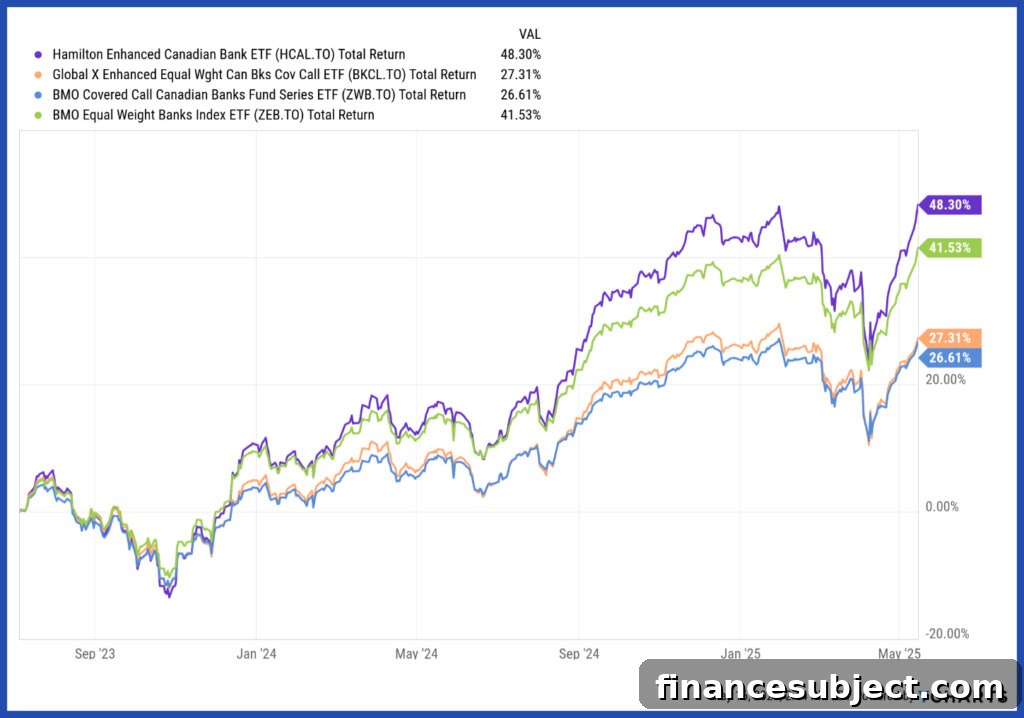
Use case: Enhanced bank ETFs are best suited for income-seeking or tactical investors who understand the risks of leverage and option strategies. Due to higher fees and complexity, these funds are often better placed in registered accounts such as a TFSA or RRSP to avoid inefficient taxation of elevated income streams.
Get free MoneySense financial tips, news & advice in your inbox.
Read more about ETF investing:
- Best online brokers in Canada for 2025
- How to invest tax-free in a bitcoin ETF in Canada
- New active U.S. ETFs for Canadian investors—are they worth your money?
- How to stay the course with your retirement plan during market volatility